What is the relevance of Luther's Reformation today? This essay will offer a historical exploration of the question of Luther's influence on the English Reformation. It will begin by considering what Luther hoped to achieve, and what he actually found himself doing. It will then discuss actual contacts between Luther and the Wittenberg Reformers and the English Church, particularly during the 1530s, before assessing the extent to which Luther's theology influenced the English Reformation.
The primary influences on English Reformation theology as it took shape in the 1540s came not from Luther and Wittenberg, but from Martin Bucer in Strasbourg and Heinrich Bullinger in Zürich.
The Book of Common Prayer illustrates how some of the theological questions raised by Luther were answered practically in the English context, and also indicates how theological disputes in the sixteenth century could play out in practice. Finally there will be a short discussion of how some of these disagreements continue to shape liturgical and ecclesiastical practice even today.
Luther did not want to establish a new Church, but to reform the Church within which he lived, prayed and existed. The event being marked in the 2017 anniversary was his decision to compose an academic disputation questioning the practice of indulgences, and then to send this list of theses to the Archbishop of Mainz, in whose name and for whose benefit the campaign was being preached. He did so in a letter dated October 31st 1517, and that was the anniversary that we marked with the conference from which this paper arose.
Luther's ninety-five theses expressed his concern that the Church was presenting people with a profound misunderstanding of what it meant to repent of their sins and be forgiven. Paying money was the not the same as repentance. The first thesis, picking up on a textual question which had emerged in the previous generation, offered a rereading of Matthew 4:17: "When our Lord and Master, Jesus Christ, said 'Repent' He called for the entire life of believers to be one of penitence". Luther's point was that the Latin translation of Matthew 4:17, which had been used to justify sacramental confession, represented a misunderstanding of Jesus's words. In the Greek of Matthew's Gospel, Jesus said μετανοεῖτε, which the Vulgate translated as paenitentiam agite, "do penance". Humanist scholars such as Lorenzo Valla and Erasmus had realised that this translation missed the meaning of μετανοεῖτε which was more like convert, or be reformed. In English in this context it is usually translated "repent", but neither German not Latin has an easy translation for this verb.
Luther's point in his first thesis was that believers must recognise that amendment of life was part of repentance. He also emphasised that God, rather than the Pope, remits sin: "The Pope himself cannot remit guilt, but only declare and confirm that it has been remitted by God" (thesis 6). And he argued that acts of love of neighbour were more important than paying money for indulgences: "Christians should be taught that one who gives to the poor, or lends to the needy, does a better action than if he purchases indulgences. Because, by works of love, love grows and a man becomes a better man; whereas, by indulgences, he does not become a better man, but only escapes certain penalties". (Theses 43 and 44)
Luther was arguing against the idea that grace is a commodity which can be bought and sold, a conviction which he also gained from the Humanist critique of the Vulgate. The angel's greeting to Mary (Luke 1: 28) read in the Vulgate Ave gratia plena Dominus tecum benedicta tu in mulieribus: "Hail [Mary], full of grace, the Lord is with thee: blessed art thou amongst women2. "Full of grace" – gratia plena – translated the Greek κεχαριτωμῖνη which Erasmus had recognised was not a description of quantity but of relationship. Luther would later explain in his Open Letter on Translating (1530) that Mary was not "full of grace like a barrel 'full of' beer or a purse 'full of' money"; rather she was beloved of God, graced by God.
The ninety-five theses were positioned against the idea that prayer, the saying of the mass and the giving of alms could somehow counterbalance sin and so bring souls out of purgatory. Tetzel's emotive sermons promoting the indulgences expressed this problematic theology vividly: "Don't you hear the voices of your wailing dead parents and others who say, 'Have mercy upon me, have mercy upon me, because we are in severe punishment and pain. From this you could redeem us with a small alms and yet you do not want to do so?'" For Luther, the idea that "As soon as the coin in the coffer rings, the soul out of purgatory springs," as a popular German ditty of the time had it, was deeply problematic, as he explained acerbically: "They preach only human doctrines who say that as soon as the money clinks into the money chest, the soul flies out of purgatory. It is certain that when money clinks in the money chest, greed and avarice can be increased; but when the church intercedes, the result is in the hands of God alone." (Theses 27, 28) It was not indulgences that the church should be offering, but the gospel: "The true treasure of the church is the most holy gospel of the glory and grace of God" (thesis 62).
In 1517, however, Luther was not yet teaching that justification was by faith through grace. By April 1518, speaking to the general Chapter of his order in Heidelberg he had come to a clearer understanding of the implication of his critique of indulgences and their underlying understanding of grace. In the Heidelberg Disputation he affirmed: "He is not righteous who does much, but he who, without work, believes much in Christ. The law says, 'Do this', and it is never done. Grace says, 'believe in this' and everything is already done." (Theses 25, 26) This understanding of justification led him to reassess much of the theology he had been taught.
Disputing against Johannes Eck in 1519, he raised questions about papal authority and the authority of General Councils. Then, in 1520, he composed three treatises laying out his theology of justification, offering a new approach to the sacraments, and calling for reform of the church. Here he expounded some of his most influential doctrines. In a treatise addressed To the Christian Nobility of the German Nation he called for the nobility to reform the church if the church hierarchy would not do so. To that end, he argued that that ordination and religious vows did not confer a special spiritual status: all Christian should be recognised as spiritually equal, and should claim the authority to interpret scripture and determine matters of faith:
"…If we are all priests, as was said above, and all have one faith, one gospel, one sacrament, why should we not also have the power to test and judge what is right or wrong in matters of faith?.. We ought to march boldly forward and test all that they do, or leave undone, by our believing understanding of the Scriptures.…Therefore, it is the duty of every Christian to espouse the cause of the faith, to understand and defend it, and to denounce every error."
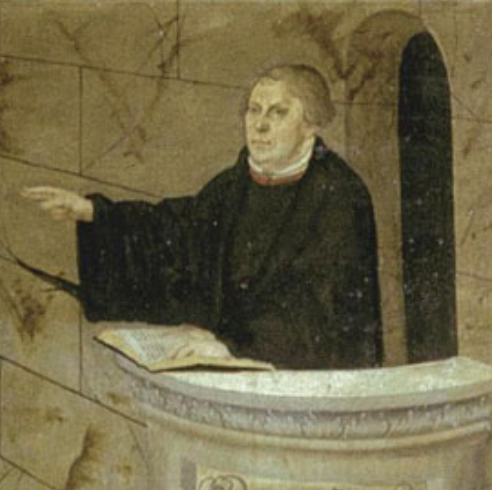
Martin Luther
Luther's doctrine of the priesthood of all believers, and his conviction that every individual could interpret scripture opened up discussions about the proper role and authority of clergy and about authority in scriptural interpretation; this doctrine would have a highly complex influence on the Reformation and it continues to engage churches today.
Luther had raised questions about the status of ordination to which he returned in De captivitate babylonica ecclesiae (On the Babylonian Captivity of the Church). Here Luther critiqued the medieval Church's understanding and practice of the sacraments, and particularly of the mass. He also argued that there were only two sacraments, baptism and the Eucharist; the remaining five (confirmation, penance, ordination, marriage, and unction) he thought, whilst not unimportant, should not be understood as sacraments since, unlike baptism and the Eucharist, they had not been instituted by Christ with a promise of grace and a physical sign.
Reading – or hearing of – Luther's work in England, Henry VIII was incensed. He wrote a defence of the seven sacraments, Assertio septem sacramentorum, condemning Luther's position. It was for this work that he received the title Defensor fidei (defender of the faith) still borne by British monarchs. Nonetheless, once Henry VIII began to think about a break from Rome, it was initially Luther's theology that he turned to. After a period of negotiations between an English embassy and the Wittenberg theologians, in 1536 the Ten Articles were passed in England. These affirmed three sacraments – baptism, the Eucharist, and penance – and questioned purgatory, although they did not propose a doctrine of justification by faith.
Henry VIII, though, was never convinced by Luther's theology, and by 1539, to the dismay of the Reformers in Wittenberg, he had reverted to a more traditional position, expressed in the Act of Six Articles. By the time of his death on January 25th, 1547, the English church had broken with Rome. In addition, English monasteries and convents had been dissolved, shrines had been destroyed, images had been removed from some churches and from 1540 an English translation of the Bible was supposed to have been placed in every parish church.
However, in 1543 restrictions had been placed on who might read the Bible (women and uneducated men were not to do so) and the English Church was still traditional in its many of its other practices: the liturgy was in Latin; communion was distributed in one kind; and priests were to be celibate (the Archbishop of Canterbury's wife, Margarete Cranmer, had fled with their children back to Germany). The break from Rome had left England with a Church which was no longer Catholic, but which also did not seem to resemble the churches emerging from the Reformation in the German and Swiss territories.
This changed under Edward VI and his regents. Thomas Cranmer invited to England a number of respected Reformers to help guide the reform process, and to whom he could offer refuge from the difficult political situation in the German empire, where war had broken out. Those who accepted his invitation were theologians influenced by the Reforms in Strasbourg and Zürich: Martin Bucer, Peter Martyr Vermigli, and Bernadino Ochino. Like Henry VIII before him, Cranmer also invited Philip Melanchthon, Luther's colleague from Wittenberg, to England, to England, but Melanchthon declined. The Reformation now began to be implemented in England.
In 1549, England's first Book of Common Prayer was implemented by the first Act of Uniformity. This gave the English (and Welsh) church a vernacular liturgy (except arguably in the case of Cornish and Welsh speakers), in the form of a set of services by which the church's life was to be ordered. These were much simplified in comparison to the medieval Sarum rite and clearly showed the influence of Reformation theology. In 1552, the revised Book of Common Prayer introduced further changes.
The liturgical terminology was adjusted: the liturgy of the Eucharist, in 1549 entitled "The Supper of the Lord and the Holy Communion, commonly called the Masse" had in 1552 become "The Order for the Administration of the Lord's Supper, or Holy Communion". The liturgy was again simplified. The shape of Holy Communion was fundamentally revised, including the Ten Commandments at the beginning of the service, as a penitential rite with the response "Lord have mercy", and moving the Gloria to the end, where it formed part of the thanksgiving for communion. References to the soul of the departed were derived from the funeral liturgy. What was being presented in this liturgy, however, was not a Lutheran theology, as is apparent from the language used in the liturgy of the Lord's Supper.
Luther's critique of the medieval mass had focused on three aspects: the giving of communion in only one kind (bread, rather than bread and wine), the doctrine of transubstantiation, and the idea of the mass as a work or a sacrifice that could obtain grace for others. The Reformers were agreed on these three points, but they took very different views on the implications of the second. Whilst Luther maintained that Christ's body and blood were truly and physically present in the Eucharistic elements of bread and wine, Zwingli in Zürich believed that Christ was spiritually present, symbolised by the bread and wine. Here Luther and Zwingli were offering different interpretations of the words of Christ at the Last Supper as recorded in Matthew's Gospel (26: 26). When Christ said hoc est corpus meum ("this is my body"), the words spoken by the priest in the Canon of the Mass, Luther maintained that the word est must be understood to mean "is". Zwingli, in contrast, believed that Christ had been speaking metaphorically, and that est was better understood as significat, "signifies".
By 1548 Thomas Cranmer's Eucharistic theology was closer to Zwingli's than to Luther's. In exhortation encouraging the people to receive communion regularly, written for the 1548 English Order for the Mass, and included in both the 1549 and the 1552 Prayer Books, he explained he believed it meant to receive communion:
… for as the benefit is great, if with a truly penitent heart and lively faith, we receive that holy Sacrament (for then we spiritually eat the flesh of Christ, and drink his blood, then we dwell in Christ and Christ in us, we be one with Christ, and Christ with us;) so is the danger great, if we receive the same unworthily.
For Cranmer, to receive the bread and wine at the Eucharist was to receive the body and blood spiritually. The retention of the language of body and blood in the liturgy should therefore be read in this context. The Eucharistic prayer indicated that the elements were blessed, including crosses in the text of the Eucharistic prayer:
Hear us (O merciful father) we beseech thee; and with thy holy spirit and word, vouchsafe to bl+ess and sanc+tify these thy gifts, and creatures of bread and wine, that they may be unto us the body and blood of thy most dearly beloved son Jesus Christ.
The phrase "be unto us" emphasised that this was not an objective presence. The priest was to say or sing the Eucharistic prayer "plainly and distinctly" and not sotto voce as in the medieval mass. Moreover, it was to be said or sung "without any elevation, or shewing the Sacrament to the people". The words of distribution to the communicant, as defined in 1549, retained the language of body and blood:
And when he delivers the Sacrament of the body of Christ, he shall say to every one these words. The body of our Lorde Jesus Christ which was given for thee, preserve thy body and soul unto everlasting life. And the Minister delivering the Sacrament of the blood, and giving every one to drink once and no more, shall say, The blood of our Lorde Jesus Christ which was shed for thee, preserve thy body and soul unto everlasting life.
However, the careful shaping of the liturgical context implies that Cranmer did not intend these words to be heard as implying a corporeal reception of Christ.
It is clear, however, that traditionalists such as Stephen Gardiner read and heard these words as implying, at the least, a physical presence, and perhaps even transubstantiation. In 1552, therefore, further revisions were undertaken which laid the focus much more strongly on remembrance. The language of "bless and sanctify" was excised from the Eucharist Prayer; instead the priest prayed:
grant that we, receiving these thy creatures of bread and wine, according to thy son our Saviour Jesus Christ's holy institution, in remembrance of his death and passion, may be partakers of his most blessed body and blood.
The words of distribution were changed, so that the priest and minister of the chalice now said:
Take and eat this, in remembrance that Christ died for thee, and feed on him in thy heart by faith, with thanksgiving….Drink this in remembrance that Christ's blood was shed for thee, and be thankful.
The memorialist focus of the Eucharistic liturgy in the 1552 Book of Common Prayer was much closer to that being taught by Heinrich Bullinger, Zwingli's successor in Zürich, than to Luther's emphasis on the corporeal real presence. In the Elizabethan Prayer Book of 1559 the changes made to the Eucharistic Prayer were retained, but the words of distribution of 1549 and 1552 were combined. This most probably represents an attempt to avoid the controversies which had split continental Protestants into opposing factions of Lutheran and Reformed: like its 1552 predecessor, which it largely reproduced, the 1559 Book of Common Prayer propounded a noticeably Reformed – as opposed to Lutheran – theology.
The rubrics of the Book of Common Prayer also reflect other debates that were taking place in reforming circles at this period. One related to the question of what kind of bread should be used for communion. The 1549 Prayer Book specified that it should be
unleavened, and round, as it was before, but without all manner of print, and something more larger and thicker than it was, so that it may be aptly divided in diverse pieces: and every one shall be divided in two pieces, at the least, or more, by the discretion of the minister, and so distributed.
Here the recommendation was the use of an unleavened host. In 1552, in contrast, the use of normal wheat bread was expected:
the bread be such, as is usual to be eaten at the Table with other meats, but the best and purest wheat bread, that conveniently may be gotten.
If any bread or wine remained, "the Curate shall have it to his own use". Communion bread was no longer to be regarded as different but was to use – and sanctify – the everyday. The Elizabethan Church compromised on this question, retaining the 1552 rubric in the Prayer Book, but including the 1549 rubric in the Elizabethan Injunctions. Similar observations could be made about the use of vestments, which in 1549 were to be used, in 1552 were not to be used, and about which the 1559 Settlement was somewhat ambiguous, but probably expected their use.
These discussions were not exclusive to the English Reformation. Calvin, writing for the church in Geneva, commented of the Eucharist in his Institutes of Christian Religion:
But as for the outward ceremony of the action – whether or not the believers take it in their hands, and divide it among themselves, or each eats what has been given to him; whether they hand the cup back to the deacon or give it to the next person; whether the bread is leavened or unleavened, the wine red or white – is of no consequence. These things are indifferent, and left free to the Church.
Some of these debates about practice have reverberated down the centuries and remain points for debate in churches today.
By the end of Edward VI's short reign the English Church had been reformed to be unambiguously Protestant. The liturgy was in English; communion was received in both bread and wine; priests might marry. Moreover, churches had been reordered in the Reformed, rather than the Lutheran manner, with stone altars replaced by wooden tables, any remaining images, and often also stained glass, removed or destroyed, and walls whitewashed. The theology of the Edwardian Church had been articulated in the form of the Forty-Two Articles, drafted in 1553, not long before Edward's death, which showed the influence of the Strasbourg and Zürich Reformers.
Edward sought to bequeath England to a Protestant queen, nominating his cousin Lady Jane Grey as his successor, but the crown passed to Mary I, as the legitimate heir, supported even by Protestants who realised that her reign would bring the reintroduction of Catholicism. Mary's reign proved, however, also to be short. She left to her half-sister Elizabeth a reordered diocesan system, but also a Protestantism which had paradoxically gained in self-confidence through the many martyrs who had given Mary her epithet "Bloody", and the experiences of the exiles who had fled to Frankfurt or Geneva, and who would now return.
Elizabeth's church would be Protestant; it drew on the theology of its Edwardian predecessor and on the experiences of English exiles. These had settled mainly in Reformed centres and generally not in Wittenberg, which in the late 1550s found itself in a highly unstable political situation and was not inviting as a place to study. England's Church, despite its recognition of Elizabeth as its Supreme Governor and its set liturgy, was theologically much more akin to the Reformed tradition than to the Lutheran.
However, Elizabeth disliked what she knew of Calvin and Geneva, and rejected the initiatives of Protestants who wanted to see in England the kind of more thoroughgoing Reformation they had witnessed in Geneva or Frankfurt, with a clearer distinction between Church and state and an emphasis on extempore prayer rather than authorised liturgy. She also took an increasingly strong line against dissenting Catholics. England's Church under Elizabeth – and under her successors, the Stuart kings of the early seventeenth century – remained a moderate Reformed Church with a strong liturgical tradition and an episcopal polity. The Church as it was restored under Charles II in 1660 continued this tradition. Luther's theology had very little direct impact on the Church of England in the seventeenth century.
Nonetheless, Luther's indirect influence on the English Church was considerable. The debates which shaped the English Church can be traced back to discussions and debates initiated by Luther and his followers. Without Luther's ideas the Reformed tradition – and with it the English Church, its practices and its liturgy – would have looked very different. Perhaps most importantly, however, a closer look at the Reformation debates reveals an engagement with a good number of contentious issues which today, five hundred years later, are still exercising the Church.
The Rev Charlotte Methuen, an Anglican priest, is a Professor of Church History at the University of Glasgow. This article is an extended version of the text delivered by Prof. Methuen at the St Albans Conference, 1517 and all that…., on October 28th, 2017.