Marking the 100th issue of The Newman in the current series, with reflections on the journal's history, policy, and highlights from its pages since 1984.
Origins and chronology
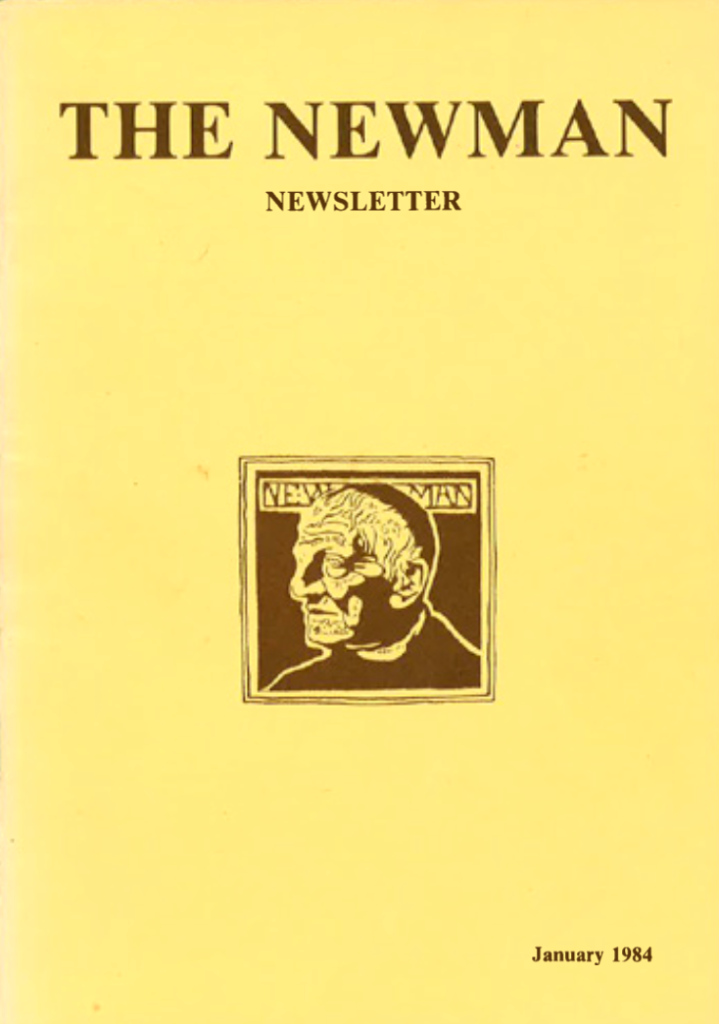
Certain occasions seem to invite a reflection; and, as we go to press for this issue of The Newman, it is perhaps apt to do just that to mark the fact that this is the 100th issue in the current series. Down the years a very large number of people have generously contributed articles, thoughts and sheer hard work in the production of the various issues, so we trust this article will do them justice and give an apt flavour of some of the items published since the series started. We also offer the article as a small way of saying a big "thank you" to all those who have helped in the production of these issues.
Started in January 1984, this series of The Newman succeeded earlier Newman Association publications, which had run under various editorships since the beginning of the Association in 1942. By 1984, a significant influence in the work of the Association was George Sayer (1914–2005), a member of Council and of the Worcester Circle, and one-time Head of English at Malvern College (see An Apprecation of George: Issue 67: January 2006); and it was on his initiative that the current series began.
Down the years, the Editorial Committee for this series has stayed remarkably steady – a wonderful and supportive aspect of things, which has been a great help to the specific Editors of each issue. Three main Editors have held office since 1984 and the number of Committee members has usually been six (now seven).
One of the privileges of being an editor is that articles come across one's desk which are uplifting, scholarly and a delight to read. By way of marking this 100th issue, therefore, three of us on the current editorial committee have agreed to share with the current readership some of the items that have caught our attention down the years. We trust these will "strike a note" too with Association members and others who may have occasion to read this issue of the journal.
Policy
So what has this series attempted to be about? As primarily a journal for members (and hopefully echoing the policies of earlier series) our first aim has been to facilitate the objectives of the Newman Association – namely the enhancement of "an instructed and well-educated laity" as famously spoken about by John Henry Newman (1801–1890). We have, however, been mindful that our readership could well extend beyond just Association members; and, in that context, it has also been a particular privilege to have articles that resonate with issues affecting both the Church and the wider world – hopefully as constructive contributions to the discussions of the day.
In the early years of the Association much thought was given to the post-war years and the discussions that would in due course lead up to the Second Vatican Council (1963–1965). Indeed, the late Hugh Dinwiddy (for an Appreciation, see Issue 79: January 2010), an early member of the Association, once described "early Newman Summer Schools and their offspring" as having "brought with them, as it were, the dawn chorus of Pope John's Council"; and one would like to think that such emphases are still the hallmark of the Newman Association and its activities.
At the time of the first issue in the current series, in 1984, the Association was, by then, beginning "... to examine the role of the Association now, some 20 years after Vatican II ...". Indeed, as we go to press, such up-dating of thoughts about the Association's work are again current. We trust, therefore, that some of the items shared in this article (especially in the following section) may help in this ongoing work of adjustment and renewal.
On a practical note, as our regular readers will know the normal contents of The Newman consist of: (i) Notification and Reports of Newman Association Circle meetings, (ii) Regular updates about Association matters – e.g. notices of and reports on AGMs, (iii) Letters to the Editor, (iv) Items about or papers from Newman Association conferences – these sometimes being held in conjunction with other Christian organisations, (v) Reports on or actual texts of London Newman Lectures and, more recently, Manchester Newman Lectures, (vi) Reports from the Association's Special Interest Groups, (vii) Scholarly articles relating to matters of contemporary interest and importance, these arising from Association members' engagement with the issues discussed, (viii) Carefully selected items for a regular "Spirituality" page, (ix) Book Reviews and (x) Circle Programmes.
In the light of this, therefore, we trust that readers will understand the magnitude of the task we have set ourselves and will be able to appreciate the selections we have made. Records of the contents of all one hundred issues are available from the Association's Editorial team and recent issues can be accessed on the website.
Items and excerpts from past issues
Given the range of material included in this series, it has been a hard job to be selective (and succinct!) with items that have "struck a chord" and which could therefore be mentioned as an appreciation to our contributors. These difficulties notwithstanding, however, such an appreciation is surely appropriate; and the following paragraphs are offered to that end.
As a start, therefore, one can, perhaps, mention a recent article in this series, which focused on Faith and Reason (Issue 83: May 2011) – surely a helpful clarification in this modern age of two key concepts; concepts, indeed, of relevance and importance for "an educated laity". By way of a reflection on Pope Benedict XVI's address in Westminster Hall (17.9.10) and citing this, it was pointed out that "faith is not an alternative to reason but ... the precondition of reason": the role of religion being "not so much to supply (objective) norms governing right action, as if they could not be known by non-believers ..., but rather to help purify and shed light upon the application of reason to the discovery of objective moral principles".
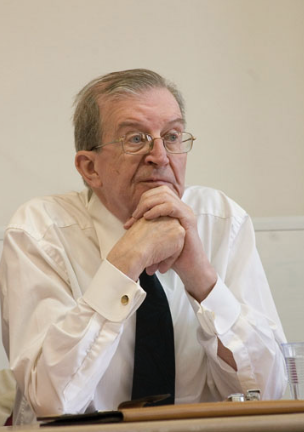
In a similar philosophical vein, with contemporary relevance, was the 2002 London Newman Lecture The Impossibility of Atheism, given that year by Professor Nicholas Lash (Issue 56: May 2002), where attention was drawn to the growing desire since the 16th and 17th centuries for "nouns" and "explanations" rather than "verbs" and "understanding" – a "dethroning of the verb" as it was put. Medieval culture was fundamentally a narrative culture, one in which verbs were central: "You need verbs to do things and so everything is thought of primarily in terms of what is going on. And this is true of you and me and of the world and of the mystery of God".
Moreover, this narrative culture was primarily about understanding; about getting the story right, trying to understand better and participating in the story of the world, including the story of creation and redemption of it. By contrast, narratives came to be "discounted" in the seventeenth century and later as a scientific perception emerged on the grounds that "storytellers aren't reliable". In place of understanding the quest was on for "explanation" and, for this purpose, "nouns are better".
Translating Calvin
As an example of this it was pointed out that "such a notion was well illustrated with reference to 'the book that Calvin never wrote'". The title of Calvin's great work Christinae Religionis Institutio of 1536 was correctly translated in 1561 as The Institution of Christian Faith. But by 1831 it had become mistranslated as Institutes of the Christian Religion. For Calvin as a medieval theologian, "institution" was a verbal noun to describe the business of building up, but by the 19th century "institution" had been turned into a thing, an organisation (something which now implies the existence of "bureaucrats" to run it!).
In a similar way, but with reference to the Liturgy, an article which struck a note was The Real Presence by Timothy Radcliffe OP (Issue 6: September 1985 and reprinted in Issue 67: January 2006). In this article it was suggested that, with reference to the bread and wine after consecration, "to ask what something really is is to ask, first, what place it has in our communication with one another". This, he went on, was in contrast to the modern understanding "that if you want to know what something really is then you must look through a microscope". For example, it is not that describing a kiss as "the mutual compression of mucous membrane" is untrue, but rather that "it fails to get at the full truth"!
Accordingly, and expanding on this analogy with reference to The Eucharist, it was pointed out that: "The whole theology of the Eucharist depends on the belief that the community between God and Man, and between man and man, is really given now in some sense in the Church. If we do not really believe that Christ is with us, dwelling with us and in us, and we in Him, then there is no context in which this bread and wine can be the Body and Blood of Christ". So what is at issue in the doctrine of the Real Presence in the Eucharist is not whether Catholics think they get a little more than some Anglicans think they get, but whether the community of the Church is in some sense sacramental – making present now the kingdom of God.
Such thoughts, surely, help both in the education of the laity and, more widely, in our ecumenical relationships with the wider Christian body. In more recent years, there has been another most helpful article on this theme by the Association's Chaplain, Fabian Radcliffe O.P. – The Eucharistic Community (Issue 76: January 2009), this arising from some parish discussions, based on the model of Newman Association Circle meetings, on the ideas of "communion" and "what makes a good parish?".
One aspect of contemporary thinking and concern covered in this series of the journal since the 1980s has been that of environmental matters – particularly our Christian discernments and responsibilities – this, surely, being a good case of reality being seen in the big picture. In this connection the Association's Environment Interest Group has come into existence and, while not so large or so formally-tasked as earlier Interest Groups such as the Philosophy of Science Group and the Theological Studies Group, this group has helped to facilitate conferences and papers down the years, many of which have been published in The Newman. Indeed, this could be said to be an interesting example of how a "sequence" can build up – "one thing following another" – through the engagement of the Association's members.
Environment Interest Group
This environmental "sequence" was launched by the Association in 1990 with the conference of that year Creation, Christians and the Environment, held at Birkbeck College, London. As a result of that conference, key links were established particularly with two of the speakers and the Association's Environment Interest Group was started – this being ecumenical as a function of the many participants at the conference. Shortly after this, members of the Interest Group were alerted to (and some attended) the London Templeton Lectures of 1995, given in that year by Sir Ghillean Prance FRS, then Director of the Royal Botanic Gardens at Kew. These talks were in due course published as The Earth Under Threat: A Christian Perspective.
Then in 1996 (four years after the UN "Earth Summit" at Rio de Janeiro), the Bath Circle hosted the Association's conference The Church and the Earth after Rio: is Creation Safe with Christians? As a result of the connection by then with Sir Ghillean he kindly came to speak at this conference on the theme Is there any Hope for Creation? (Issue 42: September 1997). The Chairman of the Bath Circle and the Convener of the Interest Group subsequently attended the 2003 London Newman Lecture Newman and the Environmental Imperative (Issue 59: May 2003) given that year by John Gummer MP, at that time Minister for the Environment. And this stimulating address then led on to the Association's 2004 Hereford ecumenical conference, jointly hosted with Christian Ecology Link (now Green Christian) Faith and the Environmental Imperative: responding to "The Call of Creation" – The Call of Creation having by then been put out by the Catholic Bishops' Conference of England and Wales to mark the 2002 UN "Earth Summit" at Johannesburg ("Rio + 10" as it was called).
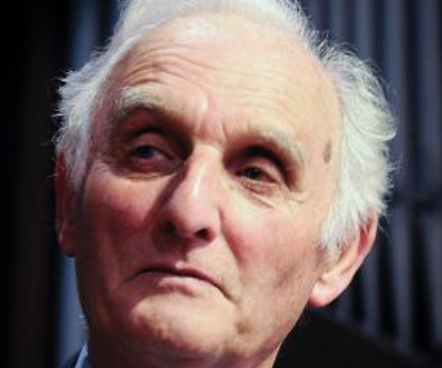
As to the two links with speakers, made as a result of the 1990 conference: one was with Robert Murray S.J., then Senior Research Fellow at Heythrop College, London and the author of The Cosmic Covenant: Biblical themes of Justice, Peace and the Integrity of Creation and the other Professor R.J. Berry, Professor of Genetics at University College, London. Through Murray opportunities arose to explore the connection between poetry and environmental theology: see Poetry for the Peaceable Kingdom (Issue 50: May 2000); while through Berry links were made between the Association and the Interest Group and The John Ray Initiative (JRI) recently established to promote "responsible environmental stewardship in accordance with Christian principles and the wise use of science and technology".
One of the founders of the JRI was Sir John Houghton, one-time Professor of Atmospheric Physics at Oxford, Director General of the UK Meteorological Office and, at that time, a member of the UN Intergovernmental Panel on Climate Change (IPCC); and it was through this connection that Sir John came to speak at the 2004 Hereford conference on Global Warming & Climate Change: a challenge to scientists and Christians. In the light of this, In the Eye of the Storm, Sir John's autobiography, was later reviewed in the journal (Issue 93: September 2014); and, more recently, there was an excellent reflection by Mike Monaghan, a member of the Environment Interest Group, on the latest papal encyclical Laudato Si': on care for our common home, this being occasioned by the 2015 UN Climate Change Conference in Paris (Issue 97: January 2016).
There are many other references to contemporary thought and the engagement of Newman members with current issues. The Bio-Ethics Group dates from 1984 with a nucleus of members from Worcester Circle. One pressing matter that it dealt with was embryo research in the light of the Warnock Report on which it organised a conference at Newman House, University of Birmingham, in 1987 (Issue 11: May 1987) and another at Worcester in 1993 on Medical Ethics more generally, of which one focus was the Tony Bland case (Issue 29: May 1993).
There have of course been many other conferences over the years where the proceedings have appeared in The Newman. One instance is the conference on the Problem of Evil organised by the North Cheshire Circle in 1990, which resulted in two notable papers in The Newman (Issue 23: May 1991). Brendan Callaghan SJ spoke on Physiology and the Problem of Evil and remarked that "Perhaps the true core of original sin lies not in our capacity to 'do wrong' but in our incapacity to allow God to 'do right'. Perhaps the devil's true artfulness is shown not in our 'sins' but in our inability to accept that God's love encompasses our sinfulness." Dr. Joseph Rymer then looked at "The Concept of Evil from Scripture" and remarked that "Evil is anything or anyone which threatens the covenant that Yahweh, the Hebrew God, has established with the people he has chosen".
Seven Key Issues
The Social Gospel has not been neglected either. There was, for example, a notable paper by Victor Guazzelli, then Bishop in East London, based on a talk given to the London Circle (Issue 19: January 1990). He noted that a report prepared for the Diocese of Westminster in 1982 identified seven issues which, as he put it, gave "a clear illustration of the scale of human suffering and the complexity of some of the issues which formed the context of the Church's social action". These were: One-Parent Families, Unemployment, Housing, Race Relations, Poverty, the Elderly and the Reduction in Public Expenditure. Readers might care to consider whether and to what extent that list has changed today and what we as Christians should be doing about them.
One also realises how much the journal has done to turn our attention to the wider world. One example is with articles about the Association's membership of Pax Romana; and, in Issue 13: January 1988, Philip Daniel, an early member of the Editorial Committee, recalled his impressions of its 40th meeting and of what Pax Romana is about. And it is to Philip that we also owe a splendid article on the The Purpose and Practice of the Newman Association (Issue 1: January 1984), which reproduces an Action Plan for the Association for 1970–75, which could well be used again.
On the theme of the wider world, one recalls also the contribution of Nigel Dees, a gifted architect and a much-loved member of the Editorial Committee until his untimely death, who used his talents to serve the developing Hospice Movement – particularly at the then-new St. Michael's Hospice, Hereford. In both these capacities, he provided a distinctive introduction to an article on this subject from the Wimbledon Circle (Issue 3: September 1984).
As to the "deepening" of faith, the regular contributions to the journal's Spirituality pages have given much food for thought. Some particular items that stand out include Julian of Norwich and the Attractiveness of God by Joyce Martin (Issue 39: September 1996), Sacramental Living, the 2014 London Newman Lecture (Issue 92: May 2014), Love, the famous poem by George Herbert (1593–1633) (Issue 78: September 2009) and Spirituality and Ageing by Rev. Dr. Albert Jewell (Issue 77, May 2009).
Inevitable, and rightly, there have been many essays on Newman himself. The first issue of the current series (January 1984) contained an article based on a talk by the well-known Newman scholar Joyce Sugg on Newman and his Relevance Today. As she pointed out, Newman is "an example of one who was intensely loyal to the Church and yet could be a critic, even a severe critic, of certain of the structures that existed then and to an extent exist now". Can the same be said of some Newman members? Later, we had the text of a sermon delivered in Newman's church of St. Mary the Virgin, Oxford, by the then Archbishop of Canterbury, Robert Runcie (Issue No. 21: September 1990). He spoke of one of Newman's final letters where he felt that a "silent and secret process is going on in the hearts of many ... that would issue in a public opinion strong enough for the spread and exaltation of divine truth over all the world".
As the Archbishop recognised, that is "a vision as yet unrealized. Indeed it seems to recede as fundamentalism grows, reactionaries recover ground and western Christendom succumbs to secularism". Yet, as he also said; "the influence of religion does not diminish", and it is of course our task as Newman members to seek to realise that vision of Newman.
Finally for this section, members of The Newman Association will surely have strong memories of past members, who have now "gone before us marked with the sign of faith". A particularly inspirational one to many of us was George Sayer, mentioned earlier, friend and biographer of C.S. Lewis. A wonderful sample of his enthusiasm is contained in, again, Issue 1: January 1984, where he gave sound advice on How to Start a Reading Circle. The last sentence is worth recalling as it also applies to recruitment to Circles: "Oh, and never forget that people like to be invited; and that, if nicely invited, their tendency is to say 'Yes'!". Do read the whole of his article.
Conclusion: thoughts for the future
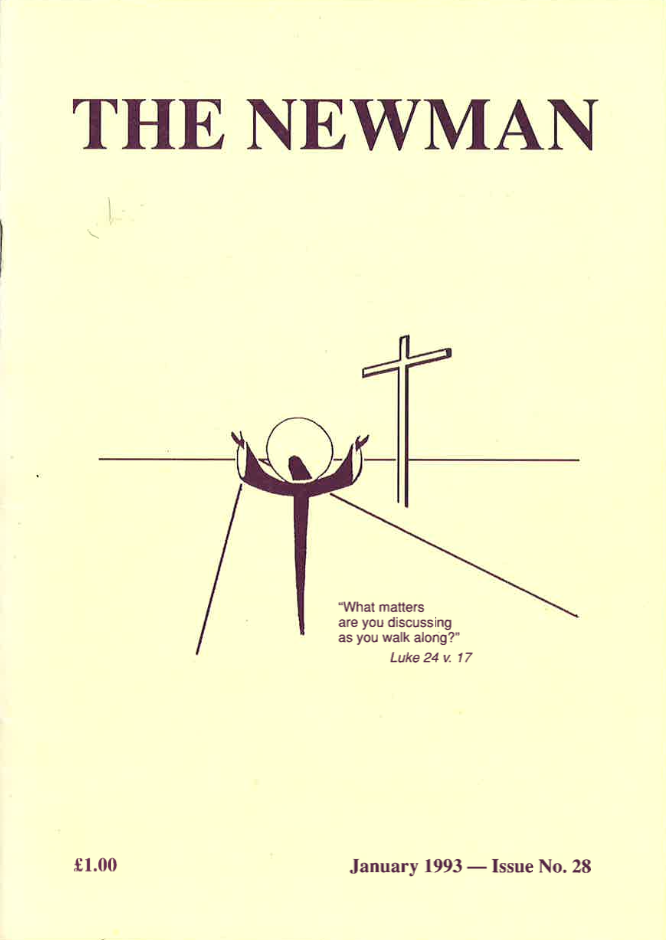
And so The Newman goes on to begin, God willing, a second century of issues – as always, interested in that synthesis of faith and reason referred to earlier; and, in the light of that, seeking to deepen the spiritual lives of its readers and to engage constructively with the issues which face the Church today – without polemic and without rancour but, as ever, seeking to discern the voice of Our Lord and to answer that question of His which, for a certain number of issues, used to appear on the front cover of the journal: "What matters are you discussing as you walk along?" (Luke 24:17).
With so much excellent material received down the years, how can one ever hope to do justice to it all in a single article? We have not been able, for instance, to give a flavour of the poems which have appeared. Suffice to say that we trust that these thoughts and references to articles published in this series of The Newman will give a flavour of our policy and the contributions received. And, as we now look beyond this 100th issue, we trust that there may be – in the items cited here – some clues to the prospects for future articles.
As to the idea of "an instructed and well-educated laity"; that, surely is as important today as it ever was. By way of an exploration of this, some helpful thoughts can be found in the first issue of The Newman in the new millennium, Seeking Newman's Message Today: the Experience of the Hertfordshire Circle (Issue 49: January 2000), by Anthony Baker, at that time Chairman of the Hertfordshire Circle. With reference to Newman's work and reflections, readers were reminded that "an informed laity is ever more required to play its part" in discernment about the truths of the Christian religion, their expression and their development. Indeed, this was strongly confirmed in the documents of Vatican II, especially Lumen Gentium and Gaudium et Spes. There is food for continuing thought here, surely, as we look to the future.
In so far, therefore, as the Association is concerned to help deepen faith and explore the implications of that for our work and wider relationships, both social and within the larger context of the natural order, then we trust that there will continue to be many further articles of the calibre of those mentioned here – scholarly, pastoral and ecumenical – coming the way of The Newman (via the range of sources mentioned in section two of this article); and that these will, as in the last 100 issues, continue to facilitate that "instructed and well-educated laity" that Newman spoke of so many years ago.
Robert Williams, Anne Duddington, John Duddington
Notes
- For details of earlier Newman Association publications, see A Use of Gifts, produced in September 1992 (in place of the 27th issue in the current series) to mark the 50th anniversary of The Newman Association: Journals and Publications by Eileen Cheverton, pp. 25–26.
- Chronology: Editors, Robert Williams 1984–86, 1991–94, 1998–2000, 2009–11, Eileen Cheverton 1986–91, 1994–98, 2000–08, Barry Riley 2011 to date. Committee: since 1984 the following Newman Association members have kindly served at various times on the Editorial Committee: Nigel Dees, Theo Westow, Philip Daniel, John Duddington, Anne Duddington, Josephine Way, Aidan Reynolds, Marie Rose Low and Christopher Quirke.
- See The Newman Association: A Personal Tribute by Hugh Dinwiddy in A Use of Gifts, p. 43.
- See The Newman Issue No. 1, 1984, p. 27: The future of the Newman Association, Peter Nielson, Association President.
- The London Newman Lectures have been held annually since 2000, thanks to the generous bequest of the late Jim Matthews (1941–1997); he was a member of the London Circle and a one-time National Treasurer of the Association.
- See A Use of Gifts: The Philosophy of Science Group (pp. 31–33) and The Theological Studies Group (pp. 38–39).
- Copies of the Conference Report available through the Convener of the Newman Association Environment Interest Group.
- The Earth Under Threat: A Christian Perspective by Ghillean Prance (1996), Wild Goose Publications, ISBN 0947988807.
- Copies of the Conference Report are available through the Convener of Newman Association Environment Interest Group.
- The Cosmic Covenant: Biblical themes of Justice, Peace and the Integrity of Creation by Robert Murray (1992), Sheed & Ward Ltd., ISBN 0-7220-2750-8.