Although there are no surviving medieval monastic gardens there is archaeological and documentary evidence for their existence such as the records of Christian monasteries from the post-Roman period, through the Dark Ages 500-1000 AD.
An Overview of Medieval Monastic Gardening.
By Maureen Thomas
Although there are no surviving medieval monastic gardens there is archaeological and documentary evidence for their existence such as the records of Christian monasteries from the post-Roman period, through the Dark Ages 500-1000 AD. The medieval monasteries in Britain emerged after the Danish invasions, and were based on the Rule of Saint Benedict who founded the first Italian monastery about 528 AD at Monte Cassino. The Norman Conquest resulted in an increase in Benedictine monasteries, which were all loosely based on the St Gall ideal suggested by Charlemagne in the 9th century. The period became known as the golden era of the medieval monasteries, and lasted into the mid C16th when Henry VIII closed them down at the time of the Dissolution of the Monasteries.
The four main orders of monks were the Benedictines, the Cistercians, the Carthusians and the Cluniacs, Much Wenlock Priory in Shropshire being the largest of the Cluniac monasteries. The gardens of each foundation had their own recognisable characteristics. The St. Gall Plan contained a list of plants, and is preserved in the monastic library of St Gall in Switzerland. As well as the buildings it shows the Cloister Garth, descendant of the Roman peristyle villa at the beginning of the first century, and three gardens, the Physic Garden, the Utilitarian Garden or vegetable garden and the orchard of the Cemetery Garden There are later references to a guest house garden, the prior's garden, vineyards and fish ponds found in subsequent research.
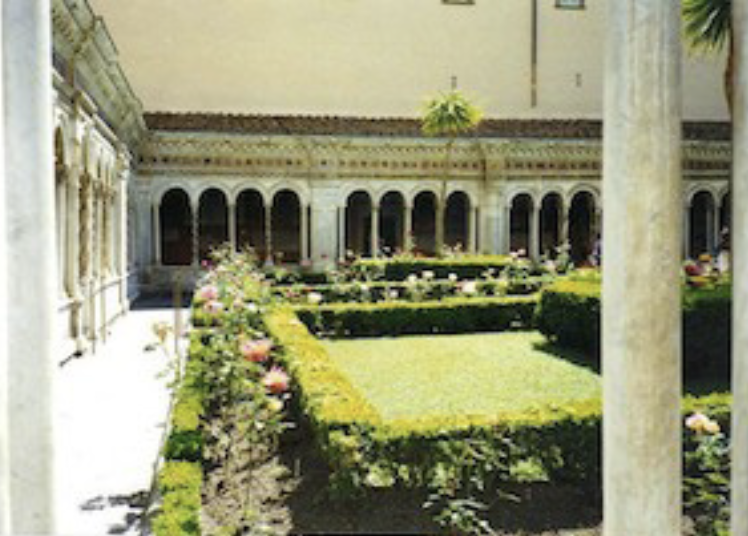
The Cloister Garth is the chief characteristic of the medieval Benedictine monastic garden, and there is no evidence that it was planted with anything other than turf, unlike the modern reproduction at Monte Cassino. Occasionally there may be paths, a fountain or lavabo as at the Cluniac Priory at Much Wenlock. The colour green provided refreshment to encloistered eyes and was a metaphysical symbol both of rebirth and everlasting life. The Cloisters which opened on to the Garth were used by the monks when sitting at their desks, illuminating their manuscripts to gain the maximum amount of light. Some monks were artists, some craftsmen, some gardeners and some physicians; the most important contributions to our knowledge of the classical writings and national chronicles were preserved by Benedictine monks at this time.
Benedictine monastic life was often the centre of communal life in a particular area, and lay people supported the monks. The monastery itself was very ordered, and each area was organised by an Obedientiar. The Physic Garden situated near the infirmary was the responsibility of the Infirmarer, who grew the herbs used for treating the sick: kidney bean, savory, rose, horsemint, cumin, lovage, fennel, tansy, lily, sage, rue, flag iris, pennyroyal, fenugreek, mint and rosemary. Because the infirmary resembled a nursing home in large monasteries, as well as a rest home for retired monks with incurable diseases of old age, the Infirmary Garden contained a wide range of pottage plants as well as medicinal plants. The Cellarer, another Obedientiar was responsible for supplying the monks with vegetables, such as brassicas, leeks, parsley, leafbeet, parsnips, turnips, skirrets; he also provided herbs, hay for latrines and rushes, mints and meadowsweet for strewing. He would, too, supply juices from the orchard fruit and vines. The orchards were planted with medlars, quince, pears, peaches and apples, and were often also the burial grounds for the monks.
At the dissolution of the Monasteries, although the monastic buildings may have been destroyed or sold as private dwellings, lessees often continued to cultivate the outlying monastic orchards. These developed into the nurseries which supplied the thousands of trees needed for the later fashion in landscape gardening. Another important development arose from the monks' knowledge of viticulture and brewing, and which formed the basis of the brewing industry as it has come down to us today.
The lily and the rose
During the early Middle Ages activity in gardening and agriculture was purely for utilitarian purposes, namely growing for food and medicine; any flowers grown such as the rose, lily, peony and violet had symbolic purposes to be used in religious rituals; the lily symbolised purity and the rose was a symbol of the Virgin Mary. Later on, however, flowers were grown for aesthetic reasons to adorn the gardens of guest houses and also for the Abbot's private gardens which were used to entertain important visitors. Haughmond Abbey in Shropshire had very extensive private quarters set aside for the Abbot. The Longnor garden was used by Abbot Nicholas de Longnor, and is known to have contained a dovecote for pigeons, providing not only meat for the dining table but also dung for use as fertiliser.
The characteristics of medieval monastic gardens varied according to the order. The Cistercians were unhappy about the increasing worldliness of the Benedictines, and St Bernard of Clairvaux founded a breakaway order which chose to live more closely to the original Benedictine ideals of poverty, chastity and obedience. They refused to accept gifts other than land, and chose remote fertile valleys with running water for their sites. Wilderness was tamed and there was always a high regard for the Cistercian expertise in water gardens.
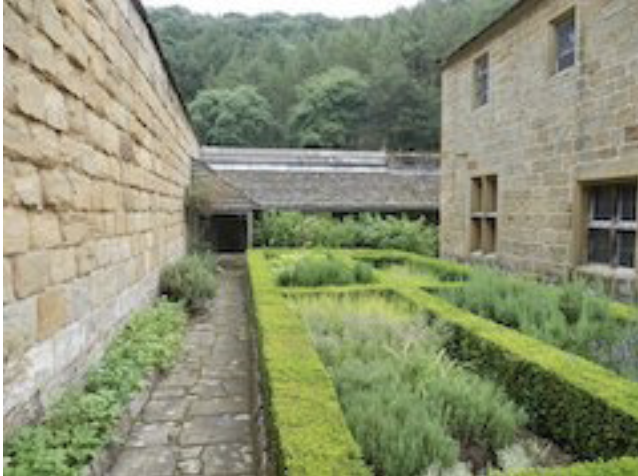
Their engineering in this field was reflected in the layout of their monasteries which included sanitation systems, and which were also adapted for the provision of night soil to be used for growing vegetables. Agriculture and sheep farming dominated their manual activities, and the wool trade soon brought them great wealth. Wool was exported to the continent, and was the foundation for the later prominence of the woollen trade.
The Carthusian monks were known as the gardening monks. Mount Grace Priory in Yorkshire is an example of why this was so. There are thirteen small cells representing Christ and the twelve apostles, and each cell had its own individual garden; the whole was enclosed by a wall, and each door of the cell opened out on to a broad cloister.
The Cluniac order, founded in Cluny in France about 910 did not spread to England until after the Norman Conquest, and Wenlock Priory is a good example of a Cluniac foundation. It was founded in the year 1200 and took over forty years to build with many endowments from Henry III, who was a regular visitor to Wenlock. There was much emphasis on communal worship and ritual, and the monks valued scholarship and manuscript illumination; the library was a purpose-built room which is still recognisable today. Although historians refer to the Cluniacs' concentration on elaborate church services and ritual they were also dedicated to caring for the sick and the poor of the local community. Medicinal herbs would have been grown for this purpose in the infirmary garden, and plants such as saffron and heliotrope might have been grown for the extraction of the yellow and blue dyes for illuminating their manuscripts. Watercolour paints used today would have had their origins in the paints used by the monks in the Middle Ages.
Although our knowledge of Welsh medieval monastic gardens is fragmentary, archaeology and carbon dating is already remedying this situation, notably, according to Stephen Briggs in his article on Garden Archaeology in Wales, at Monknash with its fish pond and dovecote, the 12 acres of orchards at Llanthony, Strata Florida (Valley of Flowers) Cistercian Abbey Grange, St David's with vines, pleasure gardens and orchards, and Llandaf Cathedral with its garden wall furnace.
The demise of the Golden Age of monasticism after the Dissolution of the monasteries by Henry VIII resulted in a landscape dotted with the remains of these wonderful buildings, many of which are cared for today by English Heritage and CADW (the environment service of the Welsh Government).
Some Secondary Sources.
A History of Gardening in England by Alicia Amherst, 1896
Garden Archaeology by Chris Currie, 2005
Medieval Gardens by John Harvey, 1981
Medieval Gardens edited by Elizabeth MacDougal, 1986; includes an essay on The Medieval Monastic Garden by Paul Meyvaert, pp23-53
A Little History of English Gardening by Jenny Uglow, 2005
There are guide books for Haughmond, Buildwas, Basingwork, Much Wenlock, Chester, Shrewsbury and Mount Grace.
Maureen Thomas, a former President of the Newman Association, has an MA in Garden History from Bristol University