The Covid pandemic should not distract us from the impact of other pandemics in the past. St John Henry Newman was greatly involved with the repeated outbreaks of cholera which struck Britain during the nineteenth century.
Newman's Pandemic Ministry: A Balm for the Bereaved
The Covid pandemic should not distract us from the impact of other pandemics in the past. St John Henry Newman was greatly involved with the repeated outbreaks of cholera which struck Britain during the nineteenth century.
John Henry Newman's condolence letters had a profound effect on the widow of Rev Walter Mayer. She describes how his words "poured balm into the wounded mind." As did his funeral homily. Upon re-reading it in the evening, she tells Newman: "I seemed to be raised far above things of time and sense. I forgot I was a mourner". (Letters and Diaries II:59; 64 fn1).
This article explores how Newman's correspondence and sermons can continue to bring consolation, in the circumstances of Covid-19, when viewed in light of his own pandemic ministry.
 Fr Peter Conley
Newman lived through four major cholera outbreaks, namely: 1831-2 where 21,800 people died; this figure was significantly increased in 1848-9 to 53,292; then the year 1853-4 saw the number of fatalities fall to 20,097; and in 1866 14,378 men, women and children lost their lives. (Proceedings of the Royal Society of Medicine Vol XLI (1947),169-70).
Newman draws Richard Hurrell Froude's attention to a case of cholera which Rev Samuel Rickards has in his parish. (Letters and Diaries III:7). It was located near a port where a coal barge carrying infected sailors had docked, but not quarantined, as the Government ordered ships to do, in October 1831. Until the mid-1850s the disease itself was thought to be spread by bad smells or contagion rather than contaminated water supplies. In fact Newman had speculated that the reason Birmingham had fewer instances was because of the City's drainage system.
In his own pastoral setting of Littlemore, Newman wrote a specific Cholera Memorandum (revised in 1857 and 1874). This charted both its presence and Newman's absence, for reasons of work and recuperation. He notes that when he heard of a person with suspected (or actual) cholera, he "went at once to the house where the suspicion lay." He also records an instance where he was in two minds whether to return to his parish base as the disease was circulating outside the church boundaries. This is because, as he explains to Henry Wilberforce: "It would greave me much did a case occur when I was away. "(Letters and Diaries III:75;68).
During the first pandemic his sister Jemima, anxious for his safety, recounts the rumour in Oxford that 13 out of 15 university servants (or Scouts) died as the result of contaminated soup, left all night, after the Magdalen College annual Gaudy celebration. A month after, Newman tells Samuel Wood that "the cholera has made a second or third start in Oxford." Several weeks later, in his diary, since the disease appears to have run its course, Newman notes that he is planning, with the Archdeacon, a thanksgiving service. (Letters and DiariesIII:77;91;97).
As a Catholic priest he said 'anti-cholera' masses and led benedictions for its demise. Newman never forgot being part of the 13 parishes under the Oxford Board of Health which, in 1832, had 174 cases of cholera with 96 deaths – 25 of which were of children. The Archive refers to the sick as having been "attacked without distinction." (Memorials of the Malignant of Oxford (1835),13). This is a chilling reminder that some of the early narratives surrounding Covid-19, described it in terms of a 'war'.
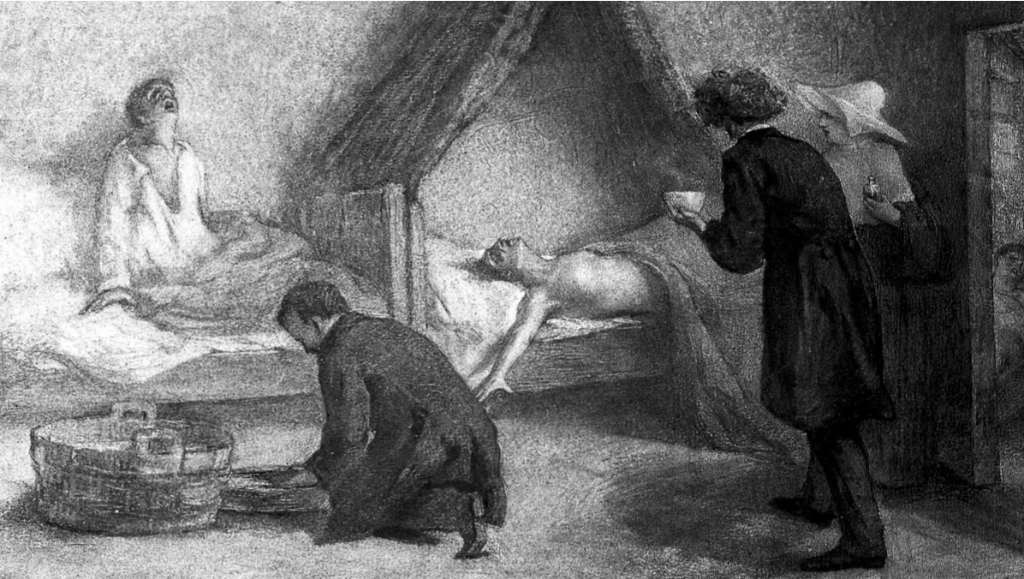 A 19th-century cholera ward, illustrating the conditions Newman witnessed during the pandemic outbreaks
Newman also drew military analogies when commenting about his own grief. In the midst of coping with the dual deaths of his community Doctor and the critical illness of a friend, he confides to Anne Mozley that it is like being "in a hail of bullets". And to James Hope-Scott he states: "The March of time is very solemn now – the year seems strewn with losses – and to hear from you is like hearing the voice of a friend on a field of battle". (Letters and Dairies XXVII:13; XIX:410). His words to Edward Badeley are particularly apposite, given the restrictions upon human intimacy that we have all experienced, when social distancing was advised in the midst of national lockdowns:
"There is something awful in the silent restless sweep of time – and, as years go on, and friends are taken away, one draws the thought of those who remain about one, as in cold weather one buttons up great coats and capes for protection." (Letters and Diaries XIX:277).
Given the background of cholera's impact across the country in 1832, Newman preaches his sombre-toned sermon The Lapse of Time. This emphasises the fragility of life and the certainty of death; the trauma of bereavement and the need for conversion, amidst the reality of God's merciful judgment. Caring for the poor, who were the ones most affected by cholera, became a major priority for Newman. He was conscious of their spiritual, practical and social needs. He provided coal for heating, secured employment opportunities through his contacts and paid their bills despite being financially stretched himself.
He recognised their needs to relieve stress and robustly defended their dignity to Charles Golightly after it was undermined by The Temperance Society calling them "drunkards". Newman reacted strongly against this crude characterisation by saying that "during the prevalence of the cholera (this) was very presumptuous and hard-hearted." To cope himself, he mentions that, throughout September, he played the violin to relax. At the end of October 1832, his diary records that he "buried early porter of All Souls, suspected to have died of cholera." (Letters and Diaries III:55;108). He also refers to another favourite hobby to his Aunt Elizabeth:
What a dream, to be sure, that coming of cholera is! How it threatened, and how it went away! The most mysterious circumstance is that it was not overcome. It was not that medical science met and foiled it: but after showing is invincible powers it retired in triumph, as mysteriously as it came…I am reading Lochart's Life of Scott for recreation. (Letters and Diaries IX:76)
Newman's understanding of how to strengthen people's faith, hope and love, in the face of epidemics, developed as well. A short time after remarking in 1832 to Hurrell Froude that, as well as the Asiatic strain, "there is much English cholera about" (Letters and Diaries III:7), Newman delivers a sermon entitled 'On justification by faith alone'. A decade later, on the cusp of a fresh wave of infections, he enhances the conclusion of The Lapse of Time:
…it is not merely a state of grace in which Christ puts us, He puts grace into our hearts. He is not merely around us but in us… He enters into our hearts, our thoughts, our affections, our aims, our exertions. He enlarged our faith. He deepens our repentance, He inflames our love, He strengthens our obedience, He beautifies and perfects our holiness. (Blehl, JHN Sermons 1824-43, Vol II, 23:183).
 Anne Mozley
The paschal mystery
Newman focuses upon the paschal mystery when comforting the bereaved. Writing to Mrs Froude over the death of her son Arthur, he observes: "This is a sorrowful Easter day for you – yet a joyful one too. Through the past week you have been like the Blessed Virgin under the cross." (Letters and Diaries XXIV: 61). As well as being infused with the reality of risen life, Newman was mindful of the intense suffering grief brings. In his sermon Affliction, a School of Comfort, he crystallises his thought. By permitting the loss of a loved one God brings those who greave…into pain, that they may be like what Christ was, and may be led to think of Him, not themselves. He brings them into trouble, that they may be near Him. When they mourn, they are more intimately in His presence than they are at any other time. Bodily pain, anxiety, bereavement, distress, are to them His forerunners. It is a solemn thing, while it is a privilege, to look upon those whom He thus visits. (Parochial and Plain Sermons V:21).
Uniting himself with the sufferings of Christ, and inviting others to do the same, remained for Newman an on-going personal journey, especially in respect of his youngest sister Mary and his Oratorian confrère Ambrose St John. As Louis Bouyer in Newman's Life and Spirituality perceptively asks "if the wound remains open does it not become the glorious stigmata on the body of the Risen Saviour?" (p.109).
Sorting through the personal possessions of family, friends or relatives is especially difficult. Newman empathises with Lord Kerr's task when he says it is "like a second death." He admits to Harriet that opening a box and seeing Mary's handwriting so "decomposed my head" that he immediately closed it and distracted his thoughts. He also remarks to Anne Mozley that there is nothing "so painful as dismantling a home". (Letters and Diaries XXVI:314; II:91; XXXIX:227). Such circumstances brought us added anxiety during Covid-19, especially when the guidance restricted households mixing freely to support each other.
Newman drew great strength from celebrating