Canon Albert Radcliffe discusses how an ideology can become an idolatry by excluding God, tracing the theme from the Ten Commandments through to artificial intelligence and transhumanism.
Canon Albert Radcliffe discusses the process through which an ideology can become an idolatry by excluding God and inducing people to become trapped in a form of worship. This text is based on a talk he gave to the Manchester and North Cheshire Circle in July 2015.
The Ten Commandments are clear: Thou shalt have none other gods but me. Another reinforces it: Thou shalt not make to thyself any graven image. Also thou shalt not take the name of the Lord thy God in vain, that is, empty the Lord's Name of its worth.
In this way idolatry was identified as the father of many sins: murder, adultery, theft etc. It was blamed for the destruction of the northern kingdom and the exile of the southern. Thereafter, in becoming an Israel of total dedication to Torah righteousness, the complete avoidance of idolatry became the defining characteristic of Judaism.
We can imagine the shock, then, when Jesus hinted that the Sadducees and some Pharisees had turned the Torah itself into idolatry! How else are we to understand his saying that the Sabbath is made for man, not man for the Sabbath. [Mk2:27] Besides rendering God's Name vain, idolatry did the same for our humanity too. The challenge of the Kingdom, even to rabbinic humanism, was so radical that it could not be ignored. In the Kingdom of God, the world is upside-down. The meek, not the rich and powerful, inherit the earth; the persecuted and not the persecutors, are rewarded. The opposite of idolatry, the way of the world, was the kingdom, the heart of Jesus' preaching.
When Einstein was working on his theory of relativity he performed what physicists call a gedanken or thought experiment: he imagined he was riding on a beam of light. Other famous scientific "thought experiments" are "Schroedinger's Cat"1 and "Maxwell's Demon"2. I suspect Jesus got the idea for his Kingdom gedanken experiment from the Magnificat. With lines like He has filled the hungry with good things and the rich he has sent empty away Mary was singing that the world was idolatrous, spiritually and morally upside-down; while its opposite, the Kingdom, is the world turned the right way round. Hence the reversal of The Sabbath is made for us, we are not made for the Sabbath. This insight of Jesus is a test for identifying idolatries.
Today, "isms" that destroy our humanity stand revealed as idolatries. It is why I can identify Jesus as a Jewish and myself as a Christian humanist. Nationalism? It's fine, until it becomes an idolatry. Capitalism? Likewise, though neither "ism" is free from idolatry for long.
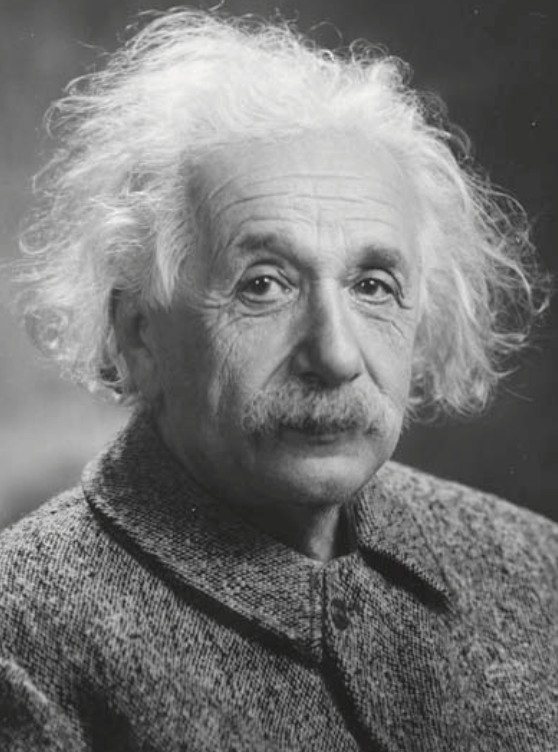
Albert Einstein
And if Jesus could criticise his own people for turning their religion into an ideology, what might he say of the Christian Church? The same, of course: all ideologies are idolatries. Whenever people are made to fit ideas, it is like getting Sabbath observance the wrong way round. My favourite example of an ideology becoming an idolatry that devours its children, like the god Moloch3, is Modern Management Practice which illustrates perfectly the way in which a process is first understood in order to control a process, but which then, instead of serving "us", manipulates "us" into serving it. The result is that wherever we look, in education, say, or the health service, those who serve these supposedly scientifically-managed systems are stressed and treated like objects. Management as idolatry is even making its way into the churches!
Cognitive dissonance
When the social psychologist Leon Festinger heard in 1955 that there was a group that believed that California was about to be destroyed, but that members would be rescued by a UFO, he tagged along to see what would happen when the spaceship failed to arrive. The cult's beliefs clashed with their experience, in what he called Cognitive Dissonance. He concluded in his study that the dissonance was resolved either by members reinterpreting their beliefs, that is, losing their faith or alternatively by defiantly ignoring the evidence, and simply asserting their convictions more loudly than ever. As an anthropologist once told me: "When the tribe is dying, the dance gets faster".
Reinterpretation is the liberal option, loss of faith the tragic one, while defiant reassertion is the approach we know as fundamentalism, a sometimes violent reaction which – when it subordinates people to belief – is idolatrous. Each of these coping strategies has its temptations and a dominant psychology and spirituality. The liberal mind is tempted by intellectual superiority and contempt; loss of faith is often accompanied by despair while the paranoia of an extreme fundamentalist may express itself in acts of terrorism. Idolatry is what drives today's news!
As the language of Genesis is so often symbolic we have to reach beneath the surface to what is really being said. Its stories we know: God creates the first man and places him in Eden with a warning not to eat of the tree of the knowledge of good and evil. If he does death will result [Gen. 2:15-17]. Knowledge can be lethal. "Of course you will not die", said the serpent, "for God knows that, as soon as you eat it, your eyes will be opened and you will be like God himself, knowing both good and evil". [Gen. 3:5] Here we have the irony that the Father of Lies is telling the truth! When Eve tempts Adam also to eat the fruit of the tree their eyes are are opened and their spiritual vulnerability is experienced as physical nakedness.
If we take these stories literally we miss their meaning: that moral and spiritual knowledge is often more dangerous than human beings can cope with. Idolatry is rooted in human nature. It is a possibility in all knowledge. Then, in the story of the Tower of Babel, matters get worse. The Lord came down to the city and the tower which they had built and he said....now they have started to do this nothing they have a mind to do will be beyond their reach [Gen. 11:6]. In Eden, eyes were opened in God-like knowledge and knowledge became a moral temptation and a spiritual trap. Now, at Babel, theoretical knowledge becomes unlimited practical knowledge. Nothing they have a mind to do will be beyond their reach.
I remember at the age of fourteen explaining nuclear fission to my grandmother. She was as horrified by Hiroshima as were Einstein and Szilard4. As an assault by human beings on their own humanity, the Manhattan Project (to create the atom bomb) had become idolatrous. Experimental science had become an idolatry. "Nothing they have a mind to do will be beyond their reach".
Science, that is, experimental science, launched by William Gilbert [1544-1603] with his experiments with magnets, is with theology, poetry and military history one of my chief interests and delights. It grieves me to think that, like religion and theology, science too can become idolatrous, but it's sadly the case, as I was reminded when watching Brian Cox's series, The Human Universe. In the last episode, as he pondered what was needed to shape the future of the human race, he dismissed something he called "superstition" and asserted that all that we needed were science and reason. I groaned and wished he had kept to cosmology, just as I wish Richard Dawkins would keep to genetics. Even if they admit that science can be put to inhuman, and therefore idolatrous, use as in the racially-biased Tuskagee Syphilis Experiments5, many atheists continue to put a blind faith in the innate moral purity of the scientific enterprise.
And when it comes to an equally misguided faith in the moral purity of reason it is as if psychologists had never established that in human affairs reason is often subverted by human emotion. Science and reason are not the reliable guides many think them to be. In his book Straw Dogs, Thoughts on Humans and Other Animals, John Gray, the philosopher, agrees: "Straw Dogs", he writes, "is an attack on the unthinking beliefs of thinking people…. Humanists like to think that they have a rational view of the world; but their core belief in progress is a superstition, further from the truth about the human animal than any of the world's religions." [page xi]. A little further down the same page he says: "Secular believers – held fast by the conventional wisdom of the time – are in the grip of unexamined dogmas." Only in mathematics is reason anything like as pure as many atheists would like to think; and the problem with reason in mathematics is that it can be unexpectedly self-limiting. This was demonstrated in the early 20th century by Gottlob Frege's [1848-1925] failure to establish arithmetic in a formal, incontrovertible manner, on an axiomatic basis of self-consistent logic and set theory. To be accepted as secure an axiom, or foundation principal, should emerge in mathematical enquiry free from contradiction. Frege's was a magnificent attempt, but finally a failed project.
His first volume was a great success but while the second was in the press it was sabotaged by Bertrand Russell who pointed out that the fifth of Frege's axioms led to a contradiction that brought the whole project tumbling down. The axiom concerned famously allowed the formation of "a set of all sets that are not members of themselves". Sets are not normally members of themselves; for example the set of Newman Association members is not itself a member of the Newman Association. For non-mathematicians this sort of abstraction is not easy to understand, but fortunately the contradiction involved is made clear by an illustration known as Russell's Barber Paradox, where "sets which are not members of themselves" becomes "men who do not shave themselves"!
The Paradox goes like this: there is a village which has a barber who only shaves men who do not shave themselves. So, who shaves the barber? He cannot shave himself, because he only shaves men who do not shave themselves; and a man from the village cannot shave him, because then he would be a man who does not shave himself and so must be shaved by the barber, and he can't shave himself because....and you see why the founder of modern mathematical logic was thrown by the contradiction. It meant that the axioms of arithmetic cannot be derived from purely logical axioms. It was as if there was a hole in the seamless robe of logical proof.
Then even more holes were discovered in the fabric of mathematical logic. In the early 1920s another mathematician, David Hilbert (1862-1943), proposed resolving the crisis by a formalisation of all of mathematics in axiomatic form, together with a proof that this axiomatising of mathematics was self-consistent. Unfortunately, in 1931, another mathematician, Kurt Gödel, [1906-78] demonstrated the failure of this proof with his famous Incompleteness Theorem.
In attempting to explain this theorem I can do no better than quote the Oxford Companion to Philosophy. "A formal system is a computable list of axioms stated in precise language with precise inference rules. Gödel's Theorem states that for any consistent formal system M containing a certain part of arithmetic, a sentence in the language of M can be constructed which is neither provable nor refutable in M." [p320]
And then, in 1936, along came Alan Turing [1912-54] with his analysis of the Halting Problem in computers. Here was another hole in the fabric of rational thinking as mathematics. Briefly, the Halting problem is that of determining, from a description of an arbitrary computer program and an input, whether the program will finish running. It is undecidable. All of which brings idolatry into the mathematical world that Turing made possible, a world dominated by computers and their algorithms, those step-by-step procedures for calculating something. For example, to do long division children are taught an algorithm, an "if this then that" sort of system. In fact, ours is a world almost entirely run on algorithms! I once chatted to a military man about robot sentries that can challenge unauthorised entry. A distant handler would decide whether to let pass, arrest or shoot, though decision-making algorithms could, if allowed, decide for themselves. In short, algorithms are now capable of making ethical decisions!
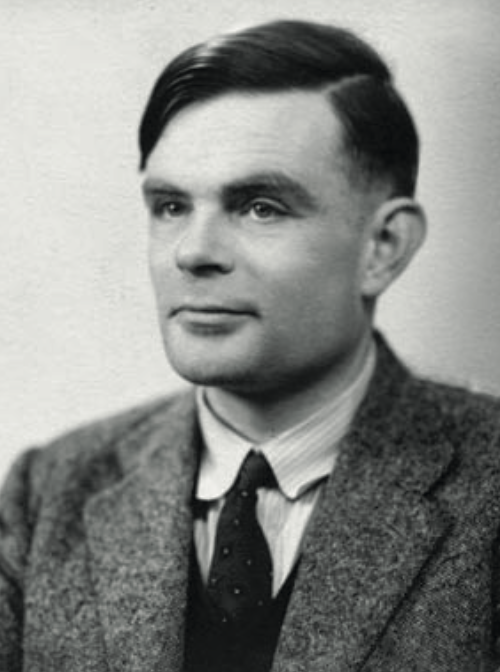
Alan Turing
In November 2014 New Scientist carried a four-page article on the growing use of automated robot systems in modern warfare, and discussions have been held by the UN to discuss if and how robot weapons, "killer bots", should be brought under the Geneva Conventions. Robots are now where Adam was! You may eat of any tree in the garden, except... But we humans ate the forbidden fruit long ago and cannot now un-eat it.
Mathematics is a spiritual quest and increasingly it is making our decisions for us. Do we think that banks make their financial decisions without the use of algorithms? Even stock exchange traders have systems whose algorithms trade millions of pounds in millionths of a second while their human minder sleeps; while systems with algorithms designed to identify possible signatures for the presence of the Higgs Boson examined trillions of reactions in the collisions of particles within the Large Hadron Collider.
On September 26th 1983 Stanislav Petrov, Deputy Chief of Combat Algorithms, was on duty at the Soviet Union's Early Warning System when the computer read-outs warned of an incoming missile strike from the United States. In breach of instructions Petrov dismissed the signal as a false alarm. A minute later the siren sounded again, then three times more. Petrov, frozen to the spot, had his doubts and still reported a systems failure. After twenty minutes the first missiles should have struck Moscow, but nothing happened. With apologies to Bertrand Russell, we had had a close shave, lucky that the Deputy Chief for Combat Algorithms believed that algorithms were created to serve us and not we them.
The role of mathematics
The myth of the Tower of Babel, Nothing they have a mind to do will be beyond their reach, is partly about the human desire to control the world, and since the days of Galileo and Newton science and technology have depended on the role of mathematics. To understand scientifically means reducing processes to equations and algorithms. For many atheists this results in an unrealistic view of reason as being sufficient for our need to control. But it is just here that we need to note that, in so far as something cannot be understood it cannot be predicted, and what cannot be predicted cannot be controlled. When these are self-organising systems are located in a self-organising universe, what chance does human reason have?
All of which brings us beyond ordinary, unaided human intelligence to AI, Artificial Intelligence; to the way in which the algorithms that make this possible are changing the very nature of our humanity. We must now reckon with the realisation that not only is reason not what many think it to be but that, because of our growing dependence on them, automated systems – that is, robots – are changing the identity and nature of the very humanity they were created to serve. Those the Sabbath existed for would soon be very different creatures from what they were in Jesus' day.
Already we are what many commentators call "enhanced human beings". We have already entered into a profound relationship with automated systems. For the moment they are physically exterior to us, though we can no longer manage without them. Already our civilisation is that of human/machine hybrids. Like medieval creatures with lions' bodies and eagles' wings we are becoming "chimera" or composite beings. With the arrival of cochlear implants human enhancement became interior to the body and the journey towards our becoming cyborgs, or human/machine creatures began.
Who now serves what? Just as Jesus interpreted the Torah for his time so now we must begin to interpret afresh his teaching on idolatry if we are to avoid idolatry in an age in which our humanity is in danger of being reduced to AI and applied mathematics.
Since the 1960s there has been a name for this shift in human identity, Transhumanism, the recognition that science and technology are changing the nature of humanity itself. Its study is now pursued at many universities.
Transhumanism has become an international movement that aims to enhance our physical and mental capacities as well as to eliminate disease and disability. Its deeper, theological and spiritual relevance is its belief that the human species in its present form does not represent the end of human development. Nothing they have a mind to do will be beyond their reach.
Most transhumanists appear to be atheists, but as the process it describes is slowly unfolding it is no longer a reality from which Christians can stand aloof. Among the theological issues raised is that of creatures made in the image of God recreating themselves in some self-made, part-human hybrid image. For those who take the future possibility of Cyborgs seriously there is also the question of the nature of the resurrection body, not to mention complications for the doctrine of the Incarnation. Nothing they have a mind to do will be beyond their reach.
It may sound a silly question, but how do we know that we are not robots? We are unless we worship a non-algorithmic God. Only in that way do we escape creaturely "reproducibility". If God does not exist then we are no more than easily-copied information. We are only fully human when we escape idolatry, the sin of being unable to enter into a relationship with the un-namable, non-algorithmic God.
To escape being only copyable organic robots we need a relationship with our creator, who cannot be reduced to algorithms because then he would be a creature! Only through worship can we escape being defined by algorithms. Becoming more than a complex bundle of algorithms is the work of prayer. Only in God's upside-down, algorithm-frustrating Kingdom do I cease to be an idolatrous, copyable robot; unless, of course, interoperability, or the capacity of one information system to reproduce the contents of another, extends to my love and worship of God. But as this is a maths question that's about more than maths, for the moment we must leave our meditation on idolatry there!
Albert Radcliffe, an Anglican, is a retired Residentiary Canon of Manchester Cathedral.
1 Erwin Schroedinger in 1935 devised an image of a cat in a box to illustrate some of the uncertainties associated with quantum mechanics.
2 In 1867 James Clerk Maxwell proposed the idea of a demon controlling flows of gas molecules between two chambers to assist understanding of the Second Law of Thermodynamics.
3 Moloch was a god worshipped by the Phoenicians and the Canaanites (and sometimes by disaffected Israelites). In some circumstances parents would sacrifice their newborn children to Moloch.
4 Leo Szilard, a physicist, conceived the idea of the nuclear chain reaction in 1933.
5 A clinical study into syphilis conducted in Alabama between 1932 and 1972, during the later years of which period penicillin-based treatment was withheld from participants.