Mike Kerrigan, chair of the Movement for Married Clergy (MMaC), examines the history of clerical celibacy, the growing shortage of priests, and the case for ordaining married men in the Catholic Church.
This article is based on a talk given to the Ealing Circle in October 2015. Mike Kerrigan is chair of the Movement for Married Clergy (MMaC). He is also a member of the Tyneside Circle of the Newman Association.
Catholic statistics are not always reliable, but it looks as though, in the past fifty years, the number of secular priests in this country has almost halved. In the Diocese of Hexham and Newcastle, for example, where seven parishes have just been amalgamated into one, this shortage is increasingly felt. And moreover the clergy are ageing: even in the last twenty years the number of retired priests has increased substantially. Meanwhile the Catholic population seems to be just about as numerous, perhaps slightly more so, than 50 years ago.
Most priests now live on their own. Curates are almost an extinct species: in Hexham and Newcastle, almost the only ones are those very recently ordained. Even MMaC's optimistic projections suggest that by 2025 the diocese will have about 40 per cent fewer priests than now, assuming the current rate of about two ordinations a year can be maintained. Ordinations nationally have declined sharply during the past few decades and, although they have picked up slightly during the past couple of years, it is by no means certain that this upturn will last. We are already extremely short of priests and we know we will soon be much shorter; MMaC feels that it is time to consider the ordination of married laymen.
A brief history of clerical celibacy
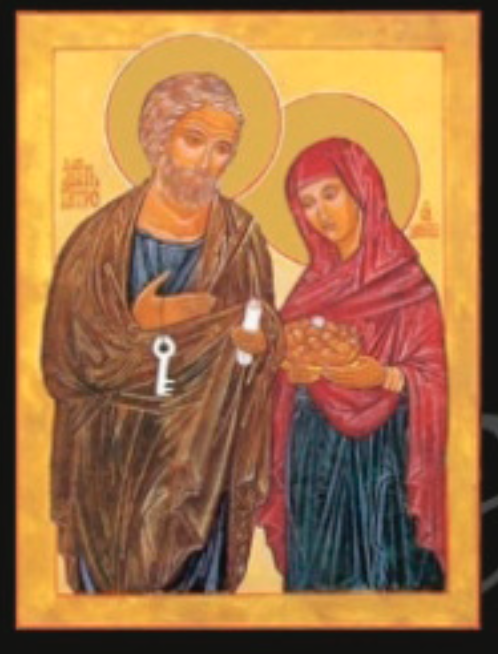
St Peter and Wife by Eileen McCabe
Most of the apostles were married, as far as we can see. Peter had a mother-in-law, according to the gospels, so he was married. St Paul, who wasn't married, nevertheless believed the other apostles and disciples of the Lord, including priests, were entitled to marry. And if we look at the earliest writers in the Church – for example, St Ignatius of Antioch – he just took it for granted that St Peter and the other apostles were married men. Most priests, bishops and even popes were married. Paul himself assumed that those who presided at the liturgy (the episkopos) would be married – though not more than once! In the early church there really was no clear notion of celibacy as a requirement for priesthood.
So how and why did the idea that priests should be celibate gain traction? Well, by the 4th century various expressions of doubt about the compatibility of marriage and the priesthood began to emerge. The Council of Nicea (325 AD) discussed the prohibition of marriage, but an Egyptian bishop, called Paphnutius, who was a monk himself, and therefore celibate, considered that imposing celibacy would be "imprudent, difficult in practice and objectionable in that it would reduce a personal choice of celibacy to a regulation". That was in 325 and interestingly, in 2015, MMaC would say very much the same thing.
There was a growth of monasticism in the Early Church. People went off, first as hermits and then to live in communities, where celibacy was of the essence. That was beginning to become an ideal: a feeling that they were the best sort of priests. This was reflected in the writings of important figures in the early Church such as St Ambrose and St Jerome: a view that celibacy was a superior state to marriage. St Augustine, a huge figure, spoke relatively positively of marriage but said in 401 AD that "marriage and virginity are two goods of whereof the one is greater" – meaning virginity. So the idea of celibacy was gaining ground and there was increasing pressure on priests to be celibate.
But the Church was not as closely-controlled at the centre as it has since become and most ordinary priests at that time continued to be married. By the eleventh century, however, opinions were changing significantly. By this time the papacy had become much more powerful than it had been 600 years before. One practical advantage of celibate clergy was that they could not pass on Church property to their children. And at this period the monasteries were being reformed in France so the prestige of monasticism was being increased still further. People like St Peter Damian were calling a priest "the bridegroom of Christ" and in that sense if the priest had any other partner he would be an adulterer. Finally, Canon Law was gaining a great deal of influence, being seen as an instrument of reform. So by the time of the Lateran Councils in the 12th century it was decreed that clergy marriages were null and void: you couldn't be married and a priest.
Still, compliance was patchy. When a new bishop took over his diocese the first thing he would do was to complain about the loose morals of his clergy and vow to do something about it. And at that time one of the highest-prized dispensations from Rome was that of legitimising priests' sons, who would otherwise be illegitimate. So discipline was irregular – until the Reformation, which required the Roman Church to clarify its own discipline. To put it simply, if the reformers said priests could be married, the Roman Church said clearly: "Oh no, they can't." This confrontation sealed the victory of celibacy in the Roman Church. The Council of Trent (1545-1563) was conclusive, saying: "If anyone says that the married state is to be placed above the state of virginity, let him be anathema". Celibacy became the badge of the Roman Catholic priesthood. Martin Luther married, and Jean Calvin said virginity was not superior to marriage. Protestant ministers were married, so Roman Catholic priests could not be. They would henceforth be trained in seminaries, often from a very early age, and therefore the Church had control over the lives of future priests. Thus celibacy became the norm by the end of the 16th century.
Whatever the special historical circumstances, however, MMaC would maintain that the key underlying motive for its adoption was still – and, one might argue, remains today – cultic purity: the ancient idea that sexuality and the priesthood cannot mix. That separation is not unique to Christianity; in the Old Testament, already, the high priests in the Temple were to be pure, they were to abstain from many "defiling" actions, and any sexual contact was seen as a cause of objective impurity.
Celibacy in the modern Church
In the Early Christian Church the argument for celibacy gained strength as time went on, especially when priests began to celebrate the Eucharist every day, as opposed to only on the Sabbath, as in the beginning. Those original priests were often urged to refrain from sex on a Saturday, before the Sunday. But if they were to say Mass every day then logically they could not have sex on any day of the week. This logic was revived as recently as 1994 when the Vatican's Congregation for the Clergy published a document entitled Directory on the Ministry and Life of Priests. This upheld the medieval law and, quoting only the ancient sources, appeared to justify it still by the ancient concept of cultic purity.
However, thirty years earlier the Vatican Council had very positive things to say about marriage, describing marital relations as "noble and worthy". So in the light of that, MMaC would say the cultic purity argument can no longer be upheld: you cannot maintain that sexual activity is incompatible with the priestly state.
So what, apart from cultic purity, are the current arguments for retaining celibacy? The cost issue is often raised, because single men are cheaper to maintain; mobility is a factor, as single men are easier to move around, including to the missions; availability can be mentioned, because a single man should be able to devote all his time to his priestly duties; tradition matters too, in a way, because the Council of Trent was unambiguous about celibacy, and as this has been the rule for a thousand years the Church is very reluctant to change. Perhaps the most cogent argument, however, is spiritual growth – that the sacrifices entailed by celibacy have led to a deepening of spiritual resources and have enabled some priests to live lives of dedicated service and genuine holiness. Not all priests experience this spiritual growth.
But the principal practical reason why today MMaC think a change to this law of mandatory celibacy is necessary is simply that we are short of priests and that the situation is going to get even worse. Indeed some other parts of the world they are much shorter than we are. In any case, some of the advantages claimed for celibacy are not so evident: after all, the married clergy in other denominations, and in the Anglican church in particular, are in many cases as wholeheartedly devoted to their congregations as our celibate clergy are. Without dwelling on the sexual abuse scandals of recent years, one has nevertheless to ask whether there is some connection between that and enforced celibacy. Then there is clericalism: celibacy makes the clergy a class apart. They live very differently, and if there is a lingering feeling that they are somehow above the ordinary people, then that is not a healthy factor for the Church.
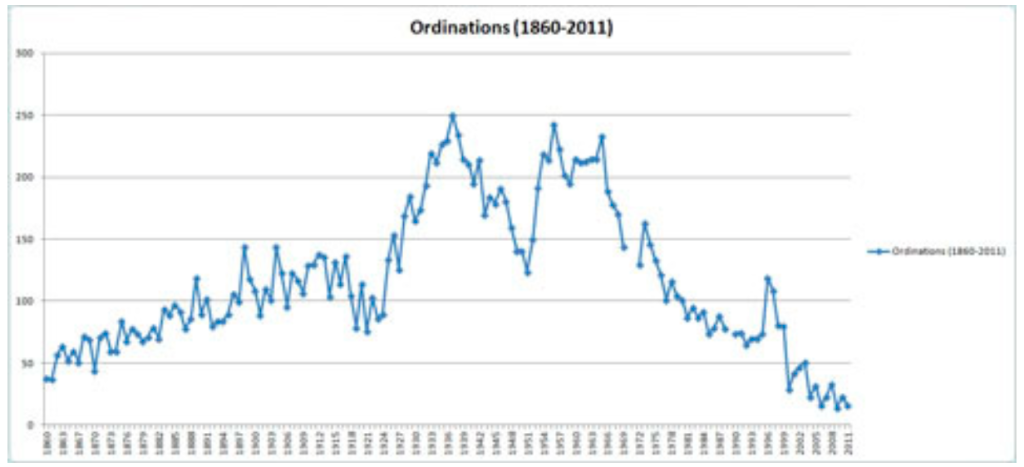
Source: The Latin Mass Society
The need for change
Change is needed, not just for reasons of shortage but for other reasons too. Change is justified because priesthood is a vocation to a ministry, whereas celibacy is a gift of grace for holiness. Briefly, the argument there is that the two are not intrinsically connected. Vatican II said as much: perfect and perpetual continence is not indeed demanded by the very nature of the priesthood. An American theologian, Richard Gaillardetz, has put it rather interestingly: he has said there are various logics at work when we consider the question of celibacy. There is the logic of cultic purity, which MMaC would argue is no longer tenable. There is the argument of prophetic witness: that celibacy is a counter-cultural affirmation of a way of life that is for the Kingdom. And then there is the logic of ministerial service, of the job that the priest does in the Church.
Now, whereas celibacy can be imposed as an obligation if one believes there is an objective incompatibility between being married and being a priest, if one doesn't accept that premise then it becomes rather difficult to see how the obligation can be justified. The argument would be that the charism of celibacy is a gift of grace given to not many (as Jesus says in St Matthew) and that it cannot be imposed as a mere obligation. Gaillardetz says that this enables us to unhinge the ministry of the priesthood from the question of celibacy; whereas you can feel that you have a vocation to be a priest, to minister to need in the Church, you are not necessarily gifted with the charism of celibacy. There are several other reasons:
- There is widespread support for change. If the laity are to be consulted we believe – although nobody has surveyed opinion in this country yet – that most Catholics would support the idea of allowing married men to be ordained priests. We are arguing that viri probati, tested men, in other words men who show all the qualities for being considered for ordination, except that they are married, should be considered for ordination.
- Also, there are many priests who have left the ministry but have not abandoned the Church – quite the contrary, many of them being very active in their parishes in the service of the Church. It is calculated that there may have been as many as 10,000 such resignations in the UK within the past fifty years, which is an awful lot considering that we have fewer than 3,000 currently active priests. However, the Church may not yet be open to accepting these priests back, so MMaC concentrates on urging that married laymen be ordained.
There will, of course, be practical issues, one of which is the need for careful planning. One may wonder whether any forward planning going on in the Church – there are no indications that anybody is thinking very broadly about it. Indeed, when MMaC first talked to ex-Anglican clergy, they did not suggest they had been consulted by the official Church about their experiences; MMaC, however, has asked them and recently published the results of its survey.
MMaC believes that married clergy would be very largely self-supporting, either through their profession – their work – or on the basis of other incomes, because in many cases they would be retired men on pensions. Therefore most of them would be non-stipendiary. They would also be practising on a part-time basis, but then we have so few priests nowadays that many of them are already only partly in their parishes because they have other jobs to do.
Another practical issue is that there would be families to be considered, and in particular there would be the wives of married priests. Also, training would need to be provided if you could not take people off into seminaries, although many of the laymen who wished to become priests would probably be theologically well-versed already.
A change of atmosphere
What is happening? Well, after the MMaC was founded in the mid-1970s not much happened in the first 35 years of its existence. There was optimism in the first years after the Vatican Council, even though Pope Paul VI had vetoed the discussion of celibacy at the Council. Despite that prohibition there was a feeling that things would change. But such optimism disappeared under the pontificates of John Paul II and Benedict XVI. However, there has been quite a change of atmosphere under Pope Francis.
The Brazilian bishop of Xingu, Bishop Erwin Kräutler, who has a tiny number of priests for an enormous diocese, asked Francis in 2014 if he could ordain married men. Francis was taken aback, but then he said, well, why not? If you come forward with some concrete suggestions, he said, we will see what happens. And the Brazilian bishops have set up a commission to do precisely this. In Ireland Bishop Leo O'Reilly of the Diocese of Kilmore has recently proposed that the Irish hierarchy do the same. In this country, it's a subject for discussion rather than a matter for action at the moment but the Bishop Emeritus of Portsmouth, Crispian Hollis, wrote to The Tablet last July and has sparked a great amount of debate about the issue: the celibacy debate is coming to the surface. What would be important, though, would be for active, rather than retired, bishops to say something.
In fact a motion for the ordination of mature married men was tabled at the Plenary Assembly of the Bishops' Conference last November by Bishop Seamus Cunningham of Hexham & Newcastle. But according to a report in the Catholic newspaper Northern Cross there was no support from other bishops. They believed that the priesthood and celibacy were intimately linked, and sacrifice was at the heart of the priesthood – the sacrifice of the Mass and the sacrifice of the priest who offered his life for his people.
In conclusion, however, one might reflect on this: the Church of England in 2010 had 563 new priests; half of those were women, granted, and some of the men were non-stipendiary. But those ordained for full-time ministry were still nine times as numerous as the Catholic priests ordained in that year, for roughly the same number of practising church members. Is celibacy the key difference? It's an interesting question.

Mike Kerrigan
Mike Kerrigan