Mike Monaghan provides a comprehensive review of Pope Francis' encyclical Laudato Si', exploring its themes of environmental crisis, Christian teaching on creation, the roots of ecological destruction, and its call to action — describing it as possibly the most important document published by the Church since Vatican II.
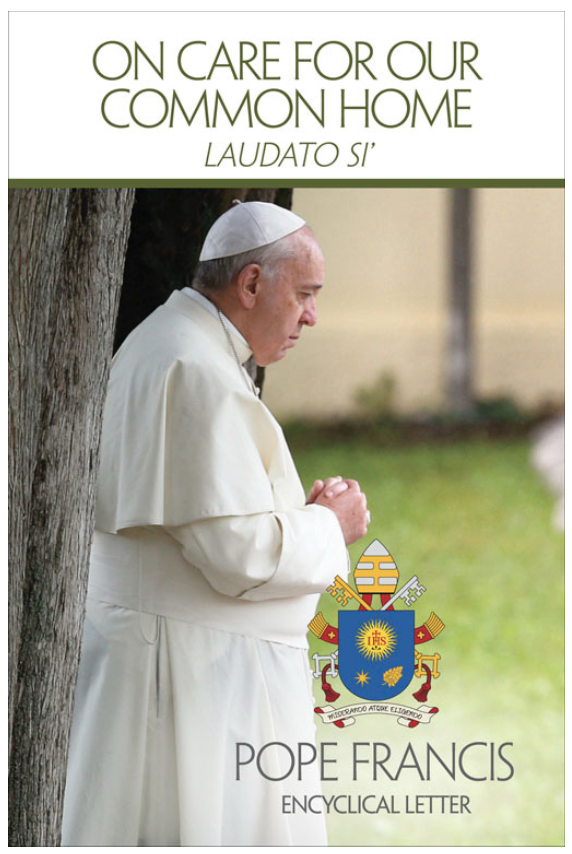
"Laudato Si', mi' Signore – Praise be to you, my Lord". In this beautiful canticle St Francis of Assisi reminds us that our common home is like "a sister with whom we share our life and a beautiful mother who opens her arms to embrace us". Did an environmental document ever begin like that?! This document adds poetry and a sense of the interconnectedness of all life on earth. No longer is it saturated with the technocratic and political heaviness which permeates much of the environmental literature (which I have personally been studying for some 40 years). Laudato Si'* must be the most readable, widely read and welcomed and inspiring document published by the Church since Vatican II. It is also possibly the most important.
Why? Firstly, simply because the Church has at last produced an encyclical devoted to the environmental crisis (and it should be stressed, not only concerned with global warming). Statements on the environment have been included in documents from Rome and by individual hierarchies, but none have been devoted solely to it. And never one so stark and clear in its warnings and challenges – but also one filled with hope and joy. Secondly, it is radically different from most other environmental statements in its constant theme of relating environmental destruction to its impact on the poor. It goes even further than this. It directly questions root causes of the environmental crisis which arise largely from the current neo-liberal economic systems. The mindset that disregards the destruction of the environment also ignores the plight of the poor and the scandal of growing inequality.
The Purpose and Structure of Laudato Si'
The tone is set in the magnificent opening paragraphs. It certainly opens with a bang.
This sister [Earth] now cries out to us because of the harm we have inflicted on her by our irresponsible use and abuse of the goods with which God has endowed her. We have come to see ourselves as her lords and masters, entitled to plunder her at will. The violence present in our hearts, wounded by sin, is also reflected in the symptoms of sickness evident in the soil, in the water, in the air and in all forms of life. This is why the earth herself, burdened and laid waste, is among the most abandoned and maltreated of our poor; she "groans in travail" (Rom 8:22). We have forgotten that we ourselves are dust of the earth (cf. Gen 2:7); our very bodies are made up of her elements, we breathe her air and we receive life and refreshment from her waters [LS2]……Now, faced as we are with global environmental deterioration, I wish to address every person living on this planet…..In this Encyclical, I would like to enter into dialogue with all people about our common home. [LS3]
Dialogue is a constant theme of Pope Francis as evidenced by the recent Synod on the Family. In paragraph 15 of the encyclical the Pope notes that he sees the document as being "added to the body of the Church's social teaching" – i.e. it is not a standalone document but is a development of a longstanding body of teaching, albeit one which many have felt has been too anthropocentric in the past. This document certainly reverses that.
The major themes of the encyclical which I will try to touch on are:
- what is happening to our common home – the scientific basis for concluding that we have an ecological crisis
- how Christian teaching gives coherence to our commitment to the environment
- an analysis of the roots of the problem, i.e. looking at not only the symptoms but the deepest causes
- proposals for dialogue and action
I will also review some of the criticisms which have been made of the encyclical.
Earlier Church Statements
However, before that I wish to refer to some previous Church statements on the environment. Laudato Si' is often described as if it emerged from the blue. Whilst not wishing to detract from its unique character it shows very clearly that it draws from and develops earlier statements, few of which sadly seem to have had much impact amongst most Catholics, let alone the wider world – though Christian environmentalists have attempted to draw attention to them. Pope Francis is at pains throughout the encyclical to refer to previous documents, not only those emerging from the Vatican but also those from bishops of many countries (no less than 21 statements from the bishops' conferences of different countries ranging from Japan to Bolivia are quoted – though not one from the UK – as well as from the Orthodox Church). This reference to a wide range of hierarchies is in accord with the Pope's emphasis on the important role of Bishops' conferences and the local church. The Pope draws particularly from Popes Paul VI, John Paul II and Benedict XVI. [LS 4-9]
Over 40 years ago, in Octogesima Adveniens, Pope Paul VI referred to the ecological concern as "a tragic consequence" of unchecked human activity: "Due to an ill-considered exploitation of nature, humanity runs the risk of destroying it and becoming in turn a victim of this degradation". He spoke in similar terms to the United Nations about the potential for an "ecological catastrophe under the effective explosion of industrial civilization" and stressed "the urgent need for a radical change in the conduct of humanity", inasmuch as "the most extraordinary scientific advances, the most amazing technical abilities, the most astonishing economic growth, unless they are accompanied by authentic social and moral progress, will definitively turn against man".
John Paul II became increasingly concerned about this issue. In his first Encyclical in 1979 he warned that human beings frequently seem "to see no other meaning in their natural environment than what serves for immediate use and consumption". Subsequently, he would call for a global "ecological conversion".
Benedict XVI likewise proposed "eliminating the structural causes of the dysfunctions of the world economy and correcting models of growth which have proved incapable of ensuring respect for the environment".
Pope Francis also draws on the inspiration of Patriarch Bartholomew of the Orthodox Church who has spoken, in particular, of the need for each of us to repent of the ways in which we have harmed the planet. For "inasmuch as we all generate small ecological damage" we are called to acknowledge "our contribution, smaller or greater, to the disfigurement and destruction of creation". (He quotes Orthodox sources no less than ten times, surely something unique in a papal document.) Sadly the many statements going back over 40 years have had little impact on the Church and even less on the rest of the world. This encyclical may be different. The urgency of the situation is more widely recognised and, as noted, Pope Francis emphasises that he sees his encyclical as being addressed to all mankind.
I want now to summarise some of the key themes. I will quote quite extensively from the document; the Pope expresses things far more eloquently and often more tellingly than I could.
What is happening to Our Common Home?
The encyclical provides a masterly summary in Chapter 1 [LS 17 to 61] of the state of the world drawing on the most up-to-date scientific information but characteristically referring the malaise to a deeper understanding of human nature. The findings are well-known to those who have chosen to be aware of them but what is original is to see them so explicitly endorsed in an encyclical. It covers a wide area; the main sections are:
- pollution and climate change
- water
- biodiversity loss
- quality of human life and inequality
and it finishes with a strong criticism of the inadequacy of the responses so far.
In a short paper it is impossible to do justice to the comprehensive coverage. I will therefore highlight one or two more striking statements made in response to the encyclical. Before looking at the Pope's words let me quote a statement from a professor of environmental studies at Yale, Gus Speth. "I used to think that the top global environmental problems were biodiversity loss, ecosystem collapse and climate change. But I was wrong. The top environmental problems are selfishness, greed and apathy. To deal with these we need a spiritual and cultural transformation." This to my mind sums up what the Pope seeks to address.
On Pollution
The Pope rather dramatically comments: "Each year hundreds of millions of tons of waste are generated, much of it non-biodegradable, highly toxic and radioactive, from homes and businesses, from construction and demolition sites, from clinical, electronic and industrial sources. The Earth, our home, is beginning to look more and more like an immense pile of filth." [LS21]
On Waste
"We have not yet managed to adopt a circular model of production capable of preserving resources for present and future generations, while limiting as much as possible the use of non-renewable resources, moderating their consumption, maximising their efficient use, reusing and recycling them."[LS22]
On Climate Change
"The climate is a common good, belonging to all and meant for all. A very solid scientific consensus indicates that we are presently witnessing a disturbing warming of the climatic system....most global warming in recent decades is due to the great concentration of greenhouse gases….released mainly as a result of human activity. Its worst impact will probably be felt by developing countries in coming decades. Many of the poor live in areas particularly affected by phenomena related to warming....Many of those who possess more resources and economic or political power seem mostly to be concerned with masking the problems or concealing their symptoms." [LS 22-26]
On Water
He comments on the growing problem of availability of water especially to the poor who lack access to it. "They are denied the right to a life consistent with their inalienable dignity." And he is also critical of privatisation of water supplies. [LS 26-31]
On Biodiversity Loss
In a striking departure from much previous Christian thinking he comments: "It is not enough, however, to think of different species merely as potential 'resources' to be exploited, while overlooking the fact that they have value in themselves. Because of us, thousands of species will no longer give glory to God by their very existence, nor convey their message to us. We have no such right." [LS 32-42]
On the Quality of Human Life, and Inequality
"....the growth of the past two centuries has not always led to an integral development and an improvement in the quality of life"; ".... lack of physical contact and encounter [with the poor], encouraged at times by the disintegration of our cities, can lead to a numbing of conscience and to tendentious analyses which neglect parts of reality. At times this attitude exists side by side with a 'green' rhetoric". [LS 43-47]
In summing up this section the Pope concludes: "We need only take a frank look at the facts to see that our common home is falling into serious disrepair. Hope would have us recognise that there is always a way out, that we can always redirect our steps, that we can always do something to solve our problems. Still, we can see signs that things are now reaching a breaking point." [LS 61]
Christian Teaching and the Environment; the Gospel of Creation
The Pope stresses the value that a religious approach has in the analysis of, and inspiration for, action in relation to the world's environmental and social problems. "Science and religion, with their distinctive approaches to understanding reality, can enter into an intense dialogue fruitful for both." [LS 62]. Christians ".... realise that their responsibility within creation, and their duty towards nature and the Creator, are an essential part of their faith". "It is good for humanity and the world at large when we believers better recognise the ecological commitments which stem from our convictions." [John Paul II, 1990, for World Day of Peace]
Biblical Insights
The encyclical analyses briefly what some of the key passages from the Bible have to say about the relationship of humans to the rest of creation. It makes an extremely important point in referring to Genesis 1:28 about mankind having "dominion" over every living thing. The Pope admits that this has been used by Christians to encourage "....the unbridled exploitation of nature....This is not a correct interpretation of the Bible as understood by the Church". [LS 67] The essence of the biblical texts, he states, is that we are charged to "till and keep" the garden of the world. "We are not God. The Earth was here before us and it has been given to us". [LS 67] And he refers several times to the biblical insights which challenge the modern myth of endless growth. "If we acknowledge the value and the fragility of nature and, at the same time, our God-given abilities, we can finally leave behind the modern myth of unlimited material progress." A fragile world, entrusted by God to human care, challenges us to devise intelligent ways of directing, developing and limiting our power. [LS 78]
The Human Roots of the Ecological Crisis: Integral Ecology
The phrase the Pope uses most frequently to describe what is the root of what has gone awry is the "technocratic paradigm". This is not an attack on technology as such. He points out that: "Technology has remedied countless evils which used to harm and limit human beings. How can we not feel gratitude and appreciation for this progress, especially in the fields of medicine, engineering and communications?" [LS 102] But he warns that "Never has humanity had such power over itself, yet nothing ensures that it will be used wisely, particularly when we consider how it is currently being used." [LS 104]
There is a tendency to assume that "....reality, goodness and truth automatically flow from technological and economic power as such." [LS105] And in a final quote from this section of the encyclical he notes that it is "....easy to accept the idea of infinite or unlimited growth, which proves so attractive to economists, financiers and experts in technology. It is based on the lie that there is an infinite supply of the earth's goods, and this leads to the planet being squeezed dry beyond every limit." He commends those who have challenged the dominant technocratic paradigm, citing for example "....cooperatives of small producers who adopt less polluting means of production, and opt for a non-consumerist model of life, recreation and community. Or, when technology is directed primarily to resolving people's concrete problems, truly helping them live with more dignity and less suffering." [LS 112]
And in a hope-filled passage he highlights that some are demonstrating that…. "An authentic humanity, calling for a new synthesis, seems to dwell in the midst of our technological culture, almost unnoticed, like a mist seeping gently beneath a closed door." The other root cause cited is "modern anthropocentrism". "When human beings place themselves at the centre, they give absolute priority to immediate convenience and all else becomes relative. Hence we should not be surprised to find, in conjunction with the omnipresent technocratic paradigm and the cult of unlimited human power, the rise of a relativism which sees everything as irrelevant unless it serves one's own immediate interests. There is a logic in all this whereby different attitudes can feed on one another, leading to environmental degradation and social decay."[LS 122]
In response to this the Pope advocates what he terms "integral ecology". This requires us to have a vision which takes into account every aspect of the global crisis.
"When we speak of the 'environment' what we really mean is a relationship existing between nature and the society which lives in it. Nature cannot be regarded as something separate from ourselves or as a mere setting in which we live."[LS138]
In a seminal passage he notes: "We are faced not with two separate crises, one environmental and the other social, but rather with one complex crisis which is both social and environmental. Strategies for a solution demand an integrated approach to combating poverty, restoring dignity to the excluded, and at the same time protecting nature."[LS 139]
And in a characteristic section on The Ecology of Daily Life he comments on the possible response to the situation faced by people in poverty: "At times a commendable human ecology is practised by the poor despite numerous hardships. The feeling of asphyxiation brought on by densely-populated residential areas is countered if close and warm relationships develop, if communities are created, if the limitations of the environment are compensated for in the interior of each person who feels held within a network of solidarity and belonging. In this way, any place can turn from being a hell on earth into the setting for a dignified life." [LS 148]
Some Criticisms
The encyclical has been widely welcomed (including by environmental groups who are often hostile to the church), scientific bodies, senior government representatives, the Secretary-General of the United Nations and many church leaders. But it has predictably generated criticism from several quarters.
The most vehement of these objections have been from generally conservative, right wing individuals. The six Catholic candidates seeking to be nominated as the Republican candidate for US President, for example, have been understandably challenged by the encyclical given their party's stance on the environment – and perhaps even more on their pro-market economic policies. The reactions of one of the candidates Jeb Bush, is perhaps typical: "I don't get economic policy from my bishops or my cardinals or my pope." He added: "The climate is changing, whether men (NB!) are doing it or not." I am not sure where he gets his economic or other policies from!
There are also sceptical voices from within the church. Cardinal Pell, who is well-known for generally conservative views and is a noted "climate change sceptic/denier", said: "The Church has got no mandate from the Lord to pronounce on scientific matters". True, Cardinal Pell does also say that the encyclical "beautifully" sets out the Christian obligation to protect the environment. But he apparently disagrees with the Pope's proposed methods of so doing. His objection echoes that of others within the Church who challenge the appropriateness of the Church to address such issues. I find this odd given that we have a long history of statements on social teaching for well over 100 years. As is amply demonstrated in this encyclical, social teaching today which ignored the environment and did not address the causes of environmental decline would be rightly criticised for its failure to look at reality.
But more representative of Catholic reaction is that of John Allen, a prominent American commentator on the Church, who said in an analysis: "Laudato si' seems destined to go down as a major turning-point, the moment when environmentalism claimed pride of place on a par with the dignity of human life and economic justice as a cornerstone of Catholic social teaching. It also immediately makes the Catholic Church arguably the leading moral voice in the press to combat global warming and the consequences of climate change."
The scientific community is, however, very supportive. An editorial in the journal Nature, for example, shortly after the encyclical's publication, stated: "Nicholas Stern, author of an influential report on climate change, stated that 'The publication of the Pope's encyclical is of enormous significance. He has shown great wisdom and leadership. Pope Francis is surely absolutely right that climate change raises vital moral and ethical issues....Moral leadership on climate change from the Pope is particularly important because of the failure of many heads of state and government around the world to show political leadership'".
There are some criticisms which to my mind, however, do have some validity. I will mention three:
- The document is long and at times repetitive. I have heard it suggested that repetition is a Jesuit way of making sure the message is heard; to me it became a little tedious and the length of the document will surely put some people off tackling it.
- Some sections are also rather simplistic in their treatment of issues on which there can be legitimate differences of view.
- Its references to the impact of population are to my mind weak. It rightly states that: "Instead of resolving the problems of the poor and thinking of how the world can be different, some can only propose a reduction in the birth rate.…To blame population growth, instead of extreme and selective consumerism on the part of some, is one way of refusing to face the issues. It is an attempt to legitimise the present model of distribution, where a minority believes that it has the right to consume in a way which can never be universalised....[LS50] And he notes that: "For poor countries, the priorities must be to eliminate extreme poverty and to promote the social development of their people." [LS 172] But I think he fails to acknowledge that continued rapid population growth in some developing countries makes the task of eliminating poverty, and of having effective environmental protection, very much more difficult. And I would note that in some of these countries the Church's "ban" on contraception has a negative impact.
A Call to Action
The call to action is widely targeted and stresses the need for dialogue amongst peoples but notes again that the world has so far been….incapable of finding effective ways of dealing with grave environmental and social problems worldwide. [LS164] He nevertheless says: "There is reason to hope that humanity at the dawn of the twenty-first century will be remembered for having generously shouldered its grave responsibilities." [LS165] And he cites international conventions on hazardous waste and ozone-depleting chemicals as examples of what can be achieved. The much more difficult issue of how to tackle climate change will require he says ….. honesty, courage and responsibility, above all on the part of those countries which are more powerful and pollute the most. [LS169]
He regrets that too often politics in such countries….concerned with immediate results, supported by consumerist sectors of the population, is driven to produce short-term growth. In response to electoral interests, governments are reluctant to upset the public with measures which could affect the level of consumption or create risks for foreign investment. [LS178] Individuals and local groups are praised as being able to stimulate real change and make a real difference including pressurising governments to develop more rigorous regulations and controls. He wisely notes that continuity is essential….because policies related to climate change and environmental protection cannot be altered with every change of government.
Results take time and demand immediate outlays which may not produce tangible effects within any one government's term. That is why, in the absence of pressure from the public and from civic institutions, political authorities will always be reluctant to intervene, all the more when urgent needs must be met. To take up these responsibilities, and the costs they entail, politicians will inevitably clash with the mindset of short-term gain and results which dominates present-day economics and politics. [LS 181]
Environmental protection cannot be assured solely on the basis of financial calculations or adequately supported by market forces. For individuals, while suggesting the need for us to be actively engaged where we can in politics, he also notes that this may not be for everyone; but involvement with one of the countless dedicated organisations and groups is advocated. He also stresses the need for us to adopt what he terms more sober lifestyles including the reduction of our own energy consumption, and he cites Pope Benedict's call to regard purchasing as a moral and not simply an economic act. He acknowledges this is not easy, especially for young people brought up in an extreme consumerist society.
Small daily actions are commended. A person who can afford to spend and consume more but regularly uses less heating, and wears warmer clothes, shows the kind of convictions and attitudes which help to protect the environment. There is a nobility in the duty to care for creation through little daily actions. [LS211] And he lists several other examples we could all follow including one which received a surprising amount of attention – practising Grace before and after meals. The concluding section is an echo of the inspiring opening verses: "We come together to take charge of this home which has been entrusted to us, knowing that all the good which exists here will be taken up into the heavenly feast. In union with all creatures, we journey through this land seeking God; let us sing as we go. May our struggles and our concern for this planet never take away the joy of our hope". [LS244]
Mike Monaghan
This article is based on a talk given to the Manchester & North Cheshire Newman Circle in November 2015, a Circle of which Mike Monaghan is a member.
*Laudato Si' can be downloaded from the Vatican website. It is also available as a paperback from the Catholic Truth Society at £4.95 plus postage.