Ben Ryan examines the Catholic intellectual roots of the European project, tracing how Christian Democracy, Catholic Social Teaching, and committed Catholic politicians shaped the founding vision of what became the EU — from the Treaty of Rome to the principles of subsidiarity and solidarity.
"So, once again, the Pope reveals that the agenda of the Roman Catholic Church is political and manipulative in its objective to be the dominant controlling force in Europe." So said Ian Paisley in 2000 as he attacked the Catholic Church's interest in the EU.
The idea that the EU is a Catholic plot was by no means invented by Paisley – it has been a recurrent refrain of nationalist groups (particularly in Protestant countries) for as long as the European project has existed. Certainly in 2000 Paisley was giving the Church too much credit: in truth as an institution the Church had (and has) no real ability to directly influence policy or shape the political future of the EU. However, in another sense Paisley was quite correct: this was a political model which, at least in its origins, was a distinctively Catholic concept.
I should stress what I mean by that. The European project was never exclusively the outpouring of Catholic thought, nor was it ever in perfect harmony with the Church. Nevertheless the early European project had an ideological basis, and that basis was drawn from Catholic Social Teaching, primarily through the medium of Christian Democrat parties and politicians.
This can be too easily overlooked or taken for granted. Plenty of historians and journalists have sought to detach somehow the European project from its intellectual origins. So, there are those who want to claim that the development of the European project reflects an American desire to establish a bloc against Soviet aggression, another string to a bow that includes NATO and the Marshall Plan. This is unhistorical: documentary evidence from the time reveals that the Americans were taken by surprise by the content of the Schuman Declaration and the European Coal and Steel Community. Certainly they were supportive, but to claim the idea came from, or was shaped by, the Americans is fanciful.
Likewise there are those that want to claim that the European project was a socialist design (a myth recently given fresh airtime by Iain Duncan Smith). Undeniably there were socialists involved in the design of the early European project (most notably the Belgian Paul-Henri Spaak); however, their impact was necessarily limited by the context of 1950s Europe and the dominance of Christian Democrat politicians.
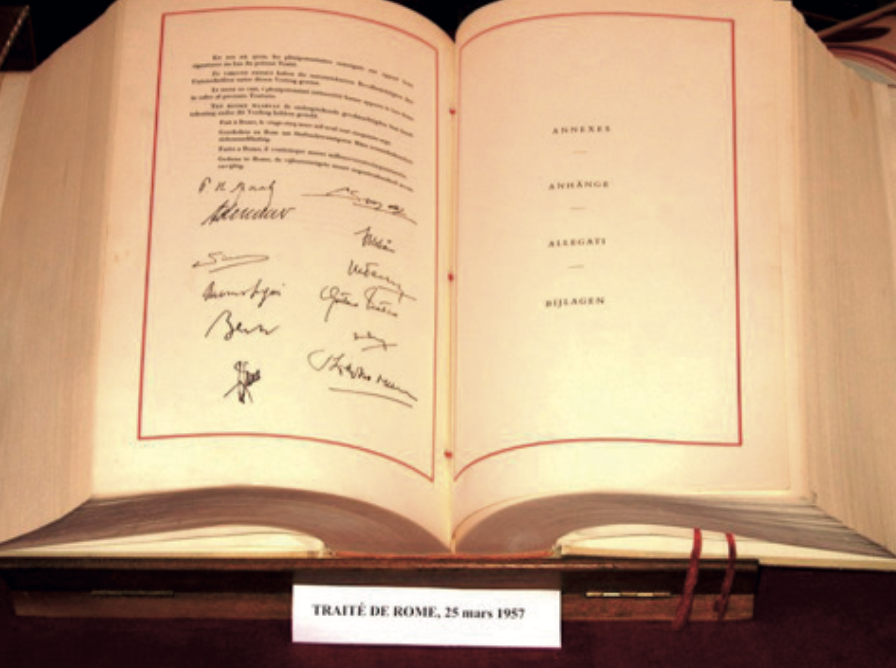
Traité de Rome, 25 mars 1957
In terms of context it is worth noting that in West Germany and Italy the Christian Democrat parties which were in power in the 1950s were obsessed with keeping the socialists out of power. Socialist parties in Germany and the Labour party in the UK meanwhile were opposed to the early European project; the Germans because they saw it as undermining the future reunification of Germany, the British because they thought it would damage British industries and, therefore, be unacceptable to the unions.
By contrast an analysis of the context and content of the early European project makes it abundantly clear that this new political entity owed its existence primarily to Christian Democracy, and particularly to Catholicism. Many of the key architects of early integration – including the French foreign minister Robert Schuman, the Italian prime minister Alcide De Gasperi and the West German chancellor Konrad Adenauer – were committed Catholics. Catholic Christian Democrats were the dominant group among signatories of the 1951 treaty of Paris that established the ECSC and the 1957 Treaty of Rome that started the EEC.
The Treaty of Rome, for example, was signed almost entirely by Catholic members of Christian Democrat parties with the exception of Paul-Henri Spaak and the two French signatories (all socialists). Spaak's fellow signatory from Belgium, Baron Jean Charles Snoy et D'Oppuers was a Catholic politician with an expertise in Thomist philosophy. Luxembourg's Joseph Bech was another leading Catholic figure as was the Dutch signatory Joseph Luns. In both treaties Catholic politicians far outnumbered the others.
When considering context, however, it is not just the fact that individually most of the figures involved were Catholic that is relevant but that the networks which connected them and aided in integration were also Catholic. The historian Wolfram Kaiser notes the role of the Nouvelles Équipes Internationales (NEI) and Geneva Circle – both of them forums for Christian Democrat politicians that pre-dated World War Two. They provided discussion forums and introduced key Catholic political figures to one another. So, for example, Schuman's proposal for the ECSC came as no surprise to Adenauer since it had often been discussed in NEI and Geneva Circle meetings even before WW2.
Catholic influence
More importantly the Catholic influence on the European project can be seen in the content of the ideological basis that came to underpin first the ECSC, then the EEC and finally the EU. Within this basis economics played only an ancillary role. The German chancellor Adenauer made it quite clear in the Bundestag in 1952 that he felt all six governments involved in the early European project (France, Italy, Luxembourg, Netherlands, Belgium, West Germany) "realise… that the political goal, the political meaning of the European Coal and Steel Community, is infinitely larger than its economic purpose." The political goals (which we could just as accurately call moral goals) were the establishment of peace, solidarity and subsidiarity.
Peace is in a sense an obvious aim of European integration (and by no means a specifically Catholic aim). What was novel about this new European model was the attempt to move beyond treaties that relied on little more than trust, to a situation in which breaking the agreement was in Schuman's words "materially impossible" because the ECSC required a pooling of sovereignty over the two industries necessary for creating military power and prevented Germany from rapidly outstripping the French industrial sector. This willingness to weaken the power of states for the sake of peace owed much to a particular Catholic ambivalence over the role of the state and nationhood.
From the outset, however the European project was about more than states. There was also a significant focus was on making workers and citizens wealthier, healthier and safer (thereby creating solidarity between people and classes). The commitment was explicitly to "the constant improvement of the living and working conditions of their [member states'] peoples." This commitment is referred to extensively in both the Treaty of Rome and Paris – for example, Article 117 of Rome states that "Member states agree upon the need to promote improved working conditions and an improved standard of living for workers."
The other guiding principle was that of subsidiarity, which, according to the glossary of the EU website, is a concept that: "[E]nsures that decisions are taken as closely as possible to the citizen and that constant checks are made to verify that action at Union level is justified in light of the possibilities available at national, regional or local level. Specifically, it is the principle whereby the Union does not take action (except in the areas that fall within its exclusive competence), unless it is more effective than action taken at national, regional or local level."
The term was consciously adapted from the 1931 Papal Encyclical Quadragesimo Anno. Critically, the idea was not only seen in terms of governance, but of justice. Indeed, Pius XI summarised the concept of subsidiarity in those terms since "it is an injustice and at the same time a grave evil and disturbance of right order to assign to a greater and higher association what lesser and subordinate organisations can do."
A broader conception
This was tied into a broader conception of how society should function. Christian democracy as an ideology emphasised "personalism", the idea that all people are fundamentally relational and tied to others. Humans are not atomised individuals but are essentially bound into social structures and particularly families. The emphasis on supporting families and local communities while resisting centralised power found in the doctrine of subsidiarity is one that it is critical to the model of Christian democracy and, therefore, the early European project.
This was the intellectual backdrop to what became today's EU – a distinctly Christian Democrat-flavoured enterprise that owed significantly more to Catholic Social Teaching than it did to Keynesian economics. None of which absolves the EU of the charge that it has not done its founders' vision justice. Nor does it demonstrate one way or the other whether the UK is right or wrong to be considering a "Brexit". However, it is to say that the history and intellectual roots of where we are now are in danger of being forgotten or obscured by those who want to tell a story that better fits their own political vision. In a sense Paisley had it right – this was a Catholic plan for a new politics, and that's a story worth telling.
Ben Ryan is a researcher at the Religion and Society think tank Theos and the author of a recent paper entitled A Soul for Union.