An exploration of sanctuary and migration in the light of Catholic Social Teaching. Barbara Hungin, Chair of the Justice and Peace Commission of the Middlesbrough Diocese, reflects on the human reality behind the migration crisis and what our faith calls us to do.
An exploration of sanctuary and migration in the light of Catholic Social Teaching
Barbara Hungin
During this last year we have seen many images of people in a desperate state fleeing their homes. Europe seems caught between an open-hearted response to an image of a tiny body washed up on a shoreline, and complicated cycles of fear about the arrival of strangers. Europe is being forced to confront the reality that ours is a generation that will be marked by the movement of displaced peoples of a proportion we perhaps could never have imagined. Certainly not since the Second World War. People are on the move – more so than ever.
When the numbers of those seeking asylum increased, many more began to be dispersed round the country. In 2002 Teesside had a significant amount of housing that was not occupied – of course in the least desirable estates! When people were dispersed they often arrived through the night. Coaches would leave London and arrive on Teesside in the early hours of the morning. Members of Stockton parish church met the new arrivals and provided hospitality until arrangements could be made for housing the next day. The system has now changed in that people are initially sent to Holding Centres and then to wherever there is housing. Our nearest centre is Wakefield.
My first involvement was as part of a group that started a Saturday morning Drop In. We provided refreshment, conversation, advice, activities. It was the power of peoples' stories that drew us into a commitment both to those we met and to the wider campaign for justice. New arrivals are angry and frightened, disempowered and frustrated. The burden of proof they have to provide to the Immigration Department comes as a shock. To be questioned about the most horrible things that they have endured – and questioned by people from a different culture – adds to their trauma. (This is especially true for women who have suffered sexual assault).
The asylum process
Though attempts have been made to make the asylum process quicker and more efficient there are still a significant number who face destitution when their initial application and appeal has been refused.
The work of Justice First (a Teesside Charity which I chair) focuses on helping those with no recourse to public funding to avoid destitution, by re-engaging with the legal system to have their support re-instated, and provides the opportunity to make a thoroughly researched presentation of their case for asylum. Rightly there remains considerable concern within the churches over the inter-related issues of destitution, detention and deportation. Access to health care is limited. Changes to legal aid make it harder to access legal representation in immigration cases, opening the path for unscrupulous advisors. Continuing bureaucratic inefficiencies in the Home Office leave people in limbo for years on end. The situation in reality is dramatically different from the impression created by tabloid newspapers and others whipping up anxiety or hatred towards such people.
I am grateful for the contribution of two authors in the preparation of this talk: Anna Rowlands, Professor of Theology – Institute of Catholic Studies, Durham University. Daniel G. Groody – a priest and Professor of Theology at Notre Dame University in USA.
This crisis is both old and new: intense waves of migration have been a hallmark of European history. What has also shifted over the last two decades is the story that the European nation state has told itself about its relation to the migrant who seeks entry. The granting of asylum has Christian theological roots traced way back to the notion of territorial asylum found in Judaism's temple and later the city-based practice of asylum: a tradition for the protection of the innocent from harm.
After all, the "Judeo-Christian tradition is steeped in images of migration and the seeking of refuge" – from the migration of Adam and Eve out of the garden of Eden, through Moses and the tribes of Israel in the Desert – to Mary and Joseph and much of Jesus' ministry.
This Jewish teaching is rooted in both a prohibition against harm and an injunction to love the stranger as yourself. Christianity inherited this understanding and intensified the link between the care offered to those in distress and salvation. Both traditions teach that the stranger, exile and person in distress carries to the settled community a form of divine message, often difficult to decipher and troubling. Anna Rowlands suggests that in relation to the admission of migrants, European states are caught between the principle of liberality of provision (a right to have a claim heard, legal support in some form, housing and some basic welfare provision) and a political desire to limit the possibilities of claiming such provision. There is thus a contradiction between the abstract rhetoric of inclusion and a concrete standing temptation to exclude, using extreme forms of coercion in the case of the asylum seeker.
At Justice First we certainly experience the process as very adversarial.
I have also welcomed the opportunity to reflect on broader issues of sanctuary and migration which are at the heart of the day to day service issues that we offer. In the light of gospel values and Catholic Social Teaching how do we see the situation today in terms of the experiences of those who are seeking sanctuary here or indeed, migrating for a number of reasons?
A pre-election document
Before the General Election last year Terry Drainey (Bishop of Middlesbrough), and Paul Ferguson (Bishop of Whitby), along with other faith leaders, signed a pre-election document affirming their commitment to seek the common good, stating:
"that people who are poor and at risk are specially deserving of fair treatment, protection and dignity; that it is our duty to promote peace as the fruit of justice, to honour people of all cultures and faiths, to serve those who have experienced injustice or persecution and to welcome people who are in need of a safe refuge."
Wouldn't that be great as a political manifesto? Political debates about migration in general and immigration in particular seem to revolve narrowly around two concepts: numbers and control. By approaching the crisis in human rather than statistical terms it becomes possible to share the reality of the individuals at its heart.
The basic questions are:
Why do people leave everything that is familiar to them and flee?
Where does the prevalent hostile attitude come from?
A commonly short sighted view is imposed by several factors – political timidity, lack of bureaucratic room for manoeuvre, newspaper scare-mongering, constant repetition of the numbers game and the popular perception that most people are "worried about immigration". This has an effect on peoples' reactions to those seeking sanctuary here. We have a task and an opportunity to challenge stereotypical views. How do we make this about people rather than abstract numbers?
An important moral theological question arises: if we cannot (or do not try to) agree on what we are FOR in terms of the moral good we aim for, are we not pushed endlessly towards a negative cycle of reaction through which we find unity only in what we are AGAINST, and make public policy to suit? The absence of an attempt towards the common good is never theologically neutral: in the absence of an orientation towards the good, evil takes hold. Is this partly how we can understand the cycles of fear that drive us towards building higher walls, and the increase in the use of detention?
The run-up to the referendum
Fears, suspicions and stresses are all exploited. In the run up to the referendum, migrants and those seeking sanctuary were themselves not at the heart of the debate. They were talked about, misrepresented, scapegoated and even demonised. We want human, helpful and hopeful conversations based on fact not supposition. Talking of people as a "breed apart" is negative and unhelpful.
This is particularly ironic in that so many politicians are descended from refugees and migrants. Looking back at our own family history, my grandfather was a migrant. I am married to a migrant; my daughter-in-law is a migrant.
It is also important to recognise that given a choice, refugees would rather stay at home. The search for life – not a better life, just LIFE – justifies their journey.
To quote one man from Afghanistan, "I knew the journey would be dangerous, but it is more dangerous to stay where people take a bomb and kill themselves and others. This happened every day."
In 2014, in a courageous speech at the National Justice and Peace Network Conference, Sarah Teather brought our attention to the prevalent attitude amongst some members of the present government who reacted to hostile media opinion by finding ways of making the environment more difficult for immigrants and refugees. These included bringing in proposals requiring landlords to verify the immigration status of their tenants and GPs of their patients. As she said it would not be long before anyone who "sounded a bit foreign" would be under scrutiny and if people could not go to their GPs they would end up at A&E departments which is contrary to everyone's wishes and certainly won't save money.
She was herself angry that there were no alternative voices on Immigration focusing on what people have to offer our communities. Sarah herself, having left politics, is now the Director of the Jesuit Refugee Service based in London. Recently in a Tablet article, she wrote:
"We've got ourselves into a position on asylum, where we imagine that everyone who comes to our shores is coming to take something from us. "They" arrive in poverty and take "our" resources. But we are missing a trick. Think about the volunteers here. They are destitute and yet they give back with an extravagance of generosity. Our reading of what is scarcity and what is abundance is a bit skewed. And we are missing what we benefit from by making people welcome."
However, a dangerous and damaging trend that we see publicly is: The promotion of otherness.
One of the ways of promoting "otherness" is categorisation and labelling. What labels do we use in this country: migrants, immigrants, illegal immigrants, refugees, asylum seekers and even "bogus" asylum seekers and so it goes on. These labels are largely political, legal and social constructions. And they convey values and judgments.
The difficulty arises when people are identified principally and primarily in terms of their political status rather than their human identity.
The universal message of modern Catholic social teaching is directed to all nations and all peoples and it is concerned with all aspects of the human being and the full human development of every person.
Catholic Social Teaching
To quote Bishop Lynch – the member of the Bishops' Conference who has pastoral responsibility for migrants:
"At the heart of Catholic Social Teaching is the principle that every human being is created in the image of God and is therefore invaluable and worthy of respect as a member of the human family. A migrant's legal status is quite separate from his or her human dignity. A human being's worth is defined and determined by their God-given dignity not by the papers they do or do not carry."
I was very affected by the words of one man who came to this country from the Democratic Republic of the Congo. His experience led him to state: "People seeking asylum - their first name is asylum seeker and their second name is 'wrong person'. Seeking asylum is what I DO, not WHO I am."
Daniel Groody argues that part of the task of a theology of migration is to challenge the dehumanising stereotypes created by these labels and build up what John Paul II called a "culture of life". A passage from Hebrews is relevant here: "Continue to love each other like brothers and sisters and remember always to welcome the stranger, for by doing this some people have entertained angels without knowing it."
The gifts that each of us bear enrich us and therefore the gifts that the stranger brings to our midst enrich us deeply and profoundly. These strangers are God's messengers to us. Migration is not only a social reality with profound implications but also a way of thinking about God and what it means to be human in the world. This can be a compelling force in understanding and responding to migrants and refugees. Human life cannot be understood apart from the mystery of God.
Daniel Groody states: "No aspect of a theology of migration is more fundamental, nor more challenging in its implications, than the incarnation. Through Jesus, God enters into the territory of the human condition in order to help men and women lost in their earthly sojourn, find their way back home to God." God migrates into a world that is poor and divided because it is precisely in history's darkest place that God can reveal hope to all who experience pain, rejection and alienation. Jesus himself was scapegoated and willing to undergo the worst human indignities.
The parallels with those seeking asylum are compelling. They, too, leave their homelands, undergo dangerous journeys and take up residence in a foreign land which not only entails emptying themselves but radically surrendering everything they own without any assurance that what they lose will come back to them.
Without adequate consideration of the humanity of the refugee it is impossible to construct just policies ordered to the common good and to the benefit of society's weakest members. Within Catholic Social Teaching the moral health of an economy is measured not in terms of GNP but in terms of how the economy affects the quality of life in the community as a whole.
A theology of migration seeks to understand what it means to take on the mind and heart of Christ in light of the plight of today's refugees. Daniel Groody asks: "Who do we see in the vulnerable stranger? A mirror of ourselves; a reflection of Christ and an invitation to human solidarity?" Misunderstandings and injustice occur when refugees are perceived primarily as problems in themselves rather than as symptoms of deeper social ills and imbalances. They are perceived as matters of national security rather than responses to human insecurity and as social threats rather than as neighbours. They seem to be used as scapegoats for problems that have caused them to flee their own country in the first place.
A Civilisation of love
Theology and Catholic Social Teaching provide a more adequate framework for responding to the most vulnerable members of society and for building a civilisation of love. Jesus' fellowship with sinners, his concern for those outside the Law and his praise of the righteous Good Samaritan raise important questions about law, its purposes, uses, misuses and abuses. Jesus recognises the value of law but compassion requires a reading of the Law that gives primary consideration to meeting human needs. Through sharing a meal – Jesus frequently crossed borders created by narrow interpretations of the law – He reached out in particular to those who were marginalised racially, economically, religiously and morally. His mission was to bring everyone into one community.
In his Lampedusa sermon in 2013, and in Laudato Si', Pope Francis has offered much wisdom: He emphasises that while there is a crisis of political will, a political crisis in the case of migrant response also always reveals a crisis of civil society: for it is civil society which is responsible for the generation and sustaining of practices of compassion. Are we willing to confront this dual crisis which has political and spiritual components?
He reminds us that the task of accompaniment is core to the intellectual theological and pastoral mission of the Church: but this will require a willingness not just to "be with" but to suffer with others.
While the Church has good reason to support the legal structures that recognise refugee need, this perhaps ought not to limit our imaginations and our memories about what protection and accompaniment of the stranger on the move might mean. Papal encyclicals point rightly to the multifaceted causes of displacement – environmental, economic and political – and to the need for systems for the management of migrant flows which recognise this humanitarian reality and respond with political and economic creativity.
Seen in the light of government policy there is a stark mismatch. What we are seeing now is a raft of new regulations to make the immigration law much tougher despite the arguments against the measures put forward by many MPs of all parties.
One of the particularly confusing elements of recent legislation is the need for people who wish to present a "fresh claim for asylum" to go in person to the Liverpool Office. Regardless of where you are living in Britain you have to go to Liverpool. (There is of course no Home Office funding available for travel to get there). With the publicity comes the statement: "We will give people at least 10 days' notice of an appointment which will give them time to raise the money to get here." That is a huge challenge for people facing destitution.
Risk and vulnerability
We have the opportunity to look at things very differently. The refugee can be seen not just as a passive recipient of charitable giving but as a bearer of the gospel. This is often encountered by moving out into places of risk and vulnerability. So many that I have met give expression to the courage needed to move forward amid the risks, tensions, vulnerabilities, and sufferings. The closer people move toward union with God and communion with others, the more such union will manifest itself in breaking down walls that divide, exclude and alienate. The passage in Matthew 25 is central to this: "For I was hungry and you gave me food, thirsty and you gave me drink".
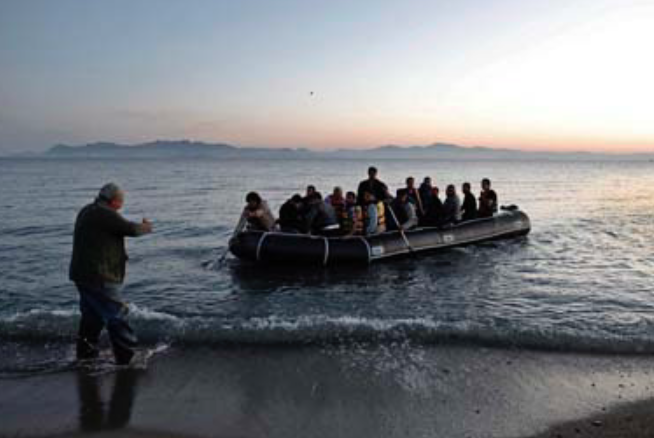
Syrian refugees in Greece
Christians played a significant role in the formulation of human rights charters and their subsequent incorporation into international and national legislative frameworks in the last century. It is vital that these are not put at risk through thoughtless rhetoric or ideological compulsion, or indeed from neglect.
A theology of migration is a way of speaking about the significance of the incarnation in light of the issues of contemporary society and the injustices of the current global economy. The incarnation has much to say about a God who crosses borders in order to forge new relationships and the challenge to all human beings to do the same. The Christian vision is that the whole earth belongs to God and that humanity has stewardship, not ownership of it. Lines drawn on maps dividing territory from territory are a consequence of human behaviour (or misbehaviour) and not of divine order.
A call for "open borders" has no traction in current migration debates but the Christian dream and long-term desire for universality should inform our challenge to the hard-hearted character of the current discussion/propaganda/and in many cases misinformation. A theology of migration seeks to foster human dignity in the poor and vulnerable, to challenge any structures and systems of society that divide and dehumanise and to uplift all efforts to build a more just and humane world. Reducing people to their legal or political status not only denies dignity to those in need but also dehumanises those who have the opportunity to help. I think this is what can happen to staff at Lunar House in Croydon, at other Home Office Centres and at the Immigration Detention Centres.
A theology of migration seeks to understand what it means to take on the mind and heart of Christ in light of the plight of today's refugees. Hopefully Christians begin with the vision of a society where all are truly valued, and to ensure our politics becomes a politics of hope and not a pessimistic retreat into xenophobia and finding someone on the edges to blame. It is also our task to ensure that we become a country rooted in both justice and compassion for the most vulnerable and exploited of our citizens.
To conclude with hope: There are many people and organisations working courageously and creatively on behalf of refugees and those seeking asylum. Their experience and dedication are significant force for good and illustrate what can be achieved – particularly when working together.
I will finish with a quote from Elie Wiesel (Jewish-American Professor and political activist) from his experiences of Auschwitz: "If I see a person or persons suffer and the distance between us does not shrink then my place is not good, not enviable."
Barbara Hungin is Chair of the Justice and Peace Commission of the Middlesbrough Diocese. This article is based on a talk she gave to the Manchester and North Cheshire Circle in May 2016.