Pope Francis published his response to the recent Synod on Marriage and the Family. Fr Martin Clayton situates his response within the context of an evolving body of magisterial teaching, asking: Is the Church's teaching on marriage changing?
Earlier this year, Pope Francis published his response to the work of the recent Synod on Marriage and the Family. In this paper I aim to situate his response within the context of an evolving body of magisterial teaching. Of course, the Synod's agenda was wider than points of doctrine. Francis had invited the Church to reflect on the vocation and mission of the family in today's world. Yet it was almost inevitable that the big question became, "Will there be any change in the Church's teaching?" Popular interest, fuelled by the media, homed in on this. Some voices called for change in response to new situations and insights; others rejected even the possibility of change. Battle lines were drawn up within the Synod itself. My own conviction was that we had to go beyond polarised mindsets and entrenched positions. Otherwise, whatever the outcome, we would have a "synod of winners and losers": a wasted opportunity, and pastorally unhelpful. At the same time, the question of change is an important one. It deserves to be addressed in the light of the Synod's discussions and the Pope's post-synodal document. Is the Church's teaching on marriage changing? Did the Synod open a door to change? If so, how, and in what directions?
Doctrinal change
Perhaps we should glance at a more basic issue first. Can Catholic doctrine change? This was the question John Henry Newman faced as he found himself drawn towards Rome. The Roman Church claimed to be the faithful custodian of an unchanging "deposit of faith". Newman was increasingly convinced by this claim. His intellectual integrity demanded that he must reconcile his conviction with the stubborn fact of historical variation in the Church's teaching, practice and worship. He needed to demonstrate – to himself, first of all – that there was nothing incoherent about Catholicism's claim to preserve intact the changeless and unchangeable truth, revealed by God in Jesus Christ, and committed to the church of the apostles. A comparison with the growth of living organisms led Newman to formulate his hypothesis of doctrinal development, with its seven "notes" or rules-of-thumb by which the authenticity of any specific reconfiguration of the original "deposit" could be judged.
His famous statement that "a great idea … changes … in order to remain the same" sums up the paradox of continuity-within-change1. Newman did not see his Essay on Development as a definitive response to what is undoubtedly a profound theological issue. However, Vatican II endorsed his insights in its document on Divine Revelation. Doctrinal development is rooted in the truth that "God, who spoke in the past, continues to converse with the spouse of his beloved Son"2.
Newman's analogy with living organisms is fortunate. It corrects a static understanding of revelation and tradition. By the time of his conversion the "deposit of faith" had been effectively reduced to a collection of magisterial statements, while "tradition" was little more than verbal repetition of formulae. The New Testament suggests a more vital and dynamic approach, centred less on "truths", more on "the truth". The object of Christian faith is fundamentally the living person of Jesus Christ. The majestic opening of the Letter to the Hebrews speaks of him as the "ex-pression" into creation, and the "im-pression" within creation, of the Father's reality as God3. And so Vatican II asserts that, in Jesus Christ, God "fully reveals and communicates both himself and the eternal decrees of his will concerning the salvation of humankind"4. And at the same time – again in the words of the Council – Christ, precisely as the Incarnate Word, "fully reveals humanity to itself, and brings to light our vocation as human persons"5.
Jesus Christ is "the same yesterday, today, and for ever" (Hebr 13:8). After Pentecost, the life, the ministry and teaching, and especially the redemptive death and exaltation of Christ, along with the implications of this for a new way of living, form the kerygma, the content of the apostolic preaching, which finds normative expression in the New Testament. The apostles and their successors were servants of the truth entrusted to them: their task was to present it in its integrity. But fidelity to this ministry could not be reduced to a mere repetition of words. The gospel had to be proclaimed within a variety of new cultural contexts, each with fresh challenges and opportunities. Certain implications of the kerygma took on greater urgency, while others receded into the background.
Preaching itself yielded new insights into the one unchanging message. The Church's turning to the Gentile world was a particularly decisive step: it demanded a re-shaping of the kerygma. But while Paul, the great "apostle to the Gentiles", can speak about "his" gospel, he went to great lengths to assure himself, and his hearers, that his own preaching in this new context was fully consonant with apostolic teaching. Even before writing his Essay, Newman was aware that within the New Testament itself there was development of doctrine6. He was able to satisfy himself that this same journey of organic development had continued in the Church, guided by the Holy Spirit who worked especially, though not exclusively, through those officially entrusted with the "deposit of faith".
Christian Marriage: an evolving theology
Across the centuries, the Church's understanding of marriage has been subject to change within continuity. Marriage possesses an unchanging and normative "profile", rooted in the teaching of scripture7.
1. Marriage is grounded in God's creative design. It is one of his "original blessings". The God-given mutual attraction between men and women leads to the formation of unique human relationships: mutual, exclusive, stable, sexual and fruitful.
2. Marriage has a sacred, symbolic capacity. Under the Old Covenant it was capable of signifying God's union with his chosen people. The Christian dispensation reveals marriage as an image of the bond between Christ and his Church, and a means by which Christ's salvation is realised in and through the Church. It is both a gift, and – in its fully Christian perspective – a particular vocation determined by the pattern of Christ's self-sacrificial love.
3. As a reality of this world, however, marriage has a precarious aspect: it is subject to the effects of human limitation, weakness and sin.
4. The New Testament sets marriage against the horizon of God's Kingdom. For all its goodness and its symbolic potential, marriage is not an "absolute" value: it stands alongside other ways of realising the Kingdom and, in the individual case, it may be renounced in favour of an alternative path.
These perspectives, received from the apostolic Church, were taken up by the great theologians and preachers of the 3rd to the 6th centuries. It was an exciting and fruitful time for the shaping of Christian doctrine, and those who did the shaping used the cultural and intellectual resources available to them. The influence of contemporary philosophies, however, led to an ambivalent attitude towards marriage. In the West especially, Augustine's teaching was to colour the Church's approach for many centuries to come. For Augustine, the sexual aspect of marriage was an insurmountable obstacle. Physical sexuality belonged to the animal domain. Moreover it was deeply wounded by sin, and so human sexual activity was tainted. It could be "justified" only by God's plan for the human race to continue through his institution of marriage.
Given the witness of scripture and apostolic tradition Augustine could scarcely deny that marriage had a sacred character. Yet it was sacred, thanks to the three "good things" that redeemed it: mutual fidelity, the loving acceptance of children, and what Augustine termed the sacramentum, the unbreakable bond established by God. Positively, the teaching of Augustine and others served as a bulwark to the basic values and goodness of marriage across succeeding centuries. Also, it laid the foundation for a more developed understanding of marriage as a sacrament in our modern sense of the word. Yet a serious "de-formation" of the original biblical perspectives had been introduced into the Church's thinking about marriage8.
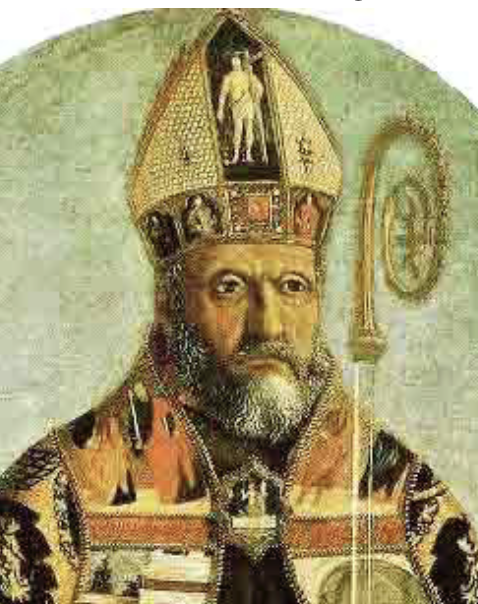
St Augustine
The 10th to the 13th centuries saw the development of Canon Law. The received teaching on marriage became crystallised within a predominantly legal framework. Marriage would now be understood primarily in juridical terms. The nuptial union was rooted in a mutual bestowal of rights and a mutual acceptance of duties, and it was brought into being by a contractual act. Given the prevalent view that marriage's primary purpose was to "legitimise" sexual activity in order to conceive children, the essential object of the marital contract had to be the exclusive right of each spouse over the other, to engage in "acts ordered towards generation".
The remaining Augustinian "goods" were secondary: fidelity and permanence ensured the social setting needed to rear and educate children. Canon Law would play an important role in safeguarding certain aspects of marriage, ensuring the right and freedom to marry, and responding (within its juridical limits) to marital breakdown. But an evaluation of marriage in legal categories alone fails to embrace its full reality.
A changing perspective: the centrality of the nuptial relationship
It is against this background that we ask, "Is the Church's teaching on marriage changing today?" In taking Pope Francis' recent Apostolic Exhortation as a springboard for reflection I must emphasise that my intention is not to undertake a detailed analysis of the document, or even a general presentation, but to situate the Pope's teaching within the context of a changing approach to marriage.
Francis draws heavily on the magisterium of his recent predecessors, and on the teaching of Vatican II. It is a body of doctrine that had begun to emerge and unfold only in relatively recent times, under the influence of numerous pressures. Among these were the seismic upheavals that shook much of Western society during the 19th and 20th centuries. The rapid expansion of industrialisation, the birth of new economic systems, political turmoil, the trauma of war on an unprecedented scale, and the emergence of new social and cultural patterns, presented huge challenges to the traditional architecture of marriage and the family. New ways of thinking called into question the institutional-legal mindset through which the Church's teaching had long been filtered. The Church itself had begun a process of "returning to the sources", rediscovering its roots in scripture, and re-evaluating the ways it had interpreted and presented its traditions. All this impacted on the Church's classical understanding of Christian marriage.
Two significant themes have emerged. Firstly, a growing affirmation of conjugal and familial love, in all its aspects, as central to the reality of marriage; and together with this, an evaluation of marriage in specifically human-personal terms, with all that this implies. These developments have begun to provide a new way for the Church to present the truth, goodness and beauty of Christian marriage9.
The opening words of Pope Francis' Apostolic Exhortation are Amoris Laetitia: "The Joy of Love". His point of departure is not an abstract principle but a human experience. At the very outset he indicates the approach he will adopt: he will look at marriage through the prism of conjugal and familial love, rather than from a predominantly institutional-legal stance. It is a shift of emphasis that had been emerging, slowly and hesitantly, from the time of Pope Leo XIII. Sometimes considered the first of the "modern" popes Leo was deeply concerned about the Church's mission in a changing world. His famous 1891 encyclical Rerum Novarum laid the foundation for what we know as Catholic Social Teaching.
Less well-known is his encyclical Arcanum Divinae Sapientiae. Issued in 1880 it was the first papal encyclical on marriage, and it too became the catalyst for a developing body of Church teaching. Leo acknowledged a fact of human experience: conjugal love, rooted in God's love, is at the heart of married life10. The magisterium of Pius XI and Pius XII endorsed this truth. But the official definition of marriage remained on the contractual-institutional level. The relationship of nuptial love was not seen as intrinsic to the purpose of marriage11. Influenced by personalist philosophies during the inter-war years a number of theologians were pressing for a new perspective. They understood marriage less in legal-social terms – as an institution governed by particular purposes – and more in terms of an interpersonal relationship. Love was not merely a desirable, even a necessary quality,
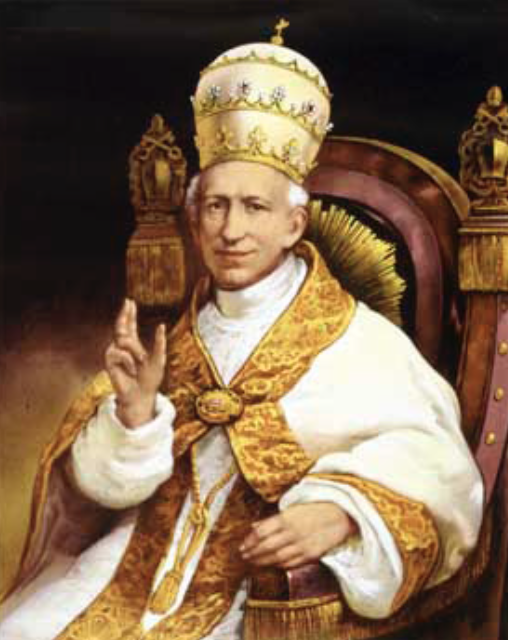
Pope Leo XIII
"added" to marriage. Rather, the exclusive and fruitful self-gift of each spouse to the other was the very essence and meaning of marriage12. The Church's official response was initially unfavourable13. Yet the "newer" approach to marriage remained a powerful undercurrent. It infiltrated the thought of Pius XII14 and, finally, it was explicitly embraced at the Second Vatican Council.
In contrast with the "classical" approach, the Council's Pastoral Constitution Gaudium et Spes addressed marriage in a way that was more deeply personal, more truly theological and more richly experiential. The contractual and institutional aspects are affirmed, certainly. But for its description of marriage the Council adopted the more biblical term foedus, "covenant". And the nuptial covenant is precisely one of interpersonal love (48*). The very essence of the married state is "an intimate communion of life and conjugal love" which "finds its source in divine charity itself", and is "patterned on Christ's own union with the Church" (48*). Further, this love – precisely as conjugal – is "uniquely expressed and perfected" by sexual union (49*). For Christians, the symbolic character of marriage takes on sacramental value: it is "caught up into divine love, and is directed and enriched by the redemptive power of Christ and the salvific action of the Church, in such a way that the spouses are effectively led to God" (48*).
Did Vatican II change Church teaching? On one level, certainly it did. Building on the magisterium of previous decades the Council found a new way of speaking about unchanging truth, and corrected inadequacies that had coloured the Church's teaching for centuries. The Council affirmed the nuptial relationship as primary and constitutive. It is the relationship that receives the status of a legal contract. It is the relationship that is given a particular institutional shape within the structures of society and the Church. It is the relationship – including its sexual dimension – that is sacramental.
Doctrinal tensions: "historical consciousness"
Gaudium et Spes is the contemporary Church's magna carta for marriage. The post-Conciliar popes adopted and developed its stance15. Within this continuity, however, tensions have surfaced. Aspects of magisterial teaching appear – to some, at least – to be not fully consistent with the Council's approach. Certain Roman declarations have been likewise criticised. Those who detect ambiguities cannot always be accused of irresponsible dissent or failure to respect the magisterium.
The root of this situation is, I believe, a tension unresolved by the Council itself: the tension between ideal and reality. It is a tension inherent in moral reflection. For all its goodness, beauty and theological depth – so powerfully highlighted by the Council – marriage is a fragile reality. It is subject to human limitation, particularly in our contemporary Western culture. It is easily damaged by failure and sin. Tragically, marital relationships sometimes collapse. The Council was acutely aware of this, yet its treatment of marriage did not address the reality of "human shortfall" beyond affirming the Church's responsibility to "guide and encourage" all who try to "preserve and foster the dignity and sacred value" of marriage16. There is a timeless element in the Council's presentation of the lofty ideal of marriage.
Drawing on the conciliar and post-conciliar magisterium, Francis reaffirms and repeats, without compromise, the normative truths about marriage. But he informs his teaching with greater "historical" awareness. Philosophers such as Martin Heidegger recognised "time" as an essential dimension of what it means to live in this world. Human reality is more than a static "fact": it is also a "project" under construction. Every situation has an element of uniqueness, forming a point of transition between a past and a future; such perspectives accord well with the scriptural vision of life as a pilgrimage.
The biblical notion of "signs of the times" – strongly embraced in fact, by Vatican II – also finds its place here. The Christian "project" requires a constant discernment of what must be done here and now to respond to God's saving purpose which is realised precisely within time and history17. Pope St John-Paul II had already referred to a "law of gradualness"18. Francis gives it a more central place in his teaching. Life is a journey through stages of growth and personal decisions: the response to the claim of what is good and true unfolds within time.
For Francis the "law of gradualness" also suggests that an individual may not always be able to internalise, adequately evaluate, or fully carry out an objective demand in the here-and-now. While acknowledging this, he is careful to repeat John-Paul's warning: "gradualness" does not mean "gradualness of law", as if objective moral truth could sometimes cease to exert a normative claim, or could be disregarded on occasions. But he does insist that the Church must embrace people where they are.
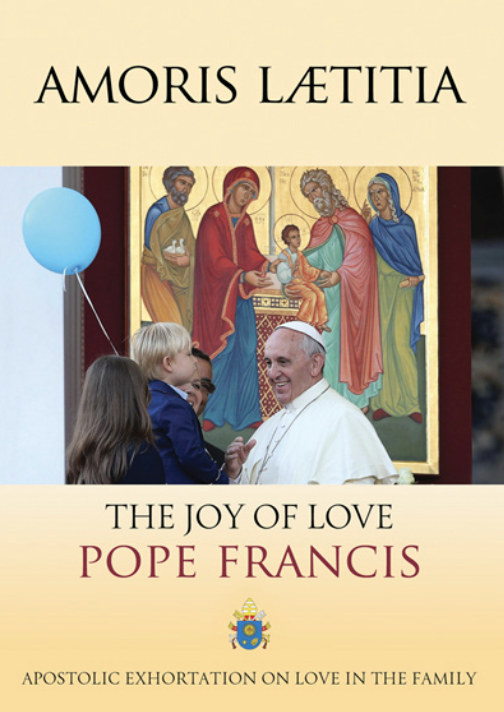
Amoris Laetitia – The Joy of Love, Pope Francis
A pastoral direction
In this way, Amoris laetitia adopts a predominantly pastoral approach, an approach that may be summed up in the two words the Jesuit Pope often uses: accompaniment and discernment.
In search of this "more", Francis looks in two directions. Firstly he insists on the Church's duty to be far-reaching and pro-active in promoting and supporting the values of marriage. He asks that particular attention be shown to those preparing for marriage, as well as to married couples and their families at every stage and in all circumstances of life, especially in times of difficulty and crisis. Secondly, Francis insists that the Church must effectively embrace those whose situations are objectively outside God's design for marriage, including the divorced, and those in second unions after divorce19. Here, the Pope's language differs somewhat from that of his immediate predecessors.
He seems aware of this, and he repeats that the Church must in no way draw back from its primary task of presenting the full truth about marriage. Yet he clearly asks the Church to move away from a one-sided reliance on objective precepts alone. Typically he wants us to look at people through the eyes of God's mercy. He favours a process of discernment within the complexity of "unlawful" situations – not all of which are identical, as John-Paul II and Benedict XVI have already acknowledged. Francis admits that there are those who would favour a more rigorous pastoral approach, with less room for confusion. In fact, he draws on traditional principles found in the moral theology of Thomas Aquinas and Alphonsus. To show understanding in the face of exceptional circumstances need not imply a denial of objective demands; and it can happen that, in particular situations of objective wrong, no grave personal fault exists.
Undeniably, he is open to the possibility of change in certain areas of pastoral practice. This is especially so with regard to the divorced-and-remarried, whose current situation as a specific group within the ecclesial community is rather anomalous, even though the recent magisterium has significantly distanced itself from the condemnatory stance of earlier times.
The divorced-and-remarried are "in good standing": far from being excluded from the Church's life, they are invited to share in its activities and mission. Although objectively in disharmony with the full significance of marriage their state may not, necessarily and in every case, radically contradict it in all respects. Separation may not always be the right solution; and where this is so, a couple should not be denied the companionship of a shared life. But in this case they must make a choice: they must abstain either from a fully sexual relationship, or from reception of the Eucharist.
John-Paul II had already spoken of the need for a careful discernment of individual situations, and had insisted that the divorced-and-remarried receive special pastoral care. But he re-affirmed current discipline without suggesting what this might mean in practice20. My impression is that Francis sees here a state of doctrinal and pastoral tension that calls for resolution, in a way that may open new doors in particular cases, without rejecting the truth of the intrinsic permanence of the nuptial relationship as affirmed in scripture and tradition. To expand this further would be outside the scope of this paper.
Is Church teaching changing?
Is the Church's teaching on marriage changing? I have attempted to show that there has indeed been change, in Newman's sense: change-within-continuity, and change to ensure continuity. I believe Pope Francis' teaching engages positively with this continuity, and will enable the Church to put itself even more fully at the service of marriage in today's world. It also opens the way towards further honest and open discernment, on the level of doctrinal and moral theology, church law, and pastoral practice, under the guidance of the Holy Spirit through whom "the Father continues to converse with the spouse of his beloved Son".
This is an edited version of a talk to the Manchester and North Cheshire Circle in June 2016. Fr Martin Clayton is Parish Priest of Our Lady of the Sorrows, Bamford, Derbyshire.
NOTES
* Paragraph numbers in Gaudium et Spes.
- J H NEWMAN, Essay on the Development of Christian Doctrine, Ch I, Sect I,7. The same paragraph concludes with the often-quoted statement that "… here below, to live is to change, and to be perfect is to have changed often."
- VATICAN II, Dei Verbum 8.
- Hebr 1:1-3. Christ is described in terms of the effulgence (apaugasma, the radiance flowing out from a source of light) of God's glory, and the image (charakter, the exact impression made by a seal in clay or wax) of God's very reality (hypostasis). What God essentially IS is made visible in Christ: to see Christ is to see what the Father is like. "To have seen me is to have seen the Father" (Jn 14:9).
- VATICAN II, Dei Verbum, 6.
- VATICAN II, Gaudium et Spes, 22.
- J H NEWMAN, University Sermons 15.
- See Catechism of the Catholic Church, 1602-1620.
- For a summary of Augustine's influence see J MAHONEY, The Making of Moral Theology, pp 37-71, esp. pp 58-68.
- See L ÖRSY, Marriage in Church Law, pp 13-37 for a concise overview (to 1983) of doctrine and legislation, precisely from the viewpoint of change and development.
- NEUNER-DUPUIS, The Christian Faith, #1820.
- In Casti Connubii (1930) PIUS XI drew on the Tridentine Roman Catechism to speak of the nuptial union as the "primary cause and reason" of marriage – but, he insisted, this was true of marriage only "in its wider sense" as an intimate life partnership, not "in its stricter sense" as an institution destined for the procreation and education of children. NEUNER-DUPUIS, #1829.
- The German theologian (and professor of moral theology at the University of Wroclaw) Herbert DOMS is worthy of special note. In Vom Zweck und Sinn der Ehe (1935) he argued that marriage is first and foremost an interpersonal relationship. The reality of marriage can be adequately understood only when its institutional purpose (Zweck) is seen as rooted in its personal meaning (Sinn) for the spouses themselves. (It may be asked if Doms was not also reacting against Nazi ideology, with its insistence on the overriding duty of married couples to populate the Third Reich.)
- PIUS XII (Address to the Roman Rota, October 1941) and the CONGREGATION OF THE HOLY OFFICE (Decree de finibus matrimonii, March 1944) upheld the "classical" stance by insisting that the fostering of conjugal love was essentially subordinate to the procreative aspect of marriage. Institutional purpose was prior to personal meaning.
- The magisterium of Pius XII reveals a growing doctrinal ambiguity. For example, his cautious acceptance of the Ogino-Knaus "rhythm method" of avoiding conception implicitly questioned the classical subordination of nuptial love, in its sexual expression, to a solely procreative purpose. (Allocution to Italian Midwives Vegliare con sollecitudine, October 1951) Developing the thought of his predecessor, Pius XII often referred to the nobility of nuptial love, including its power to transcend even the limitations of mortality.
- In his encyclical Humanae Vitae (1968) PAUL VI affirmed the intrinsic unity of the relational and fruitful dimensions of nuptial love. JOHN-PAUL II embraced the conciliar approach throughout his apostolic exhortation Familiaris Consortio (1980) and in a series of weekly catechesis. In his encyclical Deus Caritas Est (2005) BENEDICT XVI spoke in a remarkable way about the "human and divine promise" inherent in human eros as it directs man and woman towards the unique and definitive bond of marriage, and so fulfils its own deepest purpose.
- VATICAN II, Gaudium et Spes 47.
- St Paul adopted the term dokimazein, implying "assessment", "approval of worth", to speak of grace-filled discernment in the Christian moral life. A key text is Rom 12:2. His response to various questions in I Cor 8 and 9 are examples of such discernment. In continuity with this theme is the rich but often overlooked teaching of St Thomas Aquinas on prudentia (the right use of reason in practical matters) informed by the Spirit's gift of counsel, which enables believers to plan, judge and decide upon actions in keeping with God's will.
- JOHN-PAUL II, Familiaris Consortio, 34, to which Francis refers in Amoris Laetitia 293-295.
- In what follows I refer particularly to Ch 8 of Amoris Laetitia, which Francis devotes to "accompanying", "discerning" and "integrating" imperfection and weakness.
- JOHN-PAUL II, Familiaris Consortio, 84. In 2007 BENEDICT XVI re-affirmed this teaching in Sacramentum Caritatis 29.