In this London Newman Lecture, Frank Field MP traces how life chances are determined before children reach school, arguing for investment in the 'foundation years' from womb to reception class — and sounding the alarm on a return to destitution.
London Newman Lecture – March 2nd, 2017
I'm going to talk to you about from poverty to life chances – and back again, to destitution. And it is back again to part of my life experience, as I had ten years working for the Child Poverty Action Group. The journey that I want to describe to you tonight is from a society in which it was pre-ordained where we should be, and nothing much would change that, to the political campaigns and the institutional changes of the last century, and to what we now actually know about where and how life chances are actually determined.
It is partly, of course, about the movement from thinking that class determines people's life chances, and what we now know about the brain, and the very simple things the Church teaches about the nurturing of children, about the life chances which can actually develop from that activity, which is more powerful than the role that class or income play. In doing so, I am putting forward a view that probably all of you hold, and that is that schools are the key to determining life chances. You have all contributed, I am sure, massively to Catholic schools, and have thought that this support was going to change the life chances of Catholic pupils.
But although I do not wish you to cease contributing to Catholic schools, you must do it for other reasons. The research shows that life chances are determined before children come to school. Schools do not close the difference in life chances that can be measured against class. The report that I did for Prime Minister Cameron in 2010, when he was anxious to report within a matter of months, looked at whether there were forces greater than life chances in determining outcomes. Indeed, what the Prime Minister wanted me to do was to help him shock, and to enhance the traditional data on poverty, which is indeed inadequate. I refused, however, to do the report that he wanted. The report was published in 2010 on the children who had become poor adults and the conclusion was that if we really wanted to do something about that problem we had to start with the period when the child is nurtured in the womb until the time when the child actually goes to school.
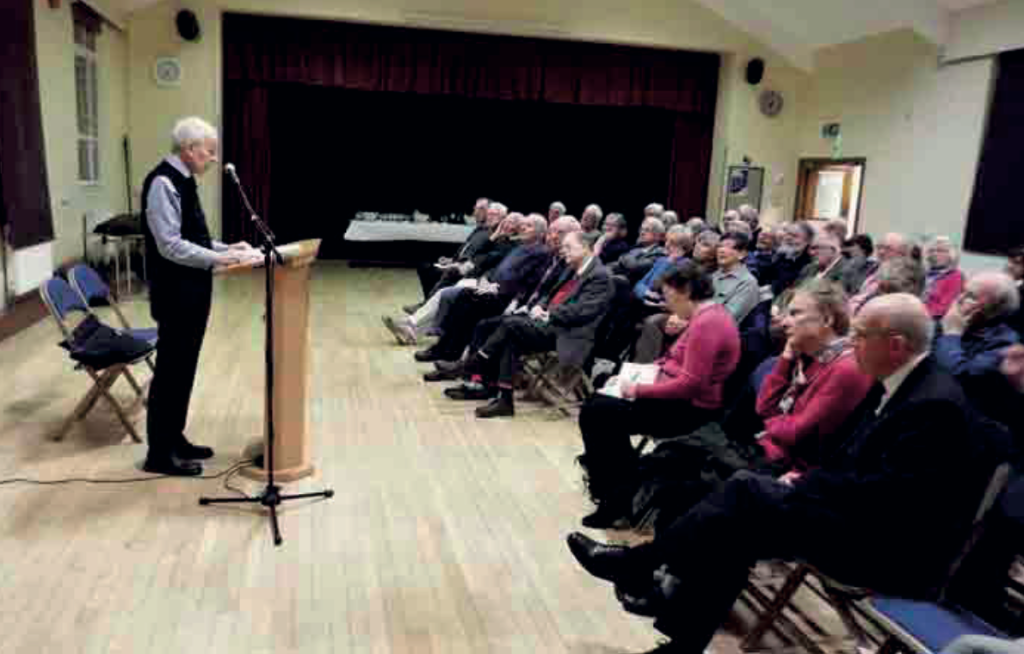
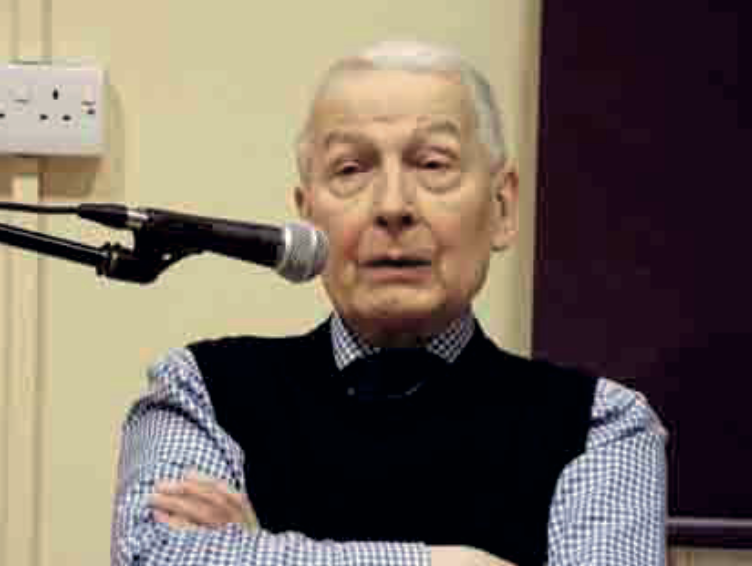
Frank Field addressing Newman members in the Loyola Hall, Heythrop College
It was very interesting, before I read the research, to find that all the reception teachers that I spoke to said that they could prophesy which girl was going to become head girl, and some were even brave enough to predict which girl would end up going to prison. They all knew that they could judge the life chances of their children in the very early stages of their school careers: who was in fact going to succeed, and who was not. That was the practical background, from the people who taught the children in their first year.
I then read one article in particular by a guy called Leon Feinstein in a magazine called Economica. He had looked at some 1970 data on all the babies born in a particular week of that year. He followed them through. What Leon was interested in was the data on the children as they entered school, and whether it was possible to work out from that data where children finally arrived in the labour market. This approach is based on what I call the foundation years.
In some ways this article gave the intellectual grist to what many people were able to predict: that while one could try to improve the standards of the individual children you couldn't widen the gap much once they were in school. In fact the data showed that, far from narrowing, the gap in attainment widened in school. That is not to say that schools are not good for all sorts of social reasons but they don't achieve the objectives of widening the life chances. Perhaps if we ever get a critical number of very, very good schools we will find that schools can be powerful enough to begin to make a difference after the age of five; but we have yet actually to see that.
The report to the Prime Minister, though, looked at why the first year in the womb is the key one: is it simply a question of social class, or are there other drivers which are more important than class itself? We asked Bristol University to look at whether there could be various correlations, and whether from a whole range of correlations one could actually show that, by holding various aspects of the data constant, there were drivers? And were there drivers that we could intervene in?
There were three factors that were crucially important in influencing the life chances of the very poorest in this country. Firstly, we would be massively concerned with the mental health of the mother – because of her relationship with herself, but also because of her relationship with her baby. Because the second driving force is bonding, how well the mother bonds with the child. The stronger that bond is, the more important it is in denying the role of class in determining the outcome of the child's life. And thirdly, to use a middle class, Guardian-type phrase, there is the learning environment: I think all of us all know the importance of reading to children and, in the same way, developing their skills in cognitive and social aspects.
Also, we asked Cambridge University to work with reception teachers and heads in Wirral in working out how we could measure life chances: who is going to do well and who's not, and at what point can we actually intervene? How can we intervene, to affect what we know is going to be a terrible outcome? And they went with a whole list of measurements from largely – but not totally – Birkenhead-dominated teachers' groups. It was questions about infants being potty-trained, knowing their own names, not having a dummy, being able to sit down and be still, not using a pencil to stab but knowing it can actually be used for drawing. These are very basic things, but basically in this country a very large group is falling out of love with being parents, and the skills of parenting are being lost. If you have been dragged up by a mother and somehow survived, how on earth should you know what the process is for good parenting? They built up a score of indicators in the reception class which worked out who were raising toddlers successfully. One of the interesting things for me, though, was that we wanted to see whether the same sets of indicators worked where there were black British as well as white British – and in Northern Ireland, too. The outcome was that the indicators worked as well whatever the circumstances were.
But we found, firstly in Birkenhead, but then elsewhere, that there was, however, a group of children who on many of these indicators entered school in the most disadvantaged group yet were actually reported to be on a par with the richest children. When Cambridge dug down into these data we found that practically all these children reported having fun. So in place of the home-learning environment children were telling us about having fun in the home.
Now it may be that these were the children who – partly because of the nature of the fun that they had – were able to describe it, whereas other children had fun but were unable to describe it. We are chasing that analysis to see where it leads. But it did leave us in the position that here was a real opportunity in 2010 with David Cameron; we were not asking for more money, but for an understanding of what we were spending on children in the womb and up to their first day in reception class – we should get on with it, but of course he never did. Then in the final weeks he began to worry about his legacy and I am sorry to say that Mrs May is not as interested as Cameron on two occasions said he was. So where this will go I do not know.
But there has been, in the last ten years, the beginning of a trend which is so much more remarkable and that is the problem of hunger. I still believe in spending money on life chances but I also believe that we need to run at the same time a campaign for money and resources and skills. I can provide witness in my own constituency of people being hungry. The food bank movement was at the great beginning of all this but it cannot be the end. Going into a food bank, which will be largely staffed by Christians, is a deeply depressing experience and if I was hungry and I had to go into a food bank it would add to my pain in my head rather than alleviating it, even though it might alleviate pains in my stomach.
It's not just a matter of culture, and the difficulty of paying big bills like heating and rent, and food. But it's now a question in my constituency of people who are actually suffering destitution. It's a most extraordinary indictment of our society that food is actually being wasted and only 2 per cent of surplus food which is being burnt or goes to landfill is being used to feed people who are hungry. We have to work out what should follow the food bank to make the whole system more effective and, above all, what increases the dignity of people using the service rather than adding to their misery. Food banks are only a temporary move and ought to be seen as such.
We ought to be looking at the longer-term issues because we haven't only got hunger, and destitution, in this country. It's now becoming prevalent in all Western economies. So something terrible has happened in the postwar period: once the weakest underbelly of society was protected in various ways but that underbelly is no longer protected. So while I have offered the Newman Association a lecture on From poverty to life chances we are now talking about going back again to destitution.
References
Inequality in the Early Cognitive Development of British Children in the 1970 Cohort, by Leon Feinstein, 2003 (Economica).
The Foundation Years: preventing poor children becoming poor adults, by Frank Field, 2010. Published by HM Government.
Frank Field on Newman and Manning
I remember going to Newman's Birmingham church, where he had his Order, and in those days I was allowed alone into his room. I remember looking into his wardrobe, opening his doors, seeing his cardinal's robe there, as though he would be expected back at any moment. In the 19th century there were two Anglicans who became Cardinals, Newman and Manning. And I know it is a mistake to play one off against the other, and that one should celebrate both of them; but if I had to choose one person of the two that I would wish to meet it would be – although this is perhaps not very appropriate for this evening – Manning: he built schools before he allowed churches to be built.
As for Newman, in my twenties I began to take an interest in the Tractarians and the power of this man's pen was extraordinary. It was a characteristic of this group that they could all write beautiful English. And Newman has grown in importance in different parts of the Church and I am so pleased that you continue to keep this memory alive of this quite extraordinary person, with real power with the pen in writing the most sublime English. When I was left alone in his room, with his books there, it was indeed an extraordinary experience.