A reflection on a personal ecumenical journey from Norfolk to Zambia to Liverpool, given to the Manchester and North Cheshire Newman Circle in June 2017.
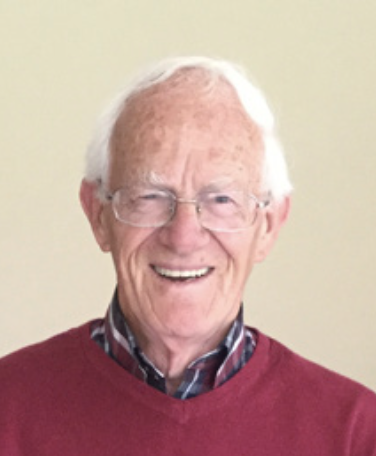
Rev Geoffrey Barnard, a retired Methodist minister, gave this talk to the Manchester and North Cheshire Circle in June 2017.
I was born in a Norfolk village in 1937 where there were two Methodist churches. That was five years after Methodist Union in 1932 between two branches of Methodism – Wesleyan and Primitive as they were called. One of the chapels was ex-Prim and one ex-Wesleyan. There were those who would have closed both and built again but attitudes were too entrenched and nothing happened. It was the "over my dead body syndrome" and that is exactly what happened! The ex-Wesleyan Methodist chapel was at the end of our street and I was sent to the Sunday school because going to the Parish church would have involved crossing a main road. There was a Catholic Chapel on the edge of the village but we knew nothing about that at all.
All of that fed into a reluctance, as I got older, to place too much importance on denominational loyalty. Often the church tradition we belong to is a matter of chance and our affection for that tradition is often born of familiarity and being comfortable in the worship and practices we have grown used to. I'm happy to be a Methodist but I wouldn't go to the stake for it. The opportunity to share with different kinds of Christians was limited given the kind of community ours was and, in my case, probably limited too because my family were not churchgoers.
A conscientious objector
Leaving home at 18, I began to open my eyes a little. I had been influenced by a local Quaker group that a friend had linked up with and that made me aware of, and drawn to, Pacifist convictions. I registered as a conscientious objector to National Service and eventually, after two tribunals, was allowed to work for two years in a Geriatric Hospital as alternative service. That brought me into contact with, and working alongside, Catholics from Ireland, Italy and France; though I would have to say it was sharing music and dancing at the International Club in Maidenhead more than theological debates and insights that added to my broader view of the world. I simply enjoyed meeting people from different backgrounds.
During that time I prepared for and moved on to theological training at the age of 20. The next four years didn't do much to broaden my outlook. I learned a little about Church history, which should have opened my eyes, but for the most part it was a Methodist diet I was fed and after four years I left our college in Leeds (since then it has been a Centre for the Little Sisters of the Poor and is now Hinsley Hall Conference Centre). I travelled almost immediately to Central Africa to work with our Methodist Missionary Society. It was there that things began to change.
Northern Rhodesia had many tribal languages, and the Protestant Missions had carved up the country between them. Our area was Methodist which only served to underline for me the denominational lottery that operated to determine which Christian label people had stamped on them. I was out in the bush and there was a Catholic Mission in the Province but I'm not sure of what Order – in N.R. there were Jesuits, White Fathers and Dominicans in different areas. Forty miles away there were Lutherans from the US and the Anglicans in the country were of the High Church tradition. The Universities Mission to Central Africa (UMCA) had been established many years earlier by Anglicans in the universities of Oxford, Cambridge, Durham and Dublin; it was firmly in the Anglo-Catholic tradition.
Vatican 2 was significant in leading to a thaw in relationships between Catholic and Protestant Missionary personnel and certainly I found lots of good colleagueship with Anglican and Catholic neighbours especially. By that time I had moved into a mining town called Kabwe (formerly known as Broken Hill) where lead and zinc were mined. (Kabwe featured in an article in The Guardian recently as the most polluted city in the world due to leakage into the water system, from lead and zinc slagheaps). There we made many friendships across the denominational lines.
Together we shared services, and celebrated the 50th anniversary of our local Anglican church with a visit from the great Bishop Trevor Huddleston, by then based in Tanzania. We participated in literacy and nutrition campaigns with the Cathedral in Lusaka and joined in religious broadcasting under the leadership of a White Father and a German Lutheran Pastor. In the local Catholic church I shared the celebration of a wedding with Father Pierre (a Canadian Jesuit) when Rosemary (a Canadian Catholic) married Johann (a Methodist from South Africa).
Father La Fontein, a Canadian priest, came to our home several times for coffee while he was being treated in our local hospital. He had contracted leprosy while working on his mission which had a Leprosarium as part of its work. And of course the great difference came for us when we sank our separate Methodist identity with the creation of the United Church of Zambia in 1965. Essentially the UCZ came about as a result of the priority given to mission outreach and pastoral care.
A dilemma for the missions
Let me explain. As I have said, Zambia had been divided up between the missions by language areas. Then in the 1920s copper was discovered and exploited and copper mines and towns developed in a specific area which became known as The Copper Belt. African workers moved in from all over the country – many bringing their Bibles and hymn books with them. What were the missions to do? Were we each to follow our own flock and set up a church OR to work together in a united enterprise? Some Protestant churches chose the latter and were helped enormously by those who joined them from The United Church of Canada who shared their own experience of coming together across denominational boundaries. The United Church had been formed in Canada in 1925 through the merger of four Protestant denominations. So I went to Africa a Methodist and came back a Methodist with an ecumenical coating that has never left me.
I have to say that love of an ecumenical environment was enhanced by marrying a Northern Ireland Protestant whose family was scarred by the intransigence of her mother's Catholic family disowning her for marrying a Protestant. In our own experience we often feel the blight of denominational prejudice. Thank goodness that has diminished to some degree! And I can add that my brother joined us in Kabwe to teach in a government school; he met and married an Irish Catholic nurse and Father Pierre conducted the wedding service.
A divided city
But to move on: we returned from Zambia to the city of Liverpool and to Methodism. Liverpool had been for a long time a divided city – divided between Catholics and Protestants, between Evertonians and Liverpudlians. But two important players took to the field. No not at Goodison or Anfield but in the two cathedrals.
As the Spinners used to sing:
In our Liverpool home,
In our Liverpool home,
We meet under a statue exceedingly bare;
If you want a cathedral we've got one to spare,
In our Liverpool home.
Those two important players were Archbishop Derek Warlock and Bishop David Shepherd and their extraordinary friendship, and respect for each other, spoke to the people much more tellingly than any amount of sermons. They changed the climate in the city and we, like many others, benefited from that. We enjoyed warm ecumenical relationships and we worked together on projects like bringing children from Belfast for respite holidays. Marcea was born….she was The Merseyside and Region Churches Ecumenical Assembly. And that atmosphere of friendship and cooperation has lasted for many years.
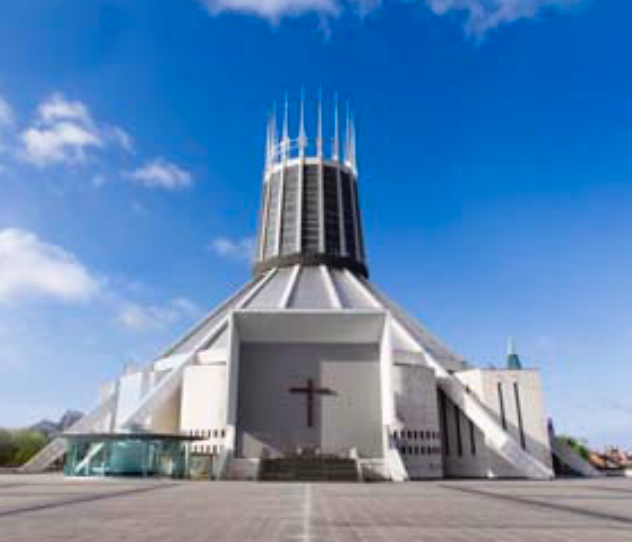
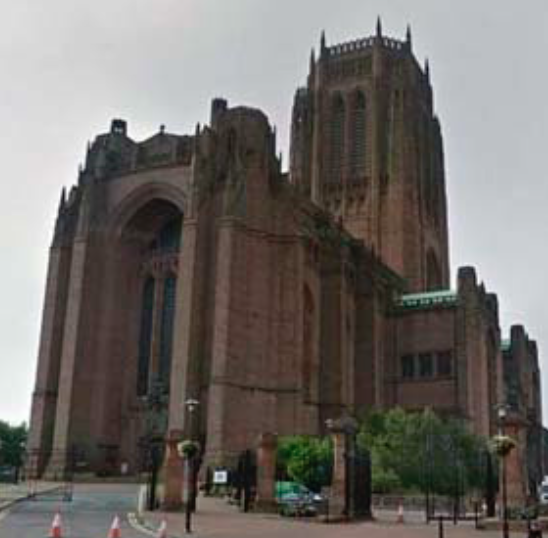
Catholic Cathedral of Christ the King and Anglican Cathedral of Liverpool
(In a lovely moment a few years ago we met Bishop Tom Williams, the Catholic Auxiliary of Liverpool. He was officiating at my grand-daughter's confirmation in Formby where I had been the Methodist Minister for 11 years and where I enjoyed warm friendships with Catholic and Anglican colleagues. Tom Williams had often visited our home in South Liverpool when he was a curate at St Francis of Assisi parish in Garston. My daughter is currently the Head of St Jerome's Catholic primary school in Formby and she and her family have joined the Catholic Church.)
A return to Africa
In 1976 we went back to Africa to work with those who were tackling a different aspect of ecumenism because that word, from the Greek oikumene, has to do with the whole created world and involves us in the healing of the natural and political worlds as well. We went to work in a school to be involved in multi-racial education as opposed to the segregated form of education being imposed in South Africa at that time. Denominational loyalties were much lower on our scale of values.
When we returned to Merseyside we found the ecumenical atmosphere alive and well. I enjoyed a pulpit exchange on a monthly basis with the local vicar and Catholic priest. We worked with St Jerome's church for bringing Catholic and Protestant youngsters from Belfast every year and that continued for over 25 years. Our house fellowship had Catholic and Anglican members (it had sprung out of a Lenten group and the mixed gathering wanted it to be more than a one-off).
Those Merseyside experiences underlined two important aspects of our ecumenical journey – the importance of leadership and the expression of that in friendships as seen in the Warlock/Shepherd relationship and the importance of translating that into shared activity on the ground in house groups, joint activities and shared worship.
Building bridges
I acknowledge that I have been fortunate. My last appointment was to the ecumenical chaplaincy in Manchester where I was Free Church chaplain supported by our three Free Church denominations. Then, in retirement, I was able to work in the Corrymeela Community in Northern Ireland enjoying relationships with colleagues from Presbyterian, Methodist, Catholic, Anglican and Baptist traditions. There was a common calling – to heal divisions and build bridges between the faiths so that people could enjoy that "life in all its fullness" that Jesus came to bring.
I think I've said enough but I must finish by saying how much I have enjoyed coming to this Newman Circle. Your emphasis on exploring faith issues and being open to new thought is what attracts me to your meetings. Thank you, and may your exploration long continue.