A reflection on Eucharistic traditions from a mystical perspective, delivered to the Edinburgh Newman Circle in March 2017 by Rev Scott McKenna, a Church of Scotland minister.
Scott McKenna is a Church of Scotland minister at Mayfield Salisbury Parish in Edinburgh.
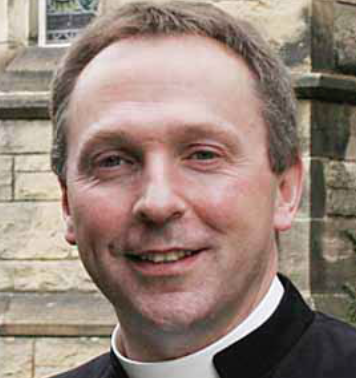
I am delighted to address the Newman Association tonight: thank you for your invitation. I am delighted because it is good and right that Christians from across denominations engage, share and co-operate with one another to the greatest extent possible. I am delighted because I already know some members of the Association and have a true and warm affection and respect for them. It says a good deal about this local Association that a minister of the Kirk is asked to offer a reflection on Eucharistic Traditions: the Eucharist, the Mass, the Sacrament of Holy Communion or the Liturgy of the Upper Room.
I have here a number of artefacts which we use at Mayfield Salisbury at our Services of Holy Communion and which have come down to us from one of the many churches which make up our history. I have also placed here a selection of Communion tokens. In the past, though not nowadays, members of the Church of Scotland required a tiny token before they were permitted to receive the Sacrament. In faith, our forebears sought to honour and protect the Sacrament: the fear that the Sacrament might be cheapened or sacrilegiously polluted by people who were unworthy to receive the Body and Blood of Christ was very real: only the worthy, the truly penitent and the morally upright were awarded a token!
There is a story from the late 18th century that a Kirk Session in the Highlands decided to hold a Service of Holy Communion. Before it could do so, the Elders needed to satisfy themselves that the people of the parish were worthy to receive the Elements. It took several visits to church members over a period of eighteen months before finally the people were deemed good enough. In part, the visiting Elders needed to assure themselves that the people knew their Bible and key articles of the Protestant Faith. As far as I know, the Elders at Mayfield Salisbury no longer catechise our members!
No more Communion tokens
In time, Communion tokens have given way to Communion Cards but today in many churches in the Church of Scotland, including this one, cards too are outmoded.
It is extraordinarily painful to most, if not all, Christians that our respective institutions lack the desire, imagination or love to scale the heights of Eucharistic doctrinal walls built centuries ago. I hope you do not feel that this is a simplistic statement but, in my view, if we the Christian churches loved one another enough, we would have found a way forward together by now. Until our peoples cry out for change, it will not happen. We are unlikely to resolve the doctrinal disputes of the past (square the circles): so we need to find a new way forward. Let me be clear because this is a sensitive subject: I respect the spiritual paths and wisdom of each Christian tradition and respect that the views are treasured and deeply held. The old battles cannot be won; it is now as fellow pilgrims that we need to journey together to a new place.
In Scotland, as well as elsewhere, our history is raw. As a student, past and present, of the University of St Andrews I am acutely aware of the martyrdom of the Lutheran Patrick Hamilton. In February 1528 he was burned at the stake from noon until 6.00pm, while on 10 March, 1615 the Jesuit John Ogilvie was hanged and drawn at Glasgow Cross. There was and is division between the Roman Catholic Church and Protestants on the place of sacrifice in the Mass and transubstantiation. Among Protestants, there remains division: Luther and Zwingli argued about the physical presence of Christ in the bread and wine. For Zwingli, the Sacrament – from the Latin sacramentum – had much to do with oath, community and interdependence.
Calvin's spiritual dream
Of all the Reformers, Calvin alone desired that the Sacrament of Holy Communion be celebrated every week. For Calvin the weekly celebration was foundational to faith, though the church leaders in Geneva did not share his spiritual insight. In so far as he could, he arranged for the Sacrament to be offered in at least one of the churches in Geneva each Sunday. The Church of Scotland – a child of Calvin – still has a long way to go before it realises his spiritual dream. If the Church of Scotland is serious about ecumenism, about walking alongside our sisters and brothers in the Roman Catholic, Anglican and Orthodox churches, our sacramental practice is one area that could be open for discussion.
However, tonight I shall not revisit and rehearse in any detail the philosophical arguments about the meaning of the Sacrament of the Lord's Supper, the mechanism involved in the epiclesis or transformation of the Elements, or any of the theological disputes from the Reformation period. Brexit, Donald Trump and Indyref2 are more likely to elicit agreement from us than any discussion on the arguments of 16th century sacramental theology!
What I offer tonight is a personal view. I am huge admirer of Pope Francis and greatly appreciate his words on the Sacrament: "The Eucharist is not a prize for the perfect, but a medicine for the weak and broken". Those who know me well will know that my approach to Scripture, theology and spirituality is largely drawn from the mystical tradition within Christianity. Tonight I shall draw upon that broad perspective.
The mystics crave union with the Divine and, in some sense at least, claim to achieve it. The greatest of the mystics, Meister Eckhart, said "Eternity is now". It is possible for each of us to be at one with the One, to be absorbed in the life of the Absolute and be saturated in the Sacred. Mystical theology guides our interpretation of Scripture. The Bible is a rich tapestry of spirituality, liturgy, mythology and fragments of history, woven together in prose and poetry. It is not a book to be read by the metaphorically challenged! Judaism explores theology through story-telling.
I like Jewish humour. The late Lionel Blue told the story of the Nazi and the Jew. Nazi to Jew: "You Jews are the cause of all the trouble". Jew to Nazi: "Yes, Jews and bicycle riders". Nazi: "Why bicycle riders?" Jew: "Why Jews?" The local Orthodox Rabbi David Rose spoke at Mayfield Salisbury a year ago. In one of his talks, he spoke about the ghastly suffering of the Jewish people at the hands of the Russians in the late nineteenth century. David told us the story of four rabbis who discussed the suffering of the people. Broken by all that they shared, they asked God, "Are we your chosen people?" God replied, "You are My chosen people". The rabbis said, "Do you think you could choose someone else?"
Jesus walking on water
Over the years, I have become more and more persuaded by the way Judaism handles Scripture. Their method calls for imaginative engagement with the text: words and phrases are woven into stories in order to suggest an older story thus importing meaning from the earlier story into the new story. On Sunday, I mentioned to my congregation that in the Resurrection account in the Gospel of St John, the spiritual gospel, the two angels seated where the dead Christ had lain, one at the head and one at the foot, is suggestive of the cherubim seated on the lid of the ark of the covenant, the seat of mercy. In so doing, the author has relocated the site of the Shekinah, the Divine Presence. Similarly, the Candlemas story of Anna and Simeon is replete with connection to the story of Samuel and the story of Jacob wrestling at Phanuel. And again, Jesus walking on water is a reworking of Wisdom walking on water in the Book of Sirach.
The Gospels are Jewish midrash, or interpretive literature. Scripture is best read as a means of facilitating encounter with the Divine, with the Holy One. Ignatian spiritual practice has much to commend it: the practice helps place us in the scene, and the scene in us. Jesus becomes very real, very present. My experience is that Scripture is most powerful when the stories of the Gospels become part of our soul, our consciousness. The Spirit in Scripture is one with the Spirit in our soul. In the Celtic tradition, John so-called, the disciple whom Jesus loved especially, leant against Jesus at the Last Supper. In the Celtic tradition, it is said that he heard the heartbeat of God.
This is the point of the Sacrament: intimate union with the Sacred, that within our soul and spiritual experience we may hear the heartbeat of God. In our mystical tradition,
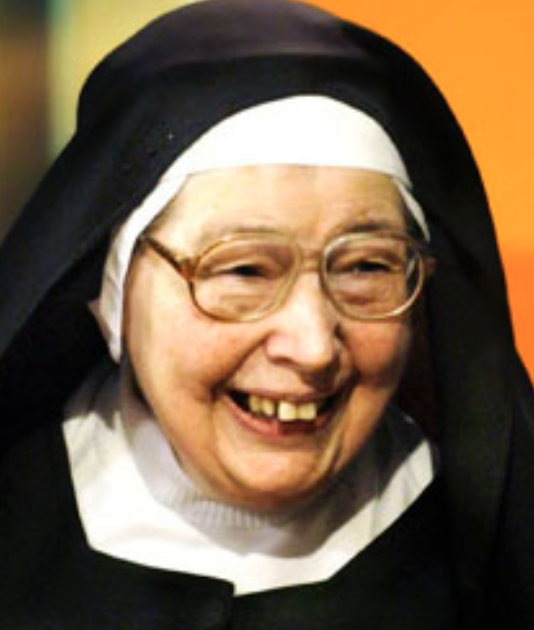
Sister Wendy Beckett
union with the Sacred is everything, and it is possible now. In iconography, Sister Wendy Beckett says that "Jesus is present, body and soul, under the appearance of bread and wine, and He is also present under the appearance of an icon". Sister Wendy has widened what we mean by sacrament: the Eternal is present in and through the temporal; the Infinite in and through the material.
Jesus said: "Very truly I tell you, unless you eat the flesh of the Son of Man and drink his blood, you have no life in you. Those who eat my flesh and drink my blood have eternal life…..for my flesh is true food and my blood is true drink." On first hearing, it is difficult not to be revolted by the words of Jesus with their cannibalistic overtones. In the Anglican tradition, in the Book of Common Prayer, the Prayer of Humble Access reads:
Grant us therefore, gracious Lord, so to eat the flesh of thy dear son Jesus Christ, and to drink his blood, that our sinful bodies may be made clean by his body, and our souls washed through his most precious blood, and that we may evermore dwell in him, and he in us.
In most of the liturgies of the Upper Room, we hear the words, "Eat the flesh….drink his blood". What are we to make of this? Within this sanctuary, the Holy Table is the focal point. The table sits beneath the stars: the breaking of the Bread and the sharing of the Wine is the still centre around which the entire cosmos revolves. How are we to understand the teaching of Jesus?
It is in the Gospel of St John that we hear Jesus say, "Those who eat my flesh and drink my blood have eternal life…" John is by far the most spiritual of the Gospels. The insight which it offers goes far deeper, is more profound, than that of the other three, Matthew, Mark and Luke. More than the others, John's Gospel captures the mystical nature of faith and the mystical teaching of Jesus. To His disciples, Jesus said, "Those who eat my flesh and drink my blood abide in me, and I in them". This is the treasure we are being offered. Later in the Gospel we hear Him say, "Abide in me as I abide in you…..As you, Father, are in me and I am in you, may they also be one in us".
Jesus invites us
Jesus speaks of a mutual indwelling. In a sense, with friends or a partner, we live in and through one another. Jesus invites us to live in and through Him, and let Him live in and through us. Jean Vanier writes:
Communion at the table of the Lord…..is a gift of his love and a sign of his desire to dwell in us all the time. The sacrament of his word and the sacrament of his presence in the poor and the weak [and the broken] are…signs of his desire to live in a heart-to-heart relationship with each one of us. The sacraments are like doors that open us up to this friendship, reveal it and deepen it.
The giants of the faith, the mystics, return to this theme again and again. One wrote: "I am a hole in a flute that the Christ's breath moves through". Julian of Norwich said: "The human soul is so glorious that God Himself chooses it as His dwelling-place". In Judaism there is a story of a rabbi who is asked: "Where is God?" The rabbi replies: "God is wherever He is let in". Metaphor is not incidental to religion: it is the language of religion. There is not a single word we can use of God that is God; every word is a metaphor.
The words of Jesus, "Eat my flesh….and drink my blood", are best understood as rich imagery of union, intimacy and communion. It is metaphorical language which has nothing to do with cannibalism; the literal interpretation of Scripture is a terrible disease! We are to ingest the Holy, feed on the Sacred, and let the Spirit of God nourish, transfigure and raise us spiritually to eternal life. George Herbert, the priest-poet, said: "Love is that liquor sweet and most divine, Which my God feels as blood but I as wine". The Sacrament is a liturgical means to filling our soul with the Spirit, the Presence, the Body, the Being of God. For me, the Sacrament of the Lord's Supper is an act of love; again, it is not for nothing that the reformer, John Calvin, believed that God's people should receive the Bread and Wine each and every week.
Becoming Christ-filled
We are to practise the Presence, invite Jesus in daily and let our consciousness, however fleetingly, become a Christ-filled consciousness. The mystics tell us that an experience of union moves us towards compassion, justice and inclusivity: we begin to love the world, love others, as God loves them. This sense of union, experienced in a sanctuary, a garden or in the high street, alone or in the company of others, does not protect us from the dangers of the world, but it does offer us strength in those times. The spiritual writer, James Finley, speaks of being grounded in the absolute love of God. We are lovers of the Divine with limbs entwined. He says:
If we are absolutely grounded in the absolute love of God that protects us from nothing even as it sustains us in all things, then we can face all things with courage and tenderness and touch the hurting places in others and in ourselves with love.
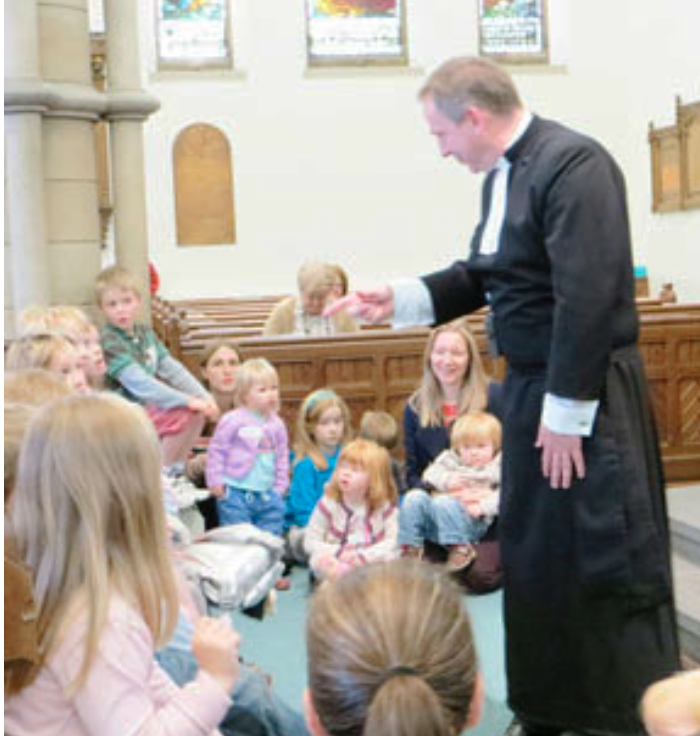
Rev McKenna with mothers and children
About 25 years ago, together with 5 other candidates for the ministry, I went on a short retreat to Pluscarden Abbey, near Elgin in Moray. One of the books I took with me was a book of prayers by the Celtic writer, David Adam. Sitting on a bench in a garden in the grounds of the Abbey, with the graves of previous generations of monks just ahead of me, I soaked up the stillness of the sacred place, a thin place, allowed myself to become aware of the saints all around, and carefully, sensitively read through the prayers prepared by David Adam. I remember the experience as though it were last week:
I weave a silence on to my lips
I weave a silence into my mind
I weave a silence within my heart
I close my ears to distractions
I close my eyes to attractions
I close my heart to temptations.
Calm me, O Lord, as you stilled the storm
Still me, O Lord, keep me from harm
Let all the tumult within me cease
Enfold me Lord in your peace.
The Celtic prayers reinforced my sense of Christ within me; they brought Jesus into focus. In his most recent book, The Awesome Journey, David Adam tells us that life is meant to be a "journey of delight….a journey of love: a journey with God and into God". Quoting Shakespeare, he says, "journeys end in lovers meeting". The Communion of Saints is also a doctrine of oneness. This morning I was reminded of a story about a man who, some time after his wife had died, spent some time in a monastery living with the monks. Among other things, he was struck by the warm familiarity they shared with the monks of previous generations. Walking among the headstones, the monks would speak of their friends who had died.
True pilgrimage
For many years, Adam was the vicar at St Mary's Church on Holy Island, Lindisfarne. At the end of each chapter of his book, he calls us to pause, pray and practise presence: be present to the Presence. "True pilgrimage" he says, "is about the opening of our eyes, our ears and our hearts, not simply about travelling….. It involves seeing the world as God's world…..Pilgrimage is more about the heart than the soles of the feet." The most important journey we make in life is the inner journey, moving beyond material pursuits, which never satisfy anyway, into moments of quiet, sensitising us to the Spirit within: the Spirit within all life, in others – God-bearers, theotokoi – and within us. The incredible revelation of Genesis 1, 2 and 3 is that we are all God-bearers, made in the image of the Holy; each of us filled with the breath of God, the very life and essence of God.
After the mythology of the creation narratives – the first eleven chapters of Genesis – a new and distinct section of the book begins. We read:
Now the Lord said to Abram, "Go from your country and your kindred and your father's house to the land that I will show you. I will make of you a great nation, and I will bless you…… in you all the families of the earth shall be blessed". So Abram went, as the Lord had told him.
It was after Abraham's father died that Abraham encountered God. Abraham's encounter began with the word "Go", which in Hebrew is lekh lekha. "Go from your country" God told Abraham. Lekh lekha had never appeared in Genesis before this point. God's relationship with Abraham is intensely personal: "I will show you, I will make of you, I will bless you". Abraham sets out for a land that God will show him, a land he had never seen. What is most striking about what God said to Abraham is the first word used – "go": lekh lekha. It means "Go towards yourself". It is an invitation to journey to a new land, a piece of physical land surely, but it is also and more deeply an invitation to journey within. After the creation narratives and long before the appearance of Moses or Joseph, God's first word is to Abraham, to the father of Judaism, Christianity and Islam is "Go towards yourself". The Divine dwells within us.
In the life of Moses, the place or dwelling-place of God was in the impenetrable cloud of Mount Sinai and later in the tent of the LORD's presence, a place alight with the luminous splendour of God's Presence. In the life of Joshua, the place of God, the tent, was at Shiloh. For King David it was in Jerusalem and for Solomon in the temple at Jerusalem. In Hebrew, the word Shekinah meaning Divine presence; it comes from the word shakan meaning to pitch a tent.
The home of the Shekinah
In Luke's Gospel Mary is the site or home of the Shekinah: the Holy Spirit overshadowed her as the Spirit had overshadowed the tent of the LORD's presence. In John's Gospel, Jesus is the Word made flesh: the home of the Shekinah. In the letters of St Paul, the apostle tells the people of Corinth that they are God's temple: we are the temple of the Living God. We are one with Christ. Jesus said, "Abide in Me as I abide in you".
Dutch Roman Catholic priest and professor, the late Henri Nouwen, said:
The Psalms are filled with a yearning to dwell in the house of God, to take refuge under God's wings, and to find protection in God's holy temple; they praise God's holy place, God's wonderful tent, God's firm refuge….. Jesus gradually reveals himself [as] the new temple. Jesus Reveals himself as our true home: "Make your home in Me, as I make mine in you".
Nouwen said: "By entering into the intimacy of our innermost self he offers us the opportunity to enter into His own intimacy with God".
The Shekinah dwells within us; the soul is the dwelling-place of God. The Pharisee Nicodemus is told that no one can see the Kingdom of God without being born from above. The Spirit, the Shekinah, needs to be born within us. The sacrament of the Lord's Supper, perhaps the supreme means of grace, is not an isolated means of grace. To the mystic the entire universe, the cosmos, is filled with God's glory.
The divine assails us
The palaeontologist, philosopher and Jesuit priest, the late Pierre Teilhard de Chardin said:
All around us, to right and left, in front and behind, above and below, we have only to go a little beyond the frontier of sensible appearances in order to see the divine welling up and showing through…..the divine assails us, penetrates us, moulds us.
In his book Writings in Time of War de Chardin celebrated the Sacrament without bread and wine. He said:
Since today, Lord, I your Priest have neither bread nor wine nor altar, I shall spread my hands over the whole universe and take its immensity as the matter of my sacrifice…..
The seething cauldron in which the activities of all living and Cosmic substance are brewed together – is not that the bitter cup that you seek to sanctify?…..
You, my God, have given me the gift of discerning, beneath this surface incoherence, the living and deep-rooted unity that your grace has mercifully imposed on – instilled breath – our hopeless plurality.
Let creation repeat to itself again today, and tomorrow, and until the end of time, so long as the transformation has not run its full course, the divine saying: "This is my body".
Along with others, de Chardin develops the theme of the Cosmic Christ. We describe Christ as the Word made flesh. It is that same Word which gives birth to the whole of creation. The Belgian priest and astronomer Georges Lemaître first proposed the theory we know as the "Big Bang", what he more sensibly called the "Cosmic Egg". The "Big Bang" or "Cosmic Egg" is the Word made matter. God is incarnate in matter, in flesh, in all creation, in the cosmos. De Chardin said that "All matter is incarnate….God is incarnate in the world". He saw that everything around us "is the body and blood of the Word". De Chardin said that the universe was the fullest extension of Christ and that the world was the "glorious living crucible in which everything melts away in order to be born anew…."
In Scripture, St Paul wrote of Christ:
He is the image of the invisible God, the firstborn of all creation; for in him all things in heaven and on earth were created, things visible and invisible…..He Himself is before all things, and in him all things hold together……
Light and darkness
Those among us of a more Presbyterian disposition may be feeling that all this mysticism is fine but it is not for us; it is not part of our tradition. In fact, there are a number of examples of mystics within the Church of Scotland, not least the blind poet-preacher of Innellan, George Matheson. Let me quote to you a passage from Matheson in which he reflects light and darkness:
We pray, "Enlighten our eyes!" but often we can only get our inner eye enlightened by having the outer eye shaded. Is the soul never to get moments for repose – for meditation, self-reflection! Is it never to have an hour all to itself – an hour when its doors are shut, when its windows are covered, when its outside voices are hushed, when it is untouched by the heat of the day! God says, "Yes, it shall have such moments"; and He prepares a place for it in the wilderness. He stops me midway in the race. He lays His hand upon me, and I fall. He bears me into the silence, into the solitude. He puts the multitude all out, and locks the door. He closes the shutters of the casement. He interrupts the music in the street; He forbids the dancing in the hall. He says, "Your nerves are weary with excitement; in this desert place you shall rest awhile".
For me, what matters most about the Eucharist is spiritual presence. How the Divine is present in matter is speculation; that the Divine is present in matter is not. In the 21st century part of the future of theological growth will be to see Christ in all things: that creation itself is a sacrament and that the Divine may be found in paths other than Christianity. Christianity is so much more than a closed system of doctrine and tradition: its core revelation is the Spiritual, a spiritual attitude towards ourselves, others, all living things and the earth beneath our feet. The Trappist monk, the late Thomas Merton, was overwhelmed with a sense of the Holy while seated in silence in a shopping mall.
In our holy space
At each and every Communion I aim to become still within, still to the point that I may become aware of Christ, that it is Jesus who speaks and Jesus who breaks the bread and shares the cup. In meditation, we can take ourselves to the Upper Room or in meditation we can envision Jesus with us here, in our holy space. I believe that the regular practice of meditation and contemplation can offer helpful paths in deepening our awareness of Jesus and our awareness of the Shekinah, the Divine Presence, in and through the bread and wine.
You will have noticed that I have cited many more Roman Catholic thinkers than Reformed ones. That is not because I am speaking to the Newman Association; it is because what they have said speaks to me. I may get into trouble from the Presbytery of Edinburgh for my views but mystics have always been persecuted by the churches. They have been persecuted largely because they have said that they already enjoyed communion with God and therefore had less need of the institution.
Tonight I have offered a mystical view of the Eucharist: it is about union, intimacy and love and not the mechanics of how God works in the world. Thank you.
This talk was delivered to the Edinburgh Circle in March, 2017.