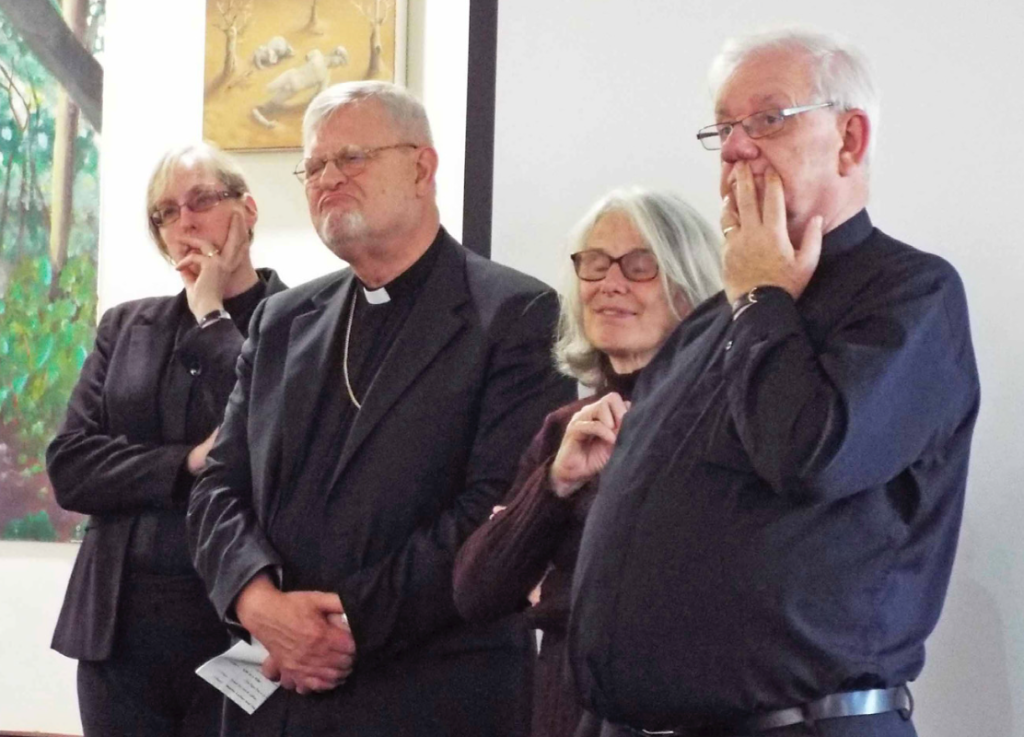
A shortened transcript of John Morrill's talk at the St Albans conference, examining the historical wounds of the Reformation and the urgent call for Christian unity expressed in Vatican II's Unitatis Redintegratio.
Shortened transcript of talk by John Morrill, St Albans, October 28th
I will start by looking at the document that came out of the great Council of the 1960s, the Second Vatican Council, a decree on ecumenism that was called Unitatis Redintegratio, the reintegration of unity amongst the churches. This is opening of a very powerful statement, and a really shocking statement compared to what went before: "The restoration of unity among all Christians is one of the principal concerns of the Second Vatican Council. Christ the Lord founded one Church and one Church only. However, many Christian communions present themselves to men as the true inheritors of Jesus Christ. Such division openly contradicts the will of Christ, scandalises the world, and damages the holy cause of preaching the Gospel."
That is an extraordinarily powerful statement, and it is a command that we must submit ourselves with humility to reconciliation. It doesn't mean that we have to give up the things that we cherish. It means that instead of starting by enumerating the things on which we disagree we begin by enumerating the things on which we do agree.
"Catholics in their ecumenical work must assuredly be concerned for their separated brethren: praying for them, keeping them informed about the Church, making the first approaches to them." Other people may not have the fullness of truth as we understand it, but they live out that part of the truth that we share much better than we do, and therefore we learn from them.
The important thing here is to have the humility to listen to what other Christian communities have to offer that isn't part of our tradition. That's the difficult bit. So we don't want to give up the claim that we have the fullness of truth in the Catholic Church. But we have to accept that other people believe that they have the fullness of truth. The worst thing that you can do is look for the highest common factor, to have only the things we agree on.
I was teaching a sixth form in Bethnal Green last year made up almost entirely of Moslems. I said that in Elizabethan times there were Catholic terrorists but most Catholics wanted to be loyal to the Crown and loyal to the Church, rendering to Caesar what belonged to Caesar and to God what belonged to God. But they were told by each that they had to betray the other. And a minority became terrorists. The problem for the regime was, how do you deal with the radicals without radicalising the moderates? Today, we are in the same position, and we are making the same mess that they did.
Beyond words are swords. Those words, at the time of the Reformation, led to violent action. Take England, and the Marian martyrs: 282 Protestants were burnt alive for their faith. On the other side, 342 Catholics were tortured to death. That's what happens when words become swords. It is a catastrophe for humankind and a catastrophe for the teaching of Christ, but that's where we descended to.
In Ireland the majority of the population refused to accept the split with Rome: and it was a rare case in which the ruler failed to determine the faith of the subjects. You had a series of religiously-motivated rebellions and a series of religiously-motivated repressions. This culminated in 1641 with the massacre of about 12,000 Protestants by Catholics. And 28 per cent of all the publications in England in the winter of 1641 were about the atrocities in Ireland.
On the other side, there was the legacy. Cromwell went to Ireland, firstly to avenge those massacres, and secondly because in order to safeguard the Protestant community the English Parliament had sent an army to Ireland. On the eve of the Civil War it couldn't raise the taxes, so it borrowed a million pounds – a huge sum – from the venture capitalists, who thought that if they were going to get five times their investment back it must be worth it, because the English always beat the Irish.
The origin of the Irish problem
That means that in 1642 the English state committed itself to confiscating 25 per cent of Ireland, taking from Catholics and giving to Protestants in Britain. By the time Cromwell had finished his work it required another 25 per cent. In the 1650s half of the land of Ireland was taken from Irish Catholics and given to British Protestants. That was the Irish problem. So the legacies of the Reformation can be very long-lasting and very negative, which is why it is so urgently important that we build ourselves anew.
Henry VIII seized the monasteries. Some of them, of course, were centres of corruption. But many of them were devoted to living the life of Christ. In many cases the Church was the only place providing for the education of the poor, and bringing welfare to the poor. It is true that with Protestantism there came got the poor laws, administered by the parishes, and from the very beginning of reformation, Poor Relief. But there was always a division between the deserving and the undeserving poor. The monasteries did not do that, they did not judge, and neither do we in modern times.
When you become too powerful you take away from people their comforts and the communion of saints, and for me the central problem of the Reformation was the challenge to the living and the dead as the communion of saints in God's great Creation. The living were able to pray for and with the dead. The dead were able to assist us in our struggle through life.
Almost all of Luther's core teachings are in the end a rejection of the Communion of Saints in favour of something which was, for him, an enormous liberation, which is the impossibility of being good enough to live in heaven – a recognition that God will save me despite myself. Of course, he then added that those who were under the covenant of grace would be more able to live a good and holy life. You weren't in heaven because you had been good, but you were good because you had been given the assurance of grace. You take away human freedom to affect salvation and that's something which we are never going to be able to agree on. It's complicated, but there are two views and I happen to be on one side.
For me, the thing that the Catholic Church rejected, manifestly wrongly, was giving all Christians access to the scriptures. That religion of the Word was something that the Catholic Church was frightened of: the liberation that comes from being able to access the pure word of God. Even Luther never originally read the scriptures – what he read were the commentaries on the scriptures.
Luther himself derived the idea of how he should study the scriptures from Erasmus, from a disobedient Catholic who was, however, never, ever, going to be a rebel and leave. But Erasmus could imagine Pope Leo X arriving at the gates of heaven and Peter saying "you're not on my list" and Leo replying, "well, I conquered half of Europe, I burned thousands of people, I did everything in your name". But Peter saying again, "you're still not on my list".
Erasmus was the one who more than anybody else said we should go back beyond the commentaries, beyond the Latin, to the Greek and the Hebrew. We should see what was lost when Jerome put it into Latin. And then we should put it into a language that everybody would understand. And that process was in train when Luther took that idea and ran with it and caused schism.
Later, when the Catholics did translate the Bible into English in the 1580s, it was deliberately a literary translation so that the priests could correct the false translations that the Protestants were perpetrating. The translations became very much confessionally-determined. The only Catholic translation that there was for centuries, the Douai Rheims, wasn't actually a readable translation and wasn't intended to be. That was a big, big problem that we have had to learn to overcome. One aspect of the Reformation, to me, is that there was a baptismal responsibility to share the Faith with others. It is unquestionably the case that the Protestant Churches, for centuries, even if they did it imperfectly, were more concerned to be involved with sharing their Faith with others. Their Faith was a gift to be shared.
A pilgrimage towards virtue
Since the Council of Trent, when it responded to Protestantism, the Catholic Church has had a body of preaching which is pretty coherent; it is not the case that everybody believes it, but everybody knows what they are supposed to believe. The Augustinian tradition led to Luther – he was, after all, an Augustinian friar – and that is why he always had a gloomy view of human nature. God reveals himself insufficiently to us to be able to conduct our lives, so in the end the human condition is one of degradation in sin. And at the other extreme there are traditions which culminate, really, with Erasmus: that life is a pilgrimage towards virtue, that through education, through the support of the Church, particularly through the sacraments, and through encounter with history and Faith, it is possible to achieve salvation. It is the optimistic view of the human condition.
But both of those traditions were outlawed through the Council of Trent. What came out of Trent, which closed in 1563, was a middle position which we can call the Thomist tradition. This says that when God created the world he implanted himself into everything, so that every single thing is redolent of the nature of God. So God is knowable, but not known. Human beings can respond to the word of God, to the Sacraments, the Life of Faith, and through that can work their way towards the sceptres of the offer of salvation. Christ died for all, but not all will be saved. Not all will take up that invitation.
But the important thing is that the Catholic Church chose not to continue to endorse the gloomy view of human nature in which there is no hope except through a divine gift. Instead there was the Erasmus programme, which was to develop mass education, to get back to the original sources, to foster renewal, to close down monasteries which were not fulfilling their tradition, to convert the assets into schools and to support all the movements towards lay spirituality which had been spreading across Northern and Southern Europe. Above all, it was to get control of governments: the Erasmians were taking over in all the courts of Europe.
At the time when Luther defied the Papacy there was every possibility of the Catholic Church renewing itself. It is perfectly possible that the Catholic Church was wrong in persecuting Luther and not trying to find a way of accommodating him. The fact is that what he started caused a schism which led to a disaster. It was possible not only in 1999, but also in 1541, for Catholics and Protestants to agree a formula on justification by faith.
I want to end by going back to hope. The parish I am in, which I think is not unrepresentative, Newmarket, incorporates 28 Anglican parishes and about 14 dissenting communities of one kind and another. We run a homeless shelter, a food bank, and we have a very healthy life of prayer together. So we don't begin by saying that we agree on what we agree on, and let's forget the rest. Let's agree on what we agree on and then be nourished by it, and then in humility listen to one another about what divides us, so the Holy Spirit can do that which we cannot do, which is to transform those contacts into sources of unity in the time to come.