John Hobson describes his three months living in the Northern West Bank as part of the Ecumenical Accompaniment Project for Palestine and Israel (EAPPI), bearing witness to the daily realities faced by Palestinian farmers.
The light breaks on a cold December morning. Around a fire agricultural workers share coffee, awaiting the arrival of soldiers. In the immediate vicinity are rolls of razor wire in front of a trench and military roadway that carves an unnatural, ugly path, across the ancient hillsides, to the left and right, and far as the eye can see.
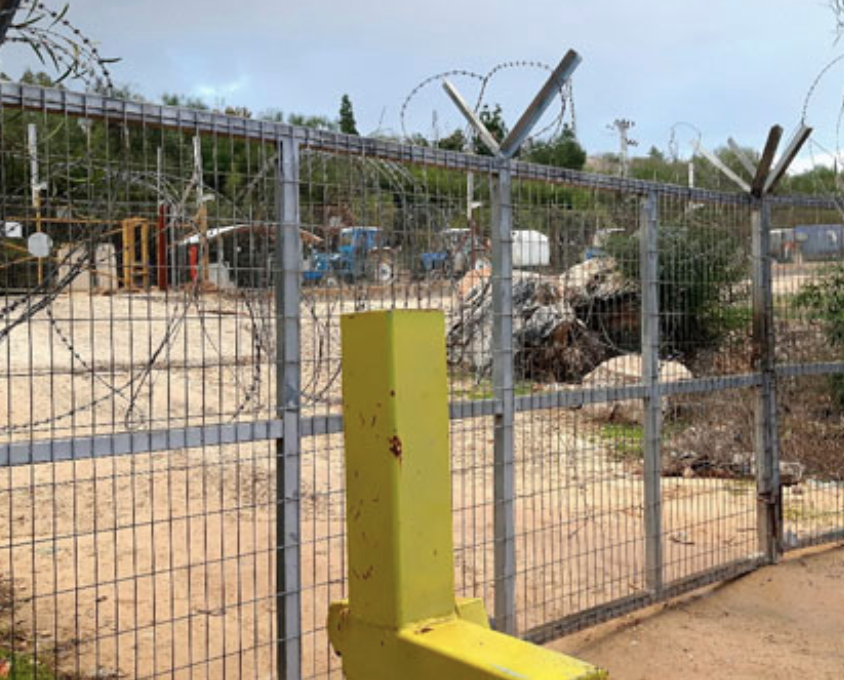
I am observing an agricultural gate – i.e. a checkpoint – in the Northern West Bank, occupied Palestinian Territory. As the sun rises, I glimpse the Mediterranean, some 8-9 miles away in the distance. Other men and women begin to gather in front of the padlocked metal gates, some with tractors, others with donkeys with carts.
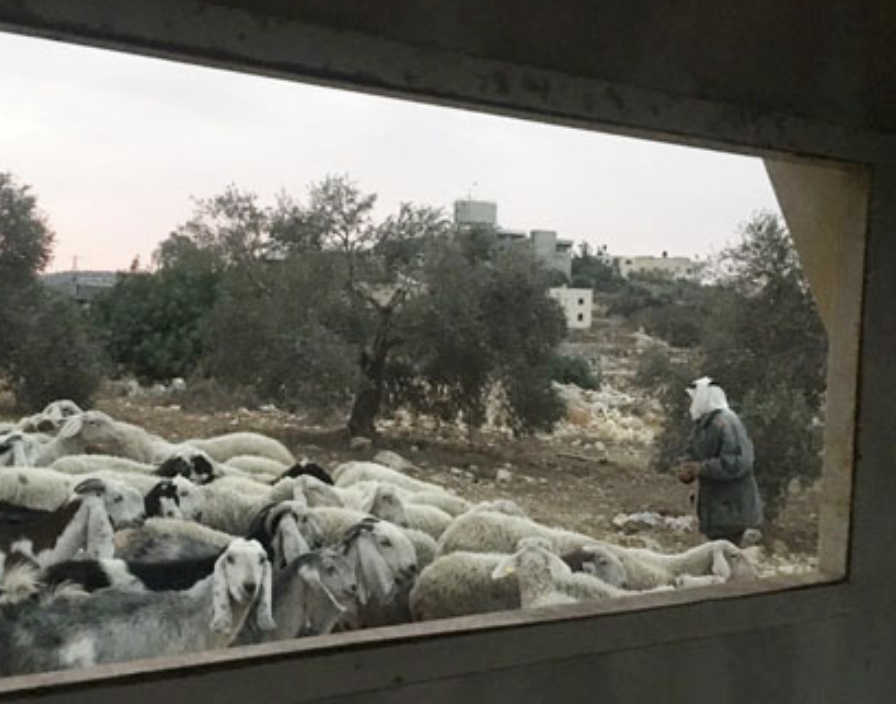
An elderly shepherd arrives with a flock of sheep and goats. I watch the animals obey the whistles and calls of their master who skilfully keeps them together in their place in the growing queue.
Four soldiers arrive and assemble themselves at a canopied desk – some 30-40 metres away – whilst two others begin to tackle the heavy padlocks on the three sets of ill-fitting gates. Five at a time, men and women proceed to walk across, papers at the ready for checking. The shepherd's turn comes and upon his signal the flock scampers forwards, parting to pass around the heavily-armed soldiers and then slowing to a graceful meander through the third set of gates.
And so I watched before me the grinding infringement of the right of these men and women to access their land and livelihoods, indeed the right to go out and complete a day's work. This is a fundamental right enshrined in international humanitarian and human rights law, breaches of which are embedded through restriction of movement into daily life across the occupied West Bank.
I had the privilege of spending three months living in the Northern West Bank as part of the Ecumenical Accompaniment Project for Palestine and Israel ("EAPPI"), one of a group of thirty volunteers drawn from more than fifteen countries. The EAPPI was set up by the World Council of Churches in 2002, following a call from the ancient Palestinian Christian community for international volunteers to bear witness to the military occupation by Israel which is now over 50 years old.
In Britain and Ireland volunteers are recruited and trained by the Quakers and they commit to live in Palestinian communities where specific monitoring of human rights is required. I previously visited annexed East Jerusalem in 2010 as part of a legal housing delegation examining the Palestinian crisis in general (and within the neighbourhood of Sheikh Jarrah in particular). I had first been there in 1991 as a student visiting traditional pilgrim and tourist sites. I retained an interest in this conflicted land, and the opportunity to take a sabbatical from work enabled me to focus on joining the programme; as a barrister in self-employment there is helpful flexibility in how I can complete required commitments to advocacy.
Following further training upon arrival we attended a handover ceremony in St George's Cathedral in East Jerusalem where the previous EAPPI group lit candles and passed a symbolic light on to each of us. Thereafter I was based in an apartment with three colleagues from Finland, Norway and Sweden. By necessity we worked quickly to establish our own ground rules building on mutual trust. Each of us was at different stages of journeying in life and we were entrusted by a wider collective to be effective regarding complicated matters surrounding the military occupation.
Amongst many issues, we were specifically tasked with daily monitoring of the difficulties faced by farmers in accessing their own land.
Upon the cessation of hostilities in 1949 an Armistice line – 'the Green Line' – demarcated Israel and the Palestinian territories, the latter which have been occupied continually by Israel since 1967. In 2002 Israel began building the Wall/separation barrier. But even a simple examination of its route explains its ongoing controversy. The route deviates substantially from the Green Line, penetrating into the West Bank, at one stage to a planned extent of 22km. As a consequence, huge swathes of fertile agricultural land, water resources and whole communities now lie between the barrier and the Green Line.
One result is the separation of farmers and workers from their land and employment, such that they rely upon short opening times at the various agricultural checkpoints situated on the Wall/separation barrier, a work still in progress by Israel and currently measuring over 700km in length. There is a complicated and often arbitrary permit system for people to access their own land. On many occasions the gates open late, regardless of the weather, and there is inconsistency in who is allowed through, even when a permit is granted.
For example, one morning an elderly woman, an agricultural labourer who harvests thyme in the fields across the gate, was refused entry. She had a permit for the coming months but did not have the current one with her. She sat down on a concrete block and loudly made the point that the previous week she had been allowed through the neighbouring checkpoint without any problem. A kindly man became involved, negotiated with the soldiers and she was eventually let through.
I observed her a few days later as she passed back through the gate after her day in the fields, having waited for over an hour with many others as the darkness fell and the temperature dropped: they were literally locked onto the land, everyone dependant on the arrival of the military if they were to continue home. On the occasions when the soldiers didn't arrive we called the humanitarian hotline, with responses varying from security explanations and fob-offs to outright dismissive sarcasm.
Legality of the Wall
In 2004 the International Court of Justice issued an Advisory Opinion* on The Legal Consequences of the Construction of a Wall in the Occupied Palestinian Territory. Drawing upon the evidence before it and applying long-established principles of international humanitarian and human rights law, the Court set out strong conclusions as to the illegality of the construction of the Wall on occupied Palestinian land. Calling specifically for cessation of the Wall's construction, the dismantling of those sections already built and of attendant legislative and regulatory systems, the court then set out the reparations and compensation by Israel required as a result of its unlawful actions. The United Nations subsequently established the United Nations Register of Damage, providing a mechanism whereby individual claims of economic loss can be recorded, in view of the ongoing failure by Israel to take action in accordance with the conclusions of the ICJ.
I often pondered the scale and micro impact of infringements on a daily basis, multiplied over the months and years since the Wall was built: the loss and denial of chances; the grinding permit bureaucracy and inconsistencies; the military control and intimidation; the sheer waste of time.
EAPPI places emphasis on supporting the work of Israeli peace groups who also oppose the occupation and we were able to meet the Israeli women's group Maschom ("checkpoint") Watch, having seen them in action one morning before dawn across the fencing at one of the checkpoints. Another organisation is Breaking the Silence, a group of young people conscripted to serve in the military in the West Bank but who, having done so, have emerged deeply troubled by their experiences. Breaking the Silence, who face hostility within Israel, conclude that the occupation must end if there is to be a lasting peace.
Away from the work, on days off, I was able to visit Capernaum, the Sea of Galilee, Nablus and the Dead Sea area. I also returned to the Mount of Olives, a place I last visited on my first visit to Jerusalem where I found my way to the small church which commemorates Jesus' weeping over the city, seen at eye level through the window behind the altar. The programme also arranged for us to spend Christmas Eve in Bethlehem. It was certainly a Christmas with a difference – being far away from home in such an historic place, passing checkpoints to get there and looking out from my room and being faced by the barrier opposite, which in Bethlehem is an 8-metre-high concrete wall.
On a later occasion I joined the EAPPI team in Bethlehem in supporting the local Christian community during a weekly prayer vigil that includes walks along a section of the Wall, to and from an icon of Mary painted on one section. Whilst personally unsure of what "prophetic" might mean, upon hearing/fielding the measured questions of a close colleague, a secular political/human rights activist with whom I had inter alia watched checkpoints in remote parts of the West Bank for three months, that was the word that from somewhere came to mind.
Perhaps it was the symbolism: the understated calling out of injustice; the belief that, ultimately, dividing walls will be shattered; that the powerful will be laid low; that chains of injustice will be loosened; that ultimately the stones may indeed cry out. Friends visiting with an Alternative Pilgrimage joined us. They had already spent a day with Sabeel, a respected Jerusalem-based Palestinian Christian grouping that is inspired by, and draws upon, liberation theology. Many were troubled and moved by their exposure to the material reality of the life of Palestinians under occupation. The vigil itself wasn't on their itinery. But upon hearing of the vigil they came to be alongside local people, prior to listening to a talk from EAPPI volunteers.
Taking a principled stand, EAPPI makes a clear call for advocacy where breaches of international humanitarian and human rights law are identified: put simply, to nurture awareness and to take action in support of the end to the occupation and for a just peace for Israelis and Palestinians based on international law.
An intense three months
Upon returning I have had the opportunity to speak to many different groups, including the Manchester Circle of the Newman Association. It was a privilege to do so: to recognise once again, and share, the experience of those short, rich, intense three months; to reflect again on the importance of amplifying the voices of those living under military occupation – of issues raised only from within those communities; to impart information and share in reasoned, concerned, discussion about a long-standing conflict that many view as intractable.
All this relates to a beautiful land that many people call Holy.
John Hobson is a barrister and churchwarden at an Anglican church in South Manchester. He writes in a personal capacity. Further information about the work of EAPPI can be found at www.eyewitnessblogs.com and *http://www.icj-cij.org/docket/files/131/1671.pdf
John Hobson gave a talk to the Manchester and North Cheshire Circle in June 2018.