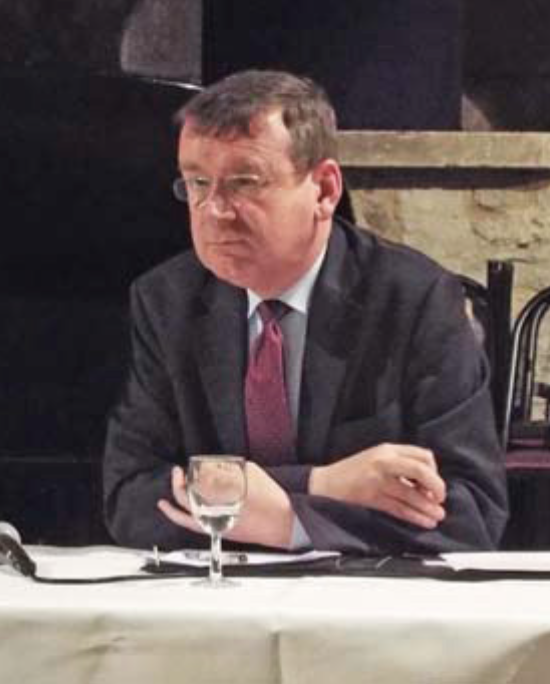
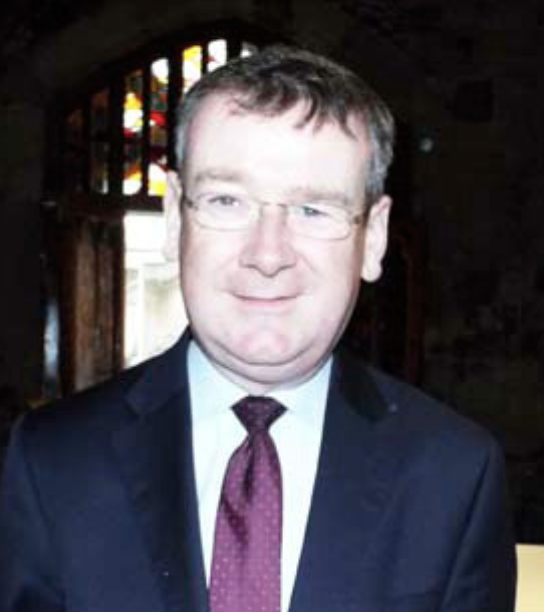
The London Newman Lecture 2018. Francis Campbell, Vice-Chancellor of St Mary's University Twickenham, explores how universities can promote reconciliation in a modern society, drawing on John Henry Newman's vision of the university.
The London Newman Lecture 2018
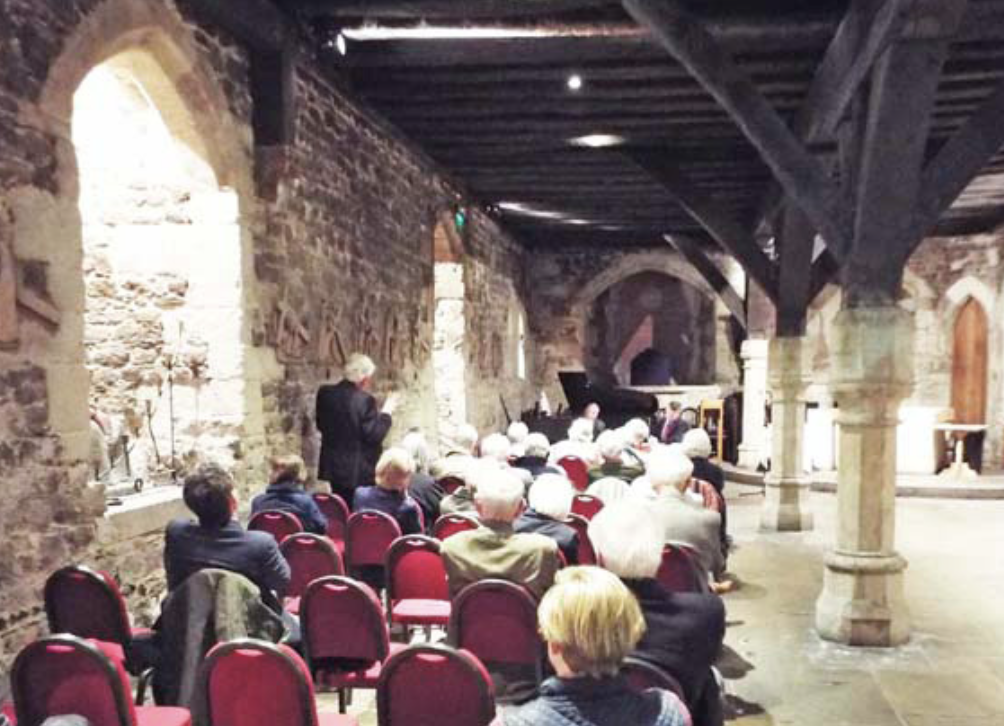
It is a delight to be with you this evening to give the annual Newman Association London Lecture. It is a delight for two reasons; the topic and the location. First the location. We are in the beautiful crypt of St. Etheldreda's Church. It is a church of the Institute of Charity, which was founded by the Blessed Antonio Rosmini, the eminent Italian priest philosopher and thinker. The Rosminian fathers and sisters educated me and so it is a pleasure to be here; and earlier this month I had the privilege of visiting his tomb in Stresa. Blessed John Henry Newman and Blessed Antonio Rosmini knew each other. Both were beatified during the pontificate of Pope Emeritus Benedict XVI and both were often misunderstood and misrepresented during their lifetimes. The second reason for my delight is because of the topic. I find Newman to be an indispensable guide in the contemporary university landscape; a constant source of inspiration reminding us of the deeper and more prophetic role of a university in society.
Those of us who follow contemporary affairs closely will be aware how critical reconciliation is for our communities. Due to new challenges some old divisions risk resurfacing. The struggle to achieve reconciliation in our societies has at times, and in different places, been long and tortuous and we know it would be naïve to suppose that what has been achieved is perfectly secure. I read my title as recognising that. The process is not yet complete. Reconciliation still needs to be promoted. It will be my contention this evening that universities have a role, perhaps even a unique role in not only providing the space, but also protecting and promoting the space where encounter can occur.
At a time when so much attention is focused on differences, and spaces of encounter and understanding across the world seem to be under pressure, it is vital to have forums dedicated to the civic space. Such a space is not a place of conformity or uniformity where we simply align with those of similar views aided by social media. It is a space where we are prepared to engage, change and be changed. There is clearly a need and universities can and must see their mission and purpose as building a civic society, which can overcome the ethnic, national, and religious divisions. But this must be achieved not by discarding those divisions in the shape of some utopia or nihilist construct, but by ensuring those differences are welcomed, integrated, respected, valued and understood, and seen in a wider civic ecology.
Now, ladies and gentlemen, how might a university assist the process of reconciliation? Before we get carried away, let's step back a little.
Universities and conflict
There are those, as you will know, mainly people with little experience of university life, who see universities as oases of calm. While they may realize that only Oxford has dreaming spires, they nevertheless envisage universities as places that are tranquil and serene, where calm scholars of sober integrity teach wisely and pursue research that strives to deepen our knowledge and understanding and to solve the problems that beset us. Well, there is often admirable teaching and impressive research and at times there are breakthroughs that help us to resolve problems that may have bewildered us for generations. That happens; but an atmosphere of calm, tranquillity and serenity is not always so immediately obvious.
A classic example, almost sixty years ago now, was triggered by C. P. Snow's famous lecture, The Two Cultures and the Scientific Revolution. He delivered it on May 7th, 1959. As you may recall, he was drawing attention to what he saw as a dangerous gap that was opening up between scientists and "literary intellectuals", between scientists who struggled to read Dickens and professors in the arts who were ignorant of the Second Law of Thermodynamics. His thesis provoked a major debate that echoed around the world, but it reached its famous peak when F. R. Leavis delivered his response in 1962.
This counter-lecture has been described as "so astonishingly vitriolic, seasoned with an almost toxic dose of the most vulgar abuse, that people were still talking about it in shock and awe … ten years later".1 And Professor Stefan Collini has observed: "A malevolent deity, setting out to design a single figure in whom the largest number of Leavis's deepest antipathies would find themselves embodied, could not have done better than to create Charles Percy Snow."2 Universities cannot be guaranteed to be oases of calm, tranquillity, and serenity.
The clash between Leavis and Snow may in fact have been more than anything a clash between personalities, as Collini's comment indicates. But there can be other clashes as well, clashes between casts of mind. After the Second World War younger members of the English Faculty at Oxford wished to extend the syllabus from 1832, where it stopped until at least 1900. It seemed unreasonable that those who read English at Oxford might leave without having had the chance to study Dickens, Thackeray, George Eliot, and others of that great Victorian period.
Among those who opposed the move most vigorously, however, were J. R. R. Tolkien and, especially, C. S. Lewis. Lewis did not despise Victorian literature; quite the contrary; but he argued that the topic was too vast for picking and choosing and students would need a thorough knowledge of the intellectual background of the period to be able to study it properly. A young Helen Gardner responded by saying that if what he said about Victorian literature was true, then it must be true for all periods of literature. "In the area of the sixteenth century, for example", she countered, "which of us has pupils who have read Calvin's Institutes of Religion?" Carried away in the heat of the moment, Lewis claimed that his pupils had all read Calvin. And then their eyes met and he realised she knew he was lying.3 Universities, ladies and gentlemen, can be scenes of fierce dispute.
More recently there have been clashes of a different kind. I am thinking of the arguments that have swirled around the question of free speech in universities. Who should be allowed to speak? Is it acceptable to offer platforms for speakers who encourage hatred and bigotry, who are sexist, racist, islamophobic, or anti-semitic? Is there space on university campuses for the smooth persuader? Will minds only partially formed become radicalised or be duped into error? How is error to be defined? Is it to be regarded as wrong because I disagree or disapprove of it? Can we be confident that open and intelligent debate will always lead us to the wisest solution?
And then there are the conflicts of a more practical kind, those that we would call demarcation disputes between departments or faculties. Staffing, facilities, resources, a share of the budget can all lead to disagreements between colleagues. In his classic work, The Idea of a University, John Henry Newman describes the university's role as keeping each in its proper place, establishing mutual relations, keeping in check the ambitious and the encroachers, and assisting and supporting those less advantageously placed. These remarks caused John Roberts, the historian, who died in 2003 and who had been Vice-Chancellor of Southampton University and then Warden of Merton College, Oxford, to comment on their remoteness from present reality. And, he added, that Newman's picture of an imaginary senate meeting shortly afterwards, where, should a dispute arise, people "talk over and arrange it, without risk of extravagant pretensions on any side, of angry collision, or of popular commotion", these remarks, he said, prompted him to burst out laughing.4 Reality is otherwise. Speaking from my experience both as a vice-chancellor and as a diplomat, diplomatic skills certainly do not go to waste in universities.
There is then plenty of scope for conflict in universities and indeed between universities, as market forces come to turn those who have been friends and allies into competitors. Are universities, therefore, incapable of promoting reconciliation? I don't think so. Have they nothing to offer? I believe they have.
Some background
My present position, as you know, is as Vice-Chancellor of St Mary's University, Twickenham. We are young as a university, but not as an institution. St Mary's was founded in 1850 as a Teacher Training College. It has an impressive history and has gained a reputation of which there is every reason for us to be proud, especially for its teacher training and also for sport. For a hundred years, from the 1890s to the 1990s, St Mary's was the responsibility of Irish Vincentians. But education like so much else develops and more recently, as St Mary's expanded, it became a University College and now it has University status in its own right. It has followed that familiar path. What's more, it is one of the last remaining faith-based public universities in the London area and the largest Catholic university in the United Kingdom.
As a public, faith-based, university it welcomes people of all belief. Its faith identity is not something which closes it off from the world, but something which demands an ever greater openness to the world. It reminds us of the foundation of universities in the western tradition, most of them emerging from within the Church and crossing boundaries for the pursuit of knowledge and truth.
In 1851, the year after St Mary's was founded, John Henry Newman accepted an invitation from Archbishop Paul Cullen of Armagh to come to Dublin and found a university there. That was where he wrote The Idea of a University to which I've already referred. Although the university didn't open until 1854, Newman came to Ireland initially in 1851 and stayed till 1858. So I want to reflect a little with you on the idea of a university, not so much rehearsing the argument of Newman's book, but rather pondering the vision that he was exploring to see whether it might not still offer us some clues towards the reconciliation that we are looking to promote in our respective universities. And let me make clear from the start that, vital as the Church and Theology were to him, Newman was not speaking as such about the idea of a Catholic university, but simply the idea of a university.5
Some recent reactions to The Idea of a University
Those who have referred to The Idea of a University more recently have acknowledged its status as a classic, even when they have been expressing their reservations. At Cambridge, for example, Professor Stefan Collini has warned us against deluding ourselves that Newman's book "describes an institution that at all closely resembles the universities we have today", while he adds that our twenty-first century universities need a literary voice like Newman's "of comparable power to articulate in the idiom of our own time the ideal of the untiring quest for understanding".6
Then Lord David Willetts, the former Minister for Universities and Science in the Coalition Government, while criticising Newman for what he called the etymological mistake of arguing that universities should be devoted to the teaching of universal knowledge, has then observed that "perhaps that mistake contained a deeper truth and there is something universal about the university … We might hope that many graduates emerge able to fulfil Newman's ambition for them."7 And back in 1990, the centenary year of Newman's death, John Roberts, whom I mentioned earlier, in his revisiting and reassessing of Newman's Idea, also declared that the circumstances of universities today are "utterly remote from the academic world taken for granted by Newman", also described Newman's vision as one "with which those of us who are concerned with education should from time to time try to refresh ourselves".
It is not a matter, Roberts noted, of forcing Newman's Idea to fit our needs, but of finding encouragement from him "to defend values now under threat".8 All these writers are emphasising principally the limitations, as they see them, of Newman's idea in our circumstances today. They are not praising Newman to the skies. Nevertheless, they are acknowledging that there is something in what he says that should be valued.
Teaching universal knowledge
At the very beginning Newman affirmed: "The view taken of a University in these Discourses, is the following: - That it is a place of teaching universal knowledge."9 Besides Lord Willetts's etymological concern, John Roberts also took issue with this starting-point. He found the claim that universities should teach all subjects implausible and impossible. He argued that it presupposed an unchanging culture that has become alien to our civilization. How can a university seek to provide a comprehensive account of knowledge in a world like ours? "For most students it is impossible fully to understand and make one subject their own," he observed. "To understand its interconnections with all others is unimaginable."
And in any case, he went on to argue, to possess truth at all it is not necessary to have the whole truth; partial knowledge is often enough; it is not necessary to know everything in order to know something. It is not necessary to teach everything so that students can learn effectively. All this makes good sense. Moreover, while he acknowledged Newman's caveat that, although a university is a place for cultivating all knowledge, that "does not imply that in matter of fact a particular University might not be deficient in this or that branch of knowledge … but only that all branches of knowledge were presupposed or implied, and none omitted on principle", he still had his reservations.
Roberts regarded the notion of principle as slippery. "It is arguable", he continued, "that a university might not support a subject when others are more important to it … And at what point do you call a halt to a university's expansion [even] if resources are available?"10 Must a university go on relentlessly adding subject after subject after subject? Yet here he seemed to be labouring the point. Is Newman necessarily saying anything more than that a university ought in principle to be open to teaching all subjects and by the same token in principle omitting none? I don't want to labour the point excessively myself, but his reflections may perhaps open up a way forward for us. Reconciliation can occur more easily when people recognise what unites them, that is, what they have in common.
Roberts was writing in a collection of essays called Newman after a Hundred Years that came out in 1990, the centenary of Newman's death. However, that was not the only volume published in 1990 to commemorate Newman's death. Louvain Studies also produced a special issue on Newman which included a contribution by Professor Nicholas Lash, who is now retired, but who at that time was the Norris-Hulse Professor of Divinity at Cambridge. He called his paper, '"A Seat of Wisdom, A Light of the World: Considering the University".11 And Lash's key observations with regard to Newman's understanding of the university correspond instructively with issues raised by Roberts, but he approaches them with a different focus.
Roberts, as we have noticed, drew attention to Newman's understanding of a university as a place where in principle all subjects were taught, and he believed that that was impossible and implausible. But Lash, on the other hand, lays emphasis on the unity of truth and knowledge that those subjects unveil. He quoted Newman: "All that exists, as contemplated by the human mind, forms one large system or complex fact, and this of course resolves itself into an indefinite number of particular facts, which, as being portions of a whole, have countless relations of every kind, one towards another. Knowledge is the apprehension of these facts, whether in themselves, or in their mutual positions and bearings."
Interconnectedness is crucial. The human mind struggles to take in such an array. And Newman then illustrated that struggle by producing one of those images which characterise his writing: "Like a short-sighted reader, its eye – the eye of the human mind – pores closely, and travels slowly, over the awful volume which lies open for its inspection."12 Newman, as Lash notes, believed there was a unity to the reality that sciences study, although they explore that reality "under its various aspects".13
Lash then offers a swift sketch of the shift in intellectual focus over recent centuries. "During the seventeenth and eighteenth centuries," he observes, "philosophy (a term which still, of course, embraced what we would now call natural science) took nature, time and space as focus for reflection. In the nineteenth century, under the impetus derived from Kant and Hegel, the quest for a coordinating focus shifted from 'nature' to the other side of things, to human thought and freedom." This shift, we might say, was from a more objective viewpoint to a more subjective one.
Then, shortly afterwards, Lash observes, "The twentieth century has seen, in several places, a further shift: towards the instrumentalism and pragmatism of 'pure experience'."14 This last comment in particular is borne out by an earlier remark of Roberts's, with regard to Newman's reference to the "bare idea" of a university, as "almost the last thing British universities seek". Why? Because, according to Roberts, these universities are "rooted in philosophical and intellectual incoherence. They are cluttered up with doctrinal and practical accretions, and are expected and usually willing to do much more than provide intellectual training". So they are not looking for a single voice to speak for them.
A unifying idea
The system of which they are a part was, he wrote, "pragmatically constructed" and "historically conditioned". Here is acknowledgement of the shift towards the pragmatism of "pure experience", which met needs as they arose.15 There is, of course, much to be said for pragmatism. It can prevent us from becoming entangled in endless theorising. Nevertheless, when pragmatism dominates, it can lead to a fragmentation that undermines coherence, leading indeed, to repeat Roberts's phrase, to universities "rooted in philosophical and intellectual incoherence".
Pragmatism has become so important in universities today because, when people come to university, they expect to be equipped for careers, supplied with the skills they need for success. They have come for a particular purpose and they want their money's worth. In Newman's view, on the other hand, more than a hundred and sixty years ago, a university was not preoccupied with utility, with what is useful. That preoccupation reduced a university, he declared, to "a sort of bazaar, in which wares of all kinds are heaped together for sale in stalls independent of each other". He believed rather that "a University is the home, it is the mansion-house, of the goodly family of the Sciences, sisters all, and sisterly in their mutual dispositions".16
So times have changed. The significance of a range of skills and training in education has come to be recognised and seen as valuable and well worthwhile. All the same, as Nicholas Lash has stressed, what unifies is also important. "The university, 'taken in its bare idea', he writes, deliberately echoing Newman's phrase, "is not a collection of libraries and lecture-rooms, departments and faculties, seminars and field-trips, playing fields and late-night resolutions of the problems of mankind. The 'idea' of a university is that there is one unifying formal feature or aspect of those things which explains and justifies the university's existence and its purposes when considered precisely in abstraction from the myriad activities, institutions and enterprises which go (materially) to make it up."17
Of course, there is no incompatibility between a unifying idea and more specialised teaching. Newman himself was delighted by his School of Medicine in Dublin. "What indeed can it [a university] teach at all, if it does not teach something particular?"18 he exclaimed. Nevertheless, as he had asserted earlier, a university essentially "educates the intellect to reason well in all matters, to reach towards truth, and to grasp it". And here he added: "A cultivated intellect, because it is a good in itself, brings with it a power and a grace to every work and occupation which it undertakes, and enables us to be more useful, and to a greater number."19
And yet it is necessary to probe more deeply. Where is the unifying factor to be located? Wherever it may be, in Roberts's view, it will not be in religion. Yet at this point Lash directs attention to a piece Newman wrote for the Dublin Catholic University Gazette in 1854, as the University was opening formally. The article is called, "What is a University?", and the understanding of the university it portrays is in fact very like the understanding of the Church. Indeed, Newman's words towards the end supply Lash with the title for his article. Newman described a university as "a seat of wisdom, a light of the world, a minister of the faith, an Alma Mater of the rising generation".20
What is needed, Lash argues, is a way to recapture a "sense of the interdependence of all the elements of that 'one large and complex fact' which all things constitute". And a real, rather than a notional, apprehension of the interrelatedness of things, he continues, "calls for something other than mere erudition or intelligence or particular skill: it calls for a 'philosophical habit', for something more like wisdom". And while philosophy rather than wisdom was the expression favoured by Newman, Lash prefers wisdom, because, as he explains, philosophy today "too readily suggests a particular discipline or subject, something in which students may be set examinations by persons acknowledged to be expert in the field. And this was not at all what Newman had in mind".21
Promoting reconciliation
Newman did not wish people simply to be well-read. A great memory, he noted, "does not make a philosopher, any more than a dictionary can be called a grammar. There are men who embrace in their minds a vast multitude of ideas, but with little sensibility about their real relations towards each other". On the other hand, "the intellect which has been disciplined to the perfection of its powers, which knows, and thinks while it knows, which has learned to leaven the dense mass of facts and events with the elastic force of reason, such an intellect cannot be partial, cannot be exclusive, cannot be impetuous, cannot be at a loss, cannot but be patient, collected, and majestically calm, because it discerns the end in every beginning, the origin in every end, the law in every interruption, the limit in each delay; because it ever knows where it stands, and how its path lies from one point to another".22
Those who are wise have done more than accumulate large quantities of information. They recognise the links and connections between what they know. And Newman was explicit that he was not referring to genius, but to that "perfection of the Intellect, which is the result of education…..the clear, calm, accurate vision and comprehension of all things, as far as the finite mind can embrace them, each in its own place, and with its own characteristics upon it".23
So how can universities promote reconciliation? Where after all does reconciliation come in? Have I simply been trying to rescue some strands of Newman's thought about universities as still significant today in spite of learned criticism? I hope I have been doing something more than that. I have been wanting to draw attention to two particular features of Newman's thought about the university: first, that there is a unity that binds all knowledge together, and secondly, that that unity involves a unifying thread, relationships, interconnectedness. The building of a civic space which we all share and is open to all regardless of attribute.
The outline of intellectual history, sketched so acutely by Nicholas Lash, has alerted us to a movement from the objective to the subjective and then on to the pragmatic, a shift that is acknowledged in John Roberts's reflections. That is where we have come to. But is it actually where we wish to be? Lord Willetts too, in summing up his study on university education, refers to the bleak analyses that are on display. "It is not just worries about funding or intrusive university administration," he remarks. "It is a deeper anxiety that the university is 'in ruins' because there is no longer any coherent account of it in our post-modern world."24 Incoherence dominates. He says he does not share this gloomy view, but he recognises that it is current. It has become the fashion. However, we need to recognise what we have in common: that we are united, that there are bonds that bind us together. There is a unity to knowledge. And we begin to find solutions when we start to make connections.
Think about explorers. When explorers find markings in a cave that they suspect may be a hitherto unknown language they come to interpret it, understand it, by making connections: the frequency, for example with which a particular mark or symbol occurs. In much the same way, when codes are broken, they too are cracked by those who study them, discovering a connection. Dillwyn Knox at Bletchley Park in the Second World War made the first significant break into the Enigma Code. Enigma had usually been described as being "like a typewriter". Suppose, Knox suddenly wondered, whether on the contrary a typewriter was like Enigma so that a typewriter's keys QWERT and so on might stand for ABCDE. And he was right.25
Making connections creates understanding and creates coherence. However pragmatic and fragmented our world and society may be – and universities need to be sensitive to that reality – universities need also to be centres that hold knowledge together, making connections and creating coherence. By doing that they will hold communities together. Then, where there are divisions and conflict, in circumstances where reconciliation is needed, perhaps universities can become – in spite of their own tensions and difficulties – beacons of hopefulness, shining a light and opening up avenues that resolve conflict and help reconciliation to be achieved.
Notes
- Robert Whelan, 'Fifty Years on C.P. Snow's Two Cultures are United in Desperation', The Daily Telegraph, 5 May 2009.
- Stefan Collini, quoted in Whelan, 'art.cit.'
- See A. N. Wilson, C. S. Lewis: A Biography, (London, 2005), p.209.
- See J. M. Roberts, 'The Idea of a University Revisited', in Ian Ker and Alan G. Hill (eds.), Newman after a Hundred Years, (Oxford, 1990), pp.206-7.
- J. H. Newman, The Idea of a University, Ian T. Ker (ed.), (Oxford, 1976), p.183 [pp.213-14]. References are to Ker's edition, while those in square brackets are to the uniform edition.
- Stefan Collini, What are Universities for? (Penguin, 2012), pp.59-60.
- David Willetts, A University Education, (Oxford, 2017), pp.14, 371-2.
- Roberts, art.cit., pp.220-1.
- Newman, Idea, p.5 [ix].
- See Roberts, art.cit., pp.204-5, n.22.
- Nicholas Lash, '"A Seat of Wisdom, A light of the World": Considering the University', Louvain Studies, vol. 15, Summer-Fall 1990, nn.2-3, pp.188-202.
- Lash, art.cit., p.191; Idea, pp.52, 53 [45].
- Idea, 54, [47].
- Lash, art.cit., pp.191, 193.
- Roberts, art.cit., pp.196, 197; Idea, p.114 [125].
- Idea, p.421.
- Lash, p.195.
- Idea, p.145 [166].
- Idea, pp.114 [126], 146 [167].
- See J. H. Newman, Historical Sketches iii, uniform edition, (Westminster, Maryland, 1970), p.16.
- Lash, pp.199-200, 201.
- Idea, pp.121 [135], 123-4 [138].
- Idea, p.124 [138-9].
- Willetts, op.cit., p.370.
- See Penelope Fitzgerald, The Knox Brothers, (London, 1977), p.253.
This lecture was delivered in the Crypt of St Etheldreda's Church, Holborn, on May 17th