Extracts from a talk to the Ealing Newman Circle on November 1st, 2018, exploring the Gospel call to radical inclusivity — from household to bioregion to the cosmos.
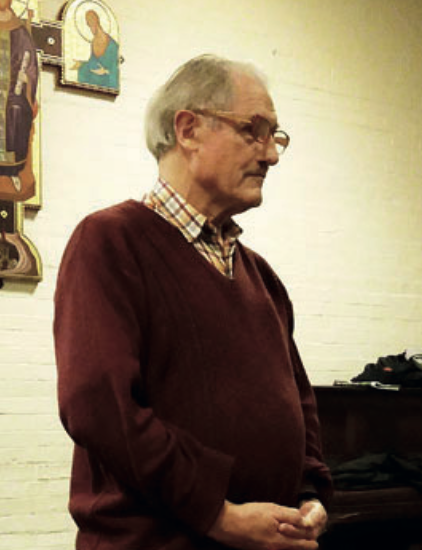
Extracts from a talk to the Ealing Newman Circle on November 1st, 2018
Jesus said: "So I say to you, ask and it will be given you; search, and you will find; knock, and the door will be opened for you." Luke 11:9.
Jesus sent his disciples into the villages. If he had really wanted to disseminate his message you would have expected him to send his disciples to the king's palace, or into the Temples, or into the synagogues. But he didn't. He sent them into the villages and into the peoples' homes. For that is where the foundations are laid for right relationships: that's the culture of inclusivity.
In each village the bioregion is encapsulated. Now, bioregion here means the wider hinterland. And through that hinterland we begin to get a sense of a wider global identity that goes beyond the nation-state, and that goes beyond our various ethnic identities into something which we might consider to be the common humanity of us all. And so the bioregion is sustained by Planet Earth and the Earth is sustained by the Universe. And there at the heart of our Gospels we have what some call the new story or the New Cosmology, this enlarged world view under which the historical Jesus operated.
That was really the biggest impediment for many of his followers, and particularly the Twelve: he blew their minds apart with the enormous world-view he had. In fact the only ones that people think might have understood it were Mary Magdelene and her followers. The Twelve Apostles certainly did not do so. But this is the heart of our Gospel, folks: inclusivity is the deep imprint. But it is not just an inclusivity relating to people – it's an inclusivity that has to include God's creation. At a local level, at a bioregional level, at an interplanetary level and at a Cosmic level – and that's about as big as you can get.
Now, in this picture there are two significant structures that we take so much for granted that are missing: the nation-state and the city do not belong here. The State of Israel today comes up with all sorts of rhetoric to justify its statehood in the name of Scripture: yet Jesus and the Hebrew Scriptures were not interested in nation-states. Most nation-states in our model have been carved out of violence and war. I don't think God ever intended civilisation to be broken into nation-states. What did our God intend creation to be broken into? In a moment I'll be suggesting the bioregions. There are cities – we all live in cities, I live in a city – but cities lack something of that organic connection. Now, there are movements in our world today concerned with greening our cities, and those aren't just modern New Age fads – if Jesus was around today I think it is just what he would want to see us doing. And more care, ecological and environmental, for our cities can carry a strong spiritual and even theological significance.
The Greek word oicos – it can mean house, household or home. And the late Michael Crosby, a Franciscan priest, said in his book Prepare My House that in the first century Mediterranean world of Jesus the house was not so much the building itself but the ordering of relationships taking place within it, among persons and their resources. It is also about how I relate rightly to the family garden, how do I relate in my environmental and ecological responsibilities, from the local parks, the streets, whatever it might be. Those are not secular issues, if we really understand our Gospel. Those are deeply sacred responsibilities. From oicos we derive words like ecology, economics and ecumenism. This is all at the heart of our Gospels, and do you wonder why it has taken us 2,000 years to notice it?
In the time of Jesus the Temple was totally male-controlled. We have no evidence whatever of women having any involvement. The synagogue was largely male-controlled; although there is some evidence of traces of female rabbis they were few and far between. The core structure that existed at the time of Jesus was the household, and that was almost totally woman-centred. And that's where the first Eucharist would have been celebrated, with probably the woman being in a leading role.
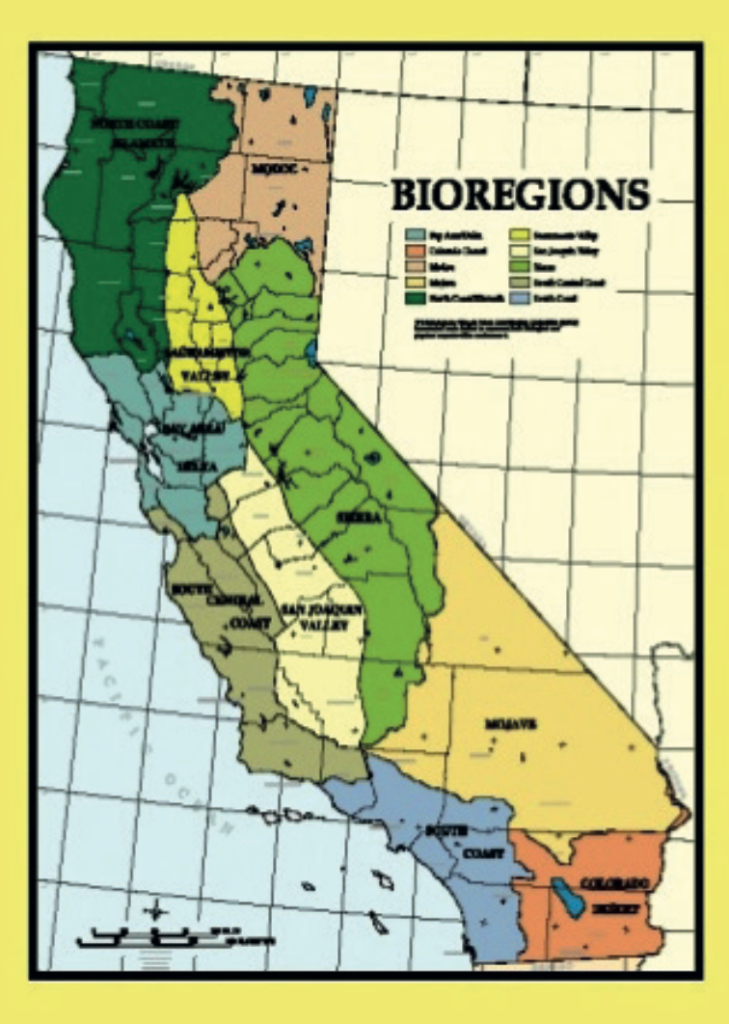
Now, we come to this notion of the bioregion. Let's take the example of California, which breaks down into ten bioregions. A bioregion can be defined as an area constituting a natural biological community with characteristic flora, fauna and environmental conditions and bounded by natural, rather than artificial, borders. In contrast, all our nation-states have artificial borders.
I will tell you a story to help you understand the nature of a bioregion. You can go online, and you can put bioregional audit into your Google search box, and you will come up with a list of about twenty questions. The first time I ever did this was for Taiwan at a Christian missionary conference about fifteen or twenty years ago. The questions were along these lines: can you point to the exact sources of the food you ate for breakfast this morning; and as for the waste that was left over, where exactly did that go? Then there were a number of questions about the watersheds and the different sources of water in the vicinity of your home. And then there were more general questions like, can you name ten trees within the vicinity of your home? Also six flowers, eight animals; and the material of which your jumper is made, where precisely did that come from? Who exactly knitted it for you?
Woven by Katie
I was brought up in Ireland – in a very poor family back in the 1950s. When we killed a pig it was the only meat we had for the whole year; we had four cows, from which we got the milk, and the cream from which we made our butter, and two acres of wheat, which was taken to the mill. We grew all our own vegetables. For my first Holy Communion I was given a present, of a jumper, made from the wool of Johnny MacAveevor up the hill, and woven by Katie in the village. So of the twenty questions on the website I could have answered seventeen. In fact I was living in London at the time I first googled bioregions, but in London I could only answer six of the twenty questions. I think you get the message. In my rural home in Ireland I was intimately connected with my environment. In London I was grossly disconnected from my bioregion.
In America there are about ten million people who have become very versatile in what they call the New Story. The question they have been putting to me is this: how come they are so immersed in this wonderful environment and yet they end up voting for someone like Donald Trump? What's the disconnect? In my opinion the disconnect is in the bioregion. Such people have wonderful knowledge, they have inspiring information, but they are not intimately grounded in their living connection with the living creation.
Friends, this is a big, wide, political statement on my part. I think the day will have to come – it might be a hundred years from now, it might be a thousand years – when we will have to return our Earth to bioregional government. And it will be then that we will begin to come home to our true meaning and our true place as earthlings, which is how God created us. I don't think that Jesus ever used the word bioregion, but the concept is certainly there in the Gospels.
I belong, therefore I am. It is not easy to come to terms with that, in a world of so much driven competitiveness, where "I am" relates to very strong individualism. Belonging is such a big feature of our Western world. It is first formed in the household, that's where it is grounded. Every household links in to the village, and every village is encapsulated into the wider hinterland of the bioregion. All the bioregions constitute Planet Earth, and Planet Earth is one of several planets constituting the Universe. And it is all there in the life and example of Jesus. From story to parable, and from parable to the cosmic horizon of our faith, nothing is excluded. Everything is sacred, at one level or another.
Nature cannot be regarded as something separate from ourselves, which is what we have been taught for centuries. Many of us have been brought up with the idea that spiritually you should abandon the world: it's a dangerous place, it's a vale of tears, it's source of sin. We have been indoctrinated with all that stuff, and now we have to try and rise above it. Nature cannot be regarded as something separate from ourselves, we are part of nature.
It's a statement which I suspect is baffling to many, many people in the Catholic Church. So much emphasis has been put on the supernatural, but not on the natural, on the soul but not on the material self. This dualistic splitting has done terrible damage to all of us, and to our world. We are part of Nature, included in it and thus in constant interaction with it. But you can only interact with it if you have some sense of your bioregional interconnectedness.
Christianity's way of making contact with the most basic physical and biological processes is through an inclusive, radical interpretation of the doctrine of the incarnation. Incarnation is a concept we Christians have but others don't have. But the vision should not now be merely in one human being called Jesus of Nazareth but in the world as God's body. Incarnation is about embodiment and the biggest body that we all have to come to terms with is the Universe. Planet Earth is a body, trees have bodies, bacteria have bodies and we have bodies.
God loves bodies. That's not what we used to be taught, but the living power of God's spirit works through the body. Oh, how are we to widen and broaden the understanding of incarnation so that it is about everybody in the whole of God's creation? That now becomes our challenge, and it fits in perfectly with this parable that we have been looking at tonight. God is always incarnate, always bound to the world as its lover, as close to it as we are to our own bodies, and concerned above all else to see that the body, namely God's world, flourishes.
This is because, as Laudato Si also says, this particular body cannot flourish unless the trees are flourishing, unless the animals are also flourishing, unless we have an environment and an ecological context that is flourishing in a healthy way. Our health and our wellbeing in that collective sense are all bound up with spiritual incarnation. So this Christmas I hope you will hear that word incarnation in a different light.
We Christians do not have a monopoly over incarnation. It should never be reduced to just the historical person of Jesus. Yet Jesus embodies in a very radical way, in a very rich way, God's love for bodies. That is why many of the parables are about the land, and about the responsibilities and duties of landowners. And, of course, in the Old Testament the land is God's great gift to the people. The land is sacred.
A personal note
I'm going to end on a rather personal note. I'm sure many of you have felt intensely over this past year or two about these horror stories of the people in the boats coming across the Mediterranean, and the hundreds of innocent lives that have been lost. This plight of refugees and asylum seekers is one of the massive issues of our time. And if Jesus was around today he would certainly want us to have a prior focus on it even if it's only in our prayer, and in contributing whatever we can to making and welcoming people to feel at home.
The European Union has been a disaster in terms of this responsibility because it lacks that fundamental spirituality of inclusivity. Its member states are too preoccupied with exclusive national borders and exclusive national patches. And so I want to dedicate this last few minutes to that sense of hospitality, that sense of the oikos, so that we at least hold it in our awareness, hold it in our prayer, hold it in our loving thoughts, and if we can in any way impress upon our politicians to be a bit more proactive towards inclusivity, all the better.
I'm going to share with you a passage by the American philosopher Richard Kearney, which is pure poetry. This is a poetic request on behalf of the asylum-seekers and the refugees. "Love the stranger as infinitely other, and wonder at the very strangeness of it all! The spiritual epiphany of welcoming, the poetic shudder of imagining, the ethical act of transfiguring our world by caring for the stranger as we watch the world become sacred."
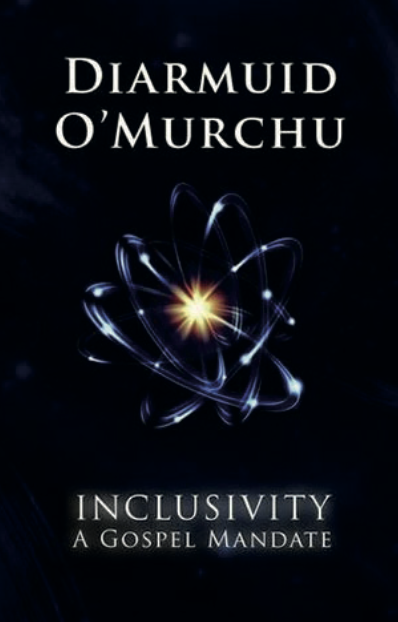
Fr Diarmuid O'Murchu is a member of the Sacred Heart Missionary Order. A social psychologist, he is the author of Inclusivity: A Gospel Mandate (Orbis Books, 2015) and Incarnation: A New Evolutionary Threshold (Orbis Books, 2017).