Extracts from a talk given to the North Merseyside Circle of the Newman Association at St Helen's Parish Centre, Crosby, on September 27th, 2018.
Extracts from a talk given to the North Merseyside Circle of the Newman Association at St Helen's Parish Centre, Crosby, on September 27th, 2018.
Introduction
The first thing to do in this sort of gathering is to distinguish what we know from what we think we know. I suspect most people here are fairly confident in their knowledge of Christianity, but I wonder how many know anything about Marxism.
At the same time, I guess most people have an opinion about both. I hope that helps you see why I shall spend far less time on Christianity than on Marxism.
The background - the thought of Karl Marx
When we look at Marxism there is no way of avoiding talking about Karl Marx, but, as some of you already know, there is much more to Marxism than can be attributed to the man who started it all off. He was born 200 years ago, on May 5th 1818, and died on March 14th 1883, being buried on St Patrick's Day, in Highgate Cemetery in London. His family was Jewish, but his father converted to Christianity in order to be able to practise law.
They lived in Trier, but Karl went off to study philosophy in Bonn and Berlin. Hegel was in vogue then and one of Karl's fellow-students was a young Dane called Søren Kierkegaard. Karl would have loved an academic career, but too many of his friends were radicals, so he became a journalist instead, writing articles mainly about politics. The four most important things he wrote as a young man were:
- Contribution to a Critique of Hegel's philosophy of Law. Introduction, and On the Jewish Question, both published in 1843
- The Economic and Philosophical Manuscripts, written in Paris in 1844
- Theses on Feuerbach, 1845
These are very different from what he wrote later. In fact, a French Marxist, Louis Althusser, put forward a theory that, sometime in 1845, there was what he called an "epistemological break" in his writings – in other words, that Marx suddenly started to think and write differently. Now he began to include economics in his theory of history and focused much more on an alternative society, writing more and more about socialism and communism. This period includes these works:
- The German Ideology, in 1845
- The Communist Manifesto, in 1848, the year of revolutions in Europe
- Contribution to a Critique of Political Economy, in 1859
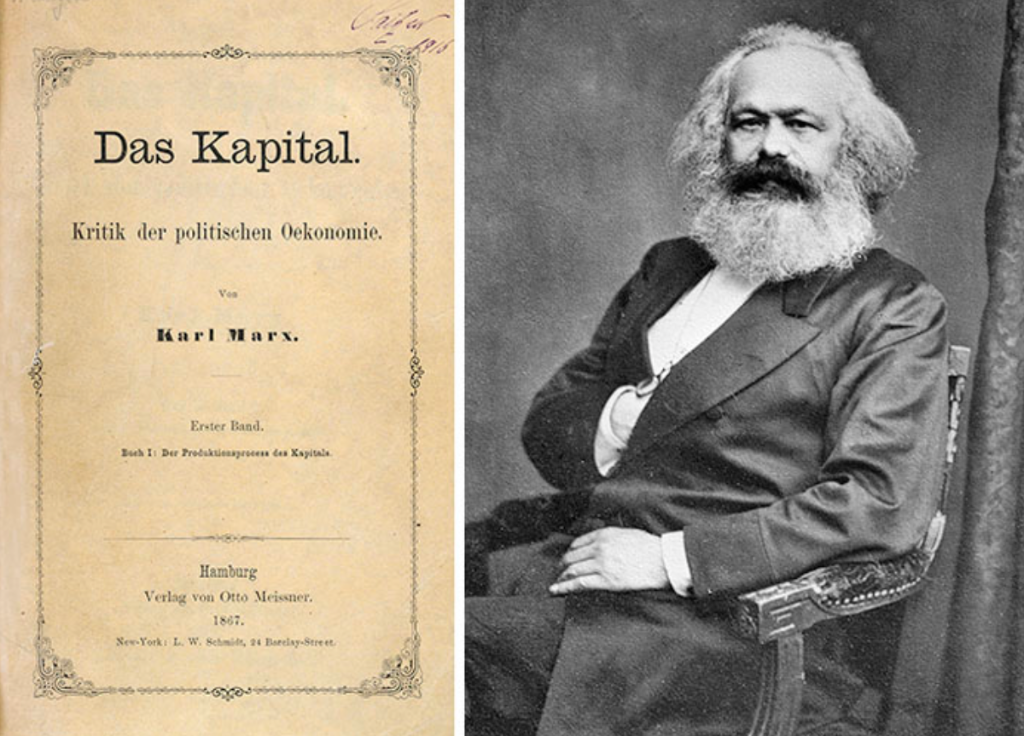
The Communist Manifesto is certainly the easiest thing to read of all Marx's writings, and when people read it for the first time many phrases sound strangely familiar. The Contribution to a Critique of Political Economy contains a clear statement of how Marx saw the development of history, a theory called "historical materialism". From here on Marx wrote mainly about economics and politics; the first volume of Capital appeared in 1867 and volumes II and III were published after his death. These are the years when he described what he imagined life in a socialist society would be like.
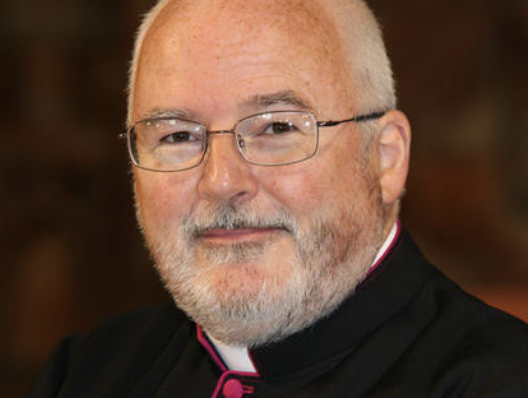
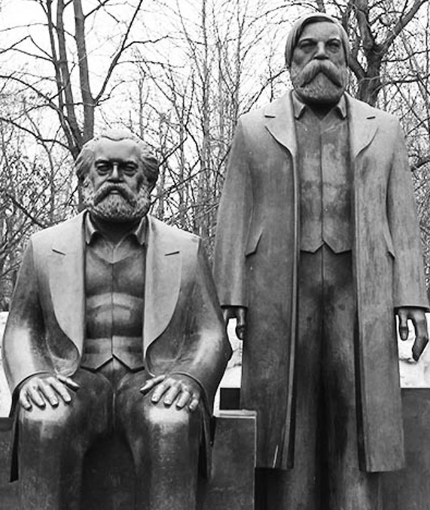
Marx never had money. He was lucky that his friend, Friedrich Engels, owned a mill in Manchester (I think it was actually in Atherton or Leigh), and supplied him with money throughout his life. He had several children with his wife, Jenny, and one with his mistress, who was the family's nanny. He was never really involved in political life, but spent his time in the British Library researching: he studied Adam Smith, David Ricardo and other economists – a long way from philosophy, as such.
I think the best way of grasping Marx's thought is to look at some texts on subjects that were important to him. You have heard a potted biography and seen what a strange life he had, in some ways like a social parasite living off the generosity of Engels, at other times making a reasonable living as a journalist, but never having a comfortable life. He has made serious contributions to philosophy, political thought and economics, and since sociology has come on the scene Marx has been on the topic list wherever the subject has been taught.
Why am I, Monsignor Peter Fleetwood, talking to you about the relationship between Marxism and Christianity? The explanation is a choice that I made in 1976. After our fifth year of studies at the seminary in Rome, it was time to decide what we would study for our last two years, at the end of which the idea was that we would achieve a Licence – something like an MA – in a specialised subject. It is called a Licence because it brings with it permission to teach in any seminary approved by the Holy See.
Most people went into one of several branches of theology, a very small number studied psychology, a steady stream studied Canon Law, some went into the much longer course in Scripture at the Pontifical Biblical Institute, and another small band went into philosophy: I was one of those. The choice to specialise in philosophy was only the first half of the decision, because within the philosophy Licence there were a few sections. I looked at the various possibilities and asked Archbishop Worlock if it would be all right to specialise in Marxist philosophy, which was part of the historical section.
I later discovered that he asked our Rector, Monsignor Cormac Murphy-O'Connor, if this Fleetwood fellow was some kind of "red under the bed". Monsignor Murphy-O'Connor told me he laughed uncontrollably, which did not amuse the Archbishop but did enable him to accept my suggestion. So I spent two years studying Marxist philosophy and wrote a dissertation on Marx's conception of history, for which I was given 10 out of 10.
Several years later, the Bishops' Conference of England and Wales asked me to be the Secretary of their Committee for Dialogue with Non-Believers. The people involved in the same work in Rome spotted that, and eventually asked me to go and work in the Pontifical Council for Culture, where I would be their specialist in dialogue with atheists and humanists. There is a long story there, for another time.
Marx on Religion
The basis of irreligious criticism is: Man makes religion, religion does not make man. In other words, religion is the self-consciousness and self-feeling of man who has either not yet found himself or has already lost himself again. But man is no abstract being squatting outside the world. Man is the world of man, the state, society. This state, this society, produce religion, a reversed world-consciousness, because they are a reversed world.
"Religion is the fantastic realisation of the human essence because the human essence has no true reality. The struggle against religion is the fight against the other world, of which religion is the spiritual aroma. Religious distress is at the same time the expression of real distress and the protest against real distress. Religion is the sigh of the oppressed creature, the heart of a heartless world, just as it is the spirit of a spiritless situation. It is the opium of the people."
The Materialist Conception of History
"In an epoch of social revolution, with the change of the economic foundation the entire immense superstructure is more or less rapidly transformed. In considering such transformations a distinction should always be made between the material transformation of the economic conditions of production, which can be determined with the precision of natural science, and the legal, political, religious, aesthetic or philosophic – in short, ideological forms in which men become conscious of this conflict and fight it out.
No social order ever perishes before all the productive forces for which there is room in it have developed; and new, higher relations of production never appear before the material conditions of their existence have matured in the womb of the old society itself. Therefore mankind always sets itself only such tasks as it can solve; since, looking at the matter more closely, it will always be found that the task itself arises only when the material conditions for its solution already exist or are at least in the process of formation."
From the Preface to A Contribution to the Critique of Political Economy
This is probably the most important text by Marx to read and understand; it is fair to see it as the basic description of Marx's view of history, what many Catholic thinkers, particularly people involved in the Theology of Liberation, call "Marxist analysis" rather than full-blown "Marxism".
What is the Catholic response? The Sacred Congregation of the Doctrine of the Faith questioned this in two documents:
- Instruction on Certain Aspects of the "Theology of Liberation" [Libertatis Nuntius] (August 6th, 1984)
- Instruction on Christian Freedom and Liberation [Libertatis Conscientia] (March 22nd, 1986).
The question is whether using a Marxian description of how history develops is compatible with Christian faith. Curiously, the Congregation stopped being called "Sacred" between the dates when these documents were published. Despite it being the most important text, it is almost impossible to grasp without being able to see it on the page, so here are the main terms Marx uses:
- Relations of production: how production is organised.
- Productive forces: the technology available.
- The mode of production: the stage of evolution of a society, which is determined by the relations of production: Asiatic, ancient, feudal, modern bourgeois.
- Conflict between the relations of production and the productive forces (what we call progress, or Vorsprung durch Technik) leads to Social Revolution.
- The way we think of our society is an ideological superstructure built on a material base; our battles are always at the ideological level - a huge red herring. Real change is in the material base.
- Revolution cannot happen before its time.
I would make two comments, one negative and one more provocative:
- I am not convinced anyone can find a place from which he or she can survey the whole of history and declare that a particular point in history, a particular state of affairs, "brings the prehistory of human society to a close". That would mean, clearly, that real human history was about to begin, and everything else had been a run-up, one or other of several preparatory stages leading up to now.
- This is not unusual in the history of modern German philosophy, and the clearest example is the person who inspired Marx in his view of history, Georg Wilhelm Friedrich Hegel. The sarcastic way of describing what he and Marx did is to paraphrase it: "Here I am; I have the clearest view of history the world has had so far; with my arrival comes the key turning-point in history". I don't think I'm being unfair.
Marxism and Christianity: The Theology of Liberation
The most famous example of Christians using some element of Marxism is Liberation Theology. The first writer to make an impact in this field was a Peruvian theologian called Gustavo Gutiérrez, who published a book called A Theology of Liberation: History, Politics, Salvation in 1971. He suggested that genuine liberation has three elements:
- political and social liberation
- the emancipation of the poor, the marginalised, the downtrodden and the oppressed from all "those things that limit their capacity to develop themselves freely and in dignity"
- liberation from selfishness and from sin, thus re-establishing a relationship with God and other people.
Three things in particular strike me about Gutiérrez' approach:
- Othopraxis is much more important than orthodoxy (read that carefully: it does not mean that orthodoxy is not important. Cf. James 1,22)
- Scripture is the heart of all our theological reflection…on everything
- It is vital to help the poor, the marginalised, the downtrodden and the oppressed find tools that let them play an active part in their own liberation.
Cardinal Ratzinger at the CDF was concerned at several aspects, especially these two:
- He thought that re-reading Scripture from the standpoint of the poor might make it too easy to bend its meaning.
- He was uneasy about the notion of collective or institutional sin – for him it was essential to remember that sins are always committed by individuals. Many people found these concerns unconvincing, but they became part of the first Vatican declaration on Liberation Theology in 1984. The second declaration was more a hand extended in cautious friendship, although some concerns remained.
The theology of liberation inspired Black Theology, Feminist Theology and, in South Africa, Contextual Theology. These all used Marxist analysis, but in different ways, and each writer should be judged on her or his own merits. Too many people accused anybody "practising" the theology of liberation of being involved in an armed struggle, with posters of priests wielding a cross and a Kalashnikov rifle, but, as far as I can judge, that is a caricature. I once saw a Soviet manual in Spanish urging local cadres to recruit disaffected priests, but such publications from Progress Publishers in Moscow stopped appearing on January 2nd, 1959, as soon as the Cuban Revolution was in place. How cynical, but that's politics.
Shortly after Pope Francis was elected I was in the press office at the Bishops' Conference building in London. A young woman sitting over the desk from me was having a telephone conversation with a pained face. She put down the telephone and said her female friend had just rung her from America to have a cry because the new Pope was a Marxist. She asked me what I thought, and my unsympathetic reply was: "I wonder if she knows what a Marxist is".
Pope Francis and his predecessors, and Catholic Social Teaching
To answer the young lady's question more politely and more fully, let me quote an article by Andrea Tornielli in Vatican Insider, where he reported excerpts from an interview with Pope Francis, some of which were very interesting, like this one: The Pope has said, "If I were to quote some excerpts from homilies of the early Fathers of the Church, from the second or third century, on how the poor should be treated, someone would accuse me of preaching Marxism.
"You are not making a gift of what is yours to the poor man, but you are giving him back what is his. You have been appropriating things that are meant to be for the common use of everyone. The earth belongs to everyone, not to the rich." These are the words of Saint Ambrose, which Pope Paul VI used in Populorum Progressio to show that private property is not an unconditional or absolute right for anyone, and that nobody is allowed to keep for his own exclusive use what is more than he needs, when others lack what is necessary.
Saint John Chrysostom declared: "Not to share one's wealth with the poor is to steal from them and to take away their livelihood. It is not our own goods which we hold, but theirs". He also asks: "Do you want to honour Christ's body? Then do not scorn him in his nakedness" – in other words, the poor, who have nothing to wear – "nor honour him here in the church with silken garments while neglecting him outside where he is cold and naked. For he who said: This is my body, and made it so by his words, also said: you saw me hungry and did not feed me."
Attention to the poor
As we can see, this attention to the poor is in the Gospel and in the tradition of the Church; it is not an invention of communism and should not be manipulated ideologically, as has sometimes happened in the course of history. When she invites us to overcome what I have called the globalisation of indifference, the Church is far from any political interest or ideology: moved only by the words of Jesus, she wants to offer her contribution to the construction of a world where we watch out for each other and look after each other".
As we can see from these quotations from the Fathers of the Church of which Francis wanted to remind us, this attention to the poor is part of the most authentic tradition of the Catholic Church. In the same way the Church's social teaching is part of her tradition, developed particularly since the end of the 19th century. In his Encyclical Letter Rerum Novarum, Pope Leo XIII wrote: "some opportune remedy must be found quickly for the misery and wretchedness pressing so unjustly on the majority of the working class…; working men have been surrendered, isolated and helpless, to the hardheartedness of employers and the greed of unchecked competition".
Pope Pius XI wrote, in his Encyclical Letter Quadragesimo Anno: "In the first place, it is obvious that not only is wealth concentrated in our times but an immense power and despotic dictatorship is consolidated in the hands of a few, who often are not owners but only the trustees and managing directors of funds which they administer according to their own arbitrary will and pleasure". In the same document we read: "The easy gains that a market unrestricted by any law opens to everybody attract large numbers to buying and selling goods, and they, their one aim being to make quick profits with the least expenditure of work, raise or lower prices by their uncontrolled business dealings so rapidly according to their own caprice and greed that they nullify the wisest forecasts of producers".
Prophetic words from Pope Ratti, who had seen what had happened in the Wall Street crash in 1929. Words that can interpret the present economic and financial crisis, too. Pius XI pulled no punches when he spoke, in the same Encyclical, of a "deadly and accursed internationalism of finance or international imperialism whose country is where profit is". Was he a Marxist or a Leninist, too? Or is it rather that certain Catholics today have forgotten the Church's social doctrine? "The hungry nations of the world cry out to the peoples blessed with abundance. And the Church, cut to the quick by this cry, asks each and every man to hear his brother's plea and answer it lovingly" – words written by Pope Blessed Paul VI in his Encyclical Letter Populorum Progressio.
Goods are made for everyone
In his Encyclical Letter Sollicitudo Rei Socialis, Pope Saint John Paul II pointed out that "the option or love of preference for the poor… is an option, or a special form of primacy in the exercise of Christian charity, to which the whole tradition of the Church bears witness". He also wrote, on the subject of the right to private property, in his Encyclical Letter Laborem Exercens, that the Church "has always understood this right within the broader context of the right common to all to use the goods of the whole of creation: the right to private property is subordinated to the right to common use, to the fact that goods are meant for everyone".
One could also recall what §1908 of the Catechism of the Catholic Church says: "The common good requires the well-being and social development of the group itself. Development is the epitome of all social duties. Certainly, it is the proper function of authority to arbitrate, in the name of the common good, between various particular interests; but it should make accessible to each what is needed to lead a truly human life: food, clothing, health, work, education and culture, suitable information, the right to establish a family, and so on".
In November 2016, in an important speech to the World Meeting of Popular Movements, the Pope said: "As long as the problems of the poor are not radically resolved by rejecting the absolute autonomy of markets and financial speculation and by attacking the structural causes of inequality, no solution will be found for the world's problems". The Pope explained that "the entire social doctrine of the Church and the magisterium of my predecessors rejects the idolatry of money that reigns rather than serves, that tyrannises and terrorises humanity".
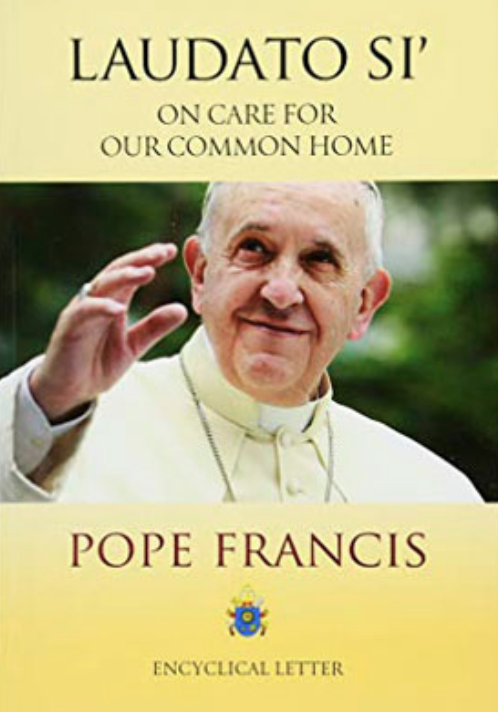
What the Pope is asking us is not to be indifferent. Not to be indifferent to poverty, to injustice, to the great waves of migrants, to the victims of war. And he wants us to make a real commitment for change. It is easy to miss how urgent the change that Francis asks of us is: urgent in order to avoid humanity sliding into an abyss. In the Encyclical Letter Laudato Si' the Pope showed how the themes of safeguarding creation and the struggle against pollution cannot be dealt with without facing up to the problem of poverty, in a world in which there ought to be resources for all, while millions of human beings are condemned to die of hunger.
"There is a way of knowing if God is close to us or far away from us: whoever takes care of someone who is hungry, without clothing, poor, 'disappeared', tortured, a prisoner, of all this suffering flesh, has God close by". So said Blessed Oscar Arnulfo Romero, the Archbishop of San Salvador who was assassinated by the death squads.
"When I give a poor man something to eat, everyone calls me a saint. But when I ask why the poor have nothing to eat, they all call me a communist", said the bishop of Recife, Hélder Câmara. The same seems to be happening today with Francis. But the Pope is not and never has been a communist. Many Christian philosophers, thinkers, economists, educators and politicians have forgotten what the Church has always taught, and ought to teach.
It would be interesting to present my students in the seminary with some of these texts interspersed with the odd Marxist text, and ask them to say who they think wrote them. They would probably be quite disoriented at the end of the exercise.
A period of brutal rule
A problem with certain variants of Marxism, has been that they allow for a period of brutal rule until they have sorted society out sufficiently to allow people the freedom they thought the revolution was going to bring them. They need to adjust everything to the blueprint and, while they are doing that, they seem unable to trust their underlings and exercise astonishing levels of control over them; sometimes they try to control what they think. A Christian view of life is startlingly different: it involves living values now in such a way that those values, because we live by them, themselves bring about the future situation. Jesus never said, start loving people when everything is sorted out. There was no time-lapse involved in his great commandment. When He said, "love one another as I have loved you", He meant, to put it bluntly, "Get on with it. Do it now".
Here lies a decisive difference between Marxism and, on the one hand, Judaism and, on the other, Christianity. For the former, the definitive situation is still to come; for a Christian, the definitive situation is already here, and it must simply be put into practice.
By coincidence, today (note from the Editor: this lecture was given on September 27th) is the feast of Saint Vincent de Paul; there is a powerful extract from his writings in the Office of Readings, part of the Prayer of the Church, the Breviary you used to see priests reading (now it's all in a smartphone).
Here are just two short sharp reminders from Saint Vincent de Paul:
- It is our duty to prefer the service of the poor to everything else and to offer such service as quickly as possible.
- Charity is certainly greater than any rule. Moreover, all rules must lead to charity. Since she is a noble mistress, we must do whatever she commands. With renewed devotion, then, we must serve the poor, especially outcasts and beggars. They have been given to us as our masters and patrons.
I have no problem when people recoil in horror at the mention of Marxism. I am happier if their reaction is more thoughtful. What I cannot accept is people who dress up their party political convictions as Christianity. Anyone who has problems with turning Christianity into Marxism should also have problems with turning Christianity into Republicanism, or any -ism. At the end of the day, an idealistic Marxist genuinely trying to improve the lot of the poor is much more appealing to me than someone who despises other people, or classes of people, and claims at the same time to be a follower of Christ.
Mgr Peter Fleetwood is Chaplain at Maryton Carmel Monastery, Liverpool, and a visiting lecturer at St Mary's College, Oscott.