I was invited here because just after Christmas last year I took part with Melvyn Bragg in a debate on the radio on Papal Infallibility – you can find it in the BBC archive on-line.
Papal Infallibility
By Thomas O'Loughlin
I was invited here because just after Christmas last year I took part with Melvyn Bragg in a debate on the radio on Papal Infallibility – you can find it in the BBC archive on-line. And one of the things I meant to say there, but didn't get a chance, was that everyone seems to have an opinion on Papal Infallibility. Some Catholics treat it almost like the centre of their Faith: any questioning is out. Interestingly there is a large group of Protestants who see it equally as the most detestable thing about Catholicism, and assume that the Pope is infallible in everything. It is, likewise, amazing the number of people who come along and use it as a sort of shibboleth. "Do you believe in Papal Infallibility?" And they are waiting for you to say "no", in which case they will tell you that you are a heretic; or they are waiting for you to say "yes", in which case they are going to call you a papalist buffoon.
Why 'infallible'?
The whole problem of Papal Infallibility is far more interesting than the question of whether you accept it, or not, or even the question as to whether the Pope is infallible or not. Because it may show up some of the fundamental problems that Christians – not just Catholics – face in the modern world. The place to start is with the word "infallibility". We do not normally think in terms of being "fallible" or "infallible"; we think of being right and wrong. There are many complex moral situations that we are all familiar with where such right/wrong answers may be problematic, but let us start with some much simpler situations. When we were in school, the first thing we did was some simple sums (two plus two equals four) and we got a tick – correct! Or, later, we are asked to prove that the square on the hypotenuse is equal to the sum of the squares on the other sides, and we either get it "right" or "wrong". And most of us have got to the age at which we know that this is true, but also know that if we tried to prove it, we would probably get the proof wrong. Thus, in our everyday lives, we deal with right and wrong.
So where does the word "infallible" come from? It does not come from either the moral sphere, or the sphere of "knowing", or even the sphere of interpreting; it comes from the sphere of formal logic. Fallacy is when into the reasoning process, assuming that the premises are true, false thinking has intruded, such that the result does not bear any credence. There was a beautiful example of this for many years on the television which was as follows: dirt is biological, Ariel washing powder is biological, Ariel washing powder is good for dealing with dirt. Now, you may think that is true; you may even have gone off and bought a packet of Ariel washing powder and then used it, and said, "Yes! It does wash clothes." But truly, the reasoning there is false, because – in logic – that is what is known as an undistributed middle. I will give you another example of the exact same argument. All sailors are men, all admirals are sailors, all men are admirals: that follows the exact same logical pattern, but we have committed a logical fallacy there – except in this case it is obvious that we have blundered.

Now, fallacy to us is something that belongs to formal logic, the courtroom, and now to computers, where it is a bug in the system. What you typed in is not wrong but there is something wrong in the system that is making it go awry. Why did the Papacy opt for such an obscure notion of its own perfection? It didn't say: the Pope is an Oracle. It didn't even say that the Pope is able to come to perfect moral judgments. It said, in the reasoning the Pope is free from fallacy: infallible.
How much do we know?
One of the problems that separates us from the world where that happened is that until sometime in the late 18th Century there was a widespread belief in all forms of Christianity that all truth was known. We have the Truth. We know the truth and we know it in its entirety – if not (yet) in all its details. Now, it could take the form that the truth is contained in the Bible. The truth is all there, and all we have to do is look in the Bible and draw it out. And if it is all there in the Bible you must be able to put certainty into that system. The Evangelicals today would use the term "inerrancy" along with the notion of "the sufficency of scripture", and they would say the text is inerrant and one can believe "sola scriptura". People can make mistakes, and there might be "surface-level" contradictions but the text is secure: it was given by the Holy Spirit and, if it is inspired, there is there all the information you could possibly need. You do not require anything else, and so such an Evangelical can say: "Just give me a Bible and it is all there".
No Catholic would ever say that; we haven't used that sort of reasoning for several centuries. But in the Middle Ages we still believed that it was all there in the Scriptures. And so, for instance, we used the Scriptures to explain natural phenomena and, of course, famously we used the Scriptures to challenge empirical phenomena: we are all familiar with the Bellarmine versus Galileo debate. We knew what the content of truth was, therefore you could not find out something that would really contradict it. But equally we had a belief that everything we needed to know for religion was already given. The way we put this was: "Revelation was complete with the death of the last apostle". Therefore (note my use of a logical connective) we knew whatever we needed to know. By direct inference (another logical process), no-one could then discover something that would contradict this body of knowledge.
Do we really grow in knowledge?
By contrast, today we would consider religion as an area where there is room for doubt. We would talk about doubt as the growing edge of Faith. And we would know that Faith is, as Newman said, a moving from shadows and images into the Truth (ex umbris et imaginibus in veritatem) – note the implication of motion from shadows into truth: knowing is a journey, a gradual process, a real discovering. But if you met a theologian in the University of Paris in 1530 − I am deliberately picking this date because these were the people who taught John Calvin and were reacting to Luther – indeed many were becoming "reformed". They would have reacted very differently. They would have admitted that at a very simple level there was empirical certainty but this was not that important because material things are subject to change – the world of the material is the world of contingency: something might be true or it might be false.
Then there is a higher level of certainty, mathematical certainty: we cannot imagine a universe where the angles of a triangle do not equal two right angles – this is real knowledge because it is free of the contingency – and such a proposition is either true or it is false. This is a world without grey! But there is a higher level of certainty, logical certainty: for example, the whole is greater than the part – this is analytically true without any external testing. That was considered to be such a perfect statement that it had to be true under all circumstances.
Then there was yet a higher level yet: metaphysical certainty. Metaphysical certainty was something like the law of identity. Everything is what it is: a thing both cannot be and not be at the same time and the same relation. That was seen as so perfect that is was a truism – for instance in Aquinas − that this "Law of Contradiction" was the point at which "all reasoning must begin". Even the simplest factual statement, such as "Lassie is a dog" was thought to assert implicitly the perfection of this law. But then there was a yet still higher level of certainty which was theological certainty. God in his Word could not be untrue to himself and therefore the Revelation had to have the perfection of the Divine Voice: it was nothing other than a manifestation of his own Being. To suggest a defect was contradictory, untrue, and, indeed, blasphemous.
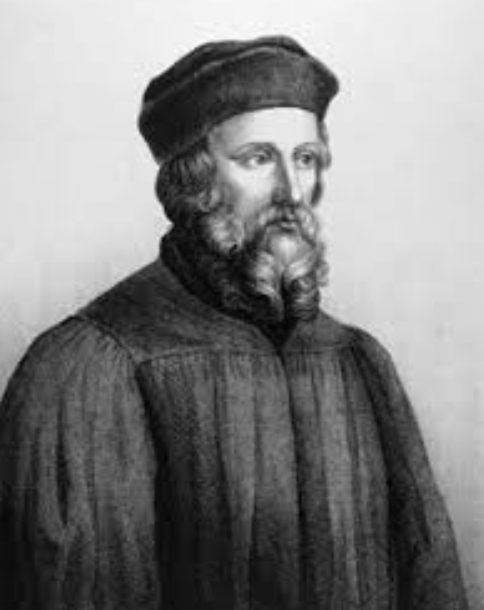
Now, every theologian in 1530 accepted that, and this is where the difference between the churches emerged. In 1530 if you went to the University of Wittenberg, where Luther had been teaching, you would have said, well, what are the three sources of the Divine Voice? Scripture, the judgments of the popes (decretals within Canon Law), and the judgments of the Councils. And Luther would have said: well, the judgments of the Popes have been found to have errors within them, and the error was visible in what was said about indulgences. Then we turn to the judgments of the Councils: people had said they could fall back on the Councils – it was called "conciliarism" in the fourteenth century. But the Council of Constance in 1415 had condemned Jan Hus, and handed him over to the civil power, and he was burned as heretic. So Luther said, if papal laws have failed, and councils have failed, then we are left with only Scripture as a manifestation of the Divine Mind. And that is what he meant by Sola Scriptura, by Scripture alone.
If you went to Paris and met the theologians who were not joining the Reform they would have said: Scripture, we are totally agreed; the Papal Decrees are still there, but they now need to be catalogued more carefully; and the Councils – well, they are perfect. Consequently, in the aftermath of the Reformation, both sides are agreed that theological certainty exists and both sides are agreed that everything is known. But for the Catholics there are more places to learn the details of what is known (i.e. "unknown knowns") and so you get the continual effort for the next three centuries to catalogue what is certain, and what is known, for these form the premises by which one will discover, in the known, ever more detailed answers.
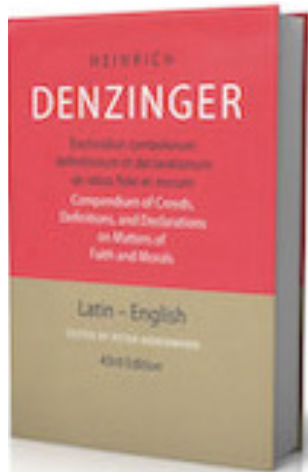
By the middle of the nineteenth century we came up with a famous catalogue of everything that we were going to stick by. It was called Denzinger*. It was a handbook, still in print, still being updated, where you could find all the decrees of all the Popes and Councils that were considered to be part of the complete fabric of theological knowledge (the so-called "deposit of faith"). If you have all of the knowledge there as a series of inputs, and you have a question over there, all you need is a perfect machine for interpreting the inputs and to generate the outputs, and that is a logical deduction machine. It is all known, and you just do the deductions. And that is the world in which infallibility was used. To assert that "the pope is infallible" is to assert that he is just such a perfect deductive logical machine (organon). Moreover, if you live in such a world you can take great consolation from the fact that one of the guarantees is that the machine has been checked.
Is knowing a matter of discovered fragments?
The problem that we face is that we have left that world where all knowledge is already granted in nuce, and we have gradually entered this world of ours where knowledge is fragile, fragmentary, and hard to attain. We took our first very frightened steps into it in the sixteenth century with the whole shift from a geocentric cosmos to a heliocentric cosmos and then on to an expanding universe. The first supernovum was a terrible shock to the system: even the "higher" supra-lunary world was not immune to change: so "certain knowledge" was incomplete. Then we took another step into it when, in the late eighteenth century, we discovered that what we believed was the most wondrous collection of perfect knowledge – the Bible – started to unravel as history. And so, for instance, in the late eighteenth century we no longer read the Gospels using the mechanisms of the Fourth Century so that they are all seen to dovetail. Then we come to see that they do not dovetail, and we produce things like the Synoptic Problem – and notice that "what the Bible says" is not a given but a tentative work of investigation and discovery.
Then in the late nineteenth century an amazing development takes place. Suddenly we realise that we do not know about medicine, and that an unimaginable development in biology seems to change the whole world. This was long before discoveries like DNA, but this changed our understanding about how human sexuality worked. I remember in the 1970s there was the major debate: how was it that contraception was wrong, but the rhythm method was said to be OK? This seemed a silly distinction, but the rationale lay in the fact that there had been approval of the rhythm method long before anyone who was involved in the theological decision-making realised that biology itself had changed. The theologians were working in a world of knowledge where all was known, and so here could not be any profound change; the medics were working in an empirical world where older teaching was simply dumped as outdated and where one expected biology – the actual content of this science – to change, be added to constantly, and every so often for the whole edifice to be turned on its head in what we now call a "paradigm shift".
This late nineteenth century incident is worth recalling for the clash of the two views of knowledge. A scrupulous medical doctor went to the Archbishop of Paris and asked whether it was lawful for him to have sex with his wife when (because he had been working on reproduction and was convinced that women only conceived on certain days of their cycle) his wife was temporarily barren every month. The Archbishop of Paris judged if that were true it would have to have been revealed to us. It hasn't been revealed to us, he said, therefore since we must know everything about this because it pertains to sin, this medic's concern is merely a transient factual opinion. It's a little like believing that the Moon is made of green cheese in terms of its status as knowledge. Mutable medical theories (i.e. opinions) cannot be contrasted with the certainty of the ecclesia docens: the Church does not have opinions, it teaches.
Alas, the Archbishop decided to send the question up the line. So he sent it to Rome, and they replied to the effect that, what are you worried about? Some mere mechanic in Paris, fiddling around with material things – women's bodies – thinks this is happening but he cannot know. We know what sin is because we have been entrusted with this perfect judgment since the time of the Apostles. And we say, whatever the medic says there is no problem. Because that judgment was made it could not be unmade, and it had to be held alongside the later decisions of 1931 and 1968, and, therefore, the Rhythm Method was, and is, OK. The circle was squared by a "distinction": contraception was not a moral issue at the level of human intentions, but at the material level depending on whether it was "artificial" or "natural".
In which epistemological world do you live?
Slowly as things have evolved in the past 150 years we have moved to a situation where today we think of knowledge not in terms of perfect deductions, but we think and work with "knowledge" in terms of induction and as something provisional and fragmented. What a place to say this: because I am here in St Albans, Verulamium, and the Baron Verulam – Francis Bacon − was, of course, the very first to challenge theological knowledge as being perfect. His famous critique of theology was "They claim to know all, and then just deduce," but Francis Bacon said we must not just deduce but build inductions. It doesn't matter what you think you know, you build it up on the basis of your experience.
Now that is the world in which we live. You may not like that fact. I am always intrigued by evangelical Christians who do not like the idea of an empirical world because it undermines the perfection of the Bible. But then they send you nasty messages on their smartphones. Be consistent is my reply: they should join the Hutterites and travel around in a horse and trap! If you don't like the empirical world stay out of it. But if you like your smartphone – and, you know, I am old enough now to need Naproxen for my knee – if you like the fact that this works better than castor oil, say, then that's the world in which you live. And, of course, that's the world in which we discourse religiously. We do not say any more "we know everything." Any religious leader who would get up today – in the face of all our challenges and all the suffering in the world – and say "we have the answers" would be seen as mad: a pied-piper to some false utopia.
Now, that is the challenge of Infallibility. It's not whether the Pope is infallible or not, or whether you like that idea or don't like it, or whether some particular judgment of the Church is infallible or not, or whether you like that or don't like it. The notion of infallibility raises for us the difference between, on one hand, the world in which we find ourselves and belong – we are not merely castaways in an alien culture – because we know that we do not know; and, on the other hand, the fact that we as Christians inherit material from an earlier world which viewed religion, and religious knowing, in such a completely different way. And, of course, we should always remember that there is something very comforting about the idea of knowing everything and attributing to something or someone. Whether it is a Pope, or a book, or a political system, or even to a conspiracy: the vain idea "all is known" can give you that warm feeling of [false] security.
But let's take a political system as an example. Marxism was a system that made a claim to knowledge of perfect understanding. Whether it was biology, how to run the economy, how to run the family, how to run the State, it could all be contained within the system. You knew the secret of the entire system. You could put your trust in it. And so the system – if you remember Aldous Huxley's famous statement, "the Party used only to claim to have invented the helicopter, now they have moved backwards and they claim to have invented the plane, they'll soon have invented the wheel" – so the problem is that once you start thinking that there is a certainty, certainty starts to creep, and so we have "creeping infallibility". And once you think you belong to a system where there is a perfect body of certainty, and a machine that will chuck out the answers for you, then you have leeching infallibility. The Pope is infallible, so the bishop is infallible, and you find out that suddenly the Parish Priest is infallible.
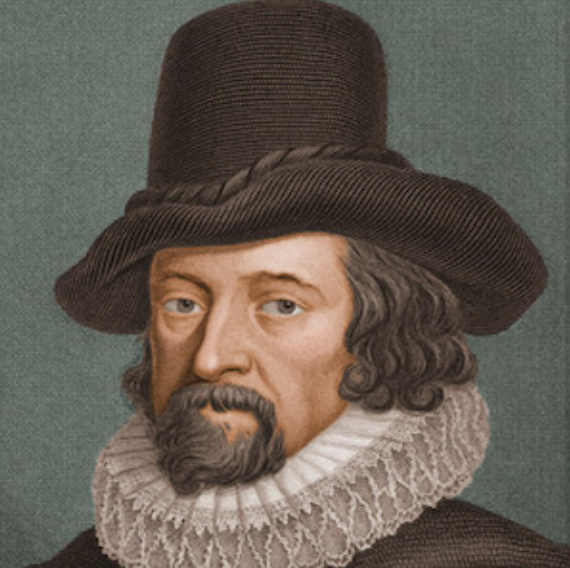
Do I believe the Pope is infallible? Well, the thing is, I came here by car. I am also pleased that these Naproxen tablets are so brilliant at removing inflammation, and the doctor who prescribed them for me said: "The next generation will be even better, because there are side-effects to Naproxen." So I live in a world where I try to make discoveries. I find myself talking to other Christians and other believers. And I realise that I have to be ready to learn. So I live in a world that was foreseen by someone who came from St Albans, in his beautiful Novum Organum.
Thomas O'Loughlin is Professor of Historical Theology at Nottingham University. This article is a transcript of a talk given to the Hertfordshire Circle in St Albans in November 2019.
*Heinrich Denziger produced the Enchiridian symbolorum et definitionem et declarationen de rebus fidei et morum in 1854. The most recent English translation was published by Ignatius Press, San Francisco CA, in 2012 with both the Latin title and alongside it this English title: Compendium of Creed, Definitions, and Declarations on Matters of Faith and Morals.