The doctrine of Purgatory, well-attested in basic form from biblical times, seems now to have been quietly forgotten. When one digs beneath those negative images to the basic concept of the doctrine of Purgatory, we encounter perhaps the most beautiful and consoling doctrine in the Church, the Communion of Saints.
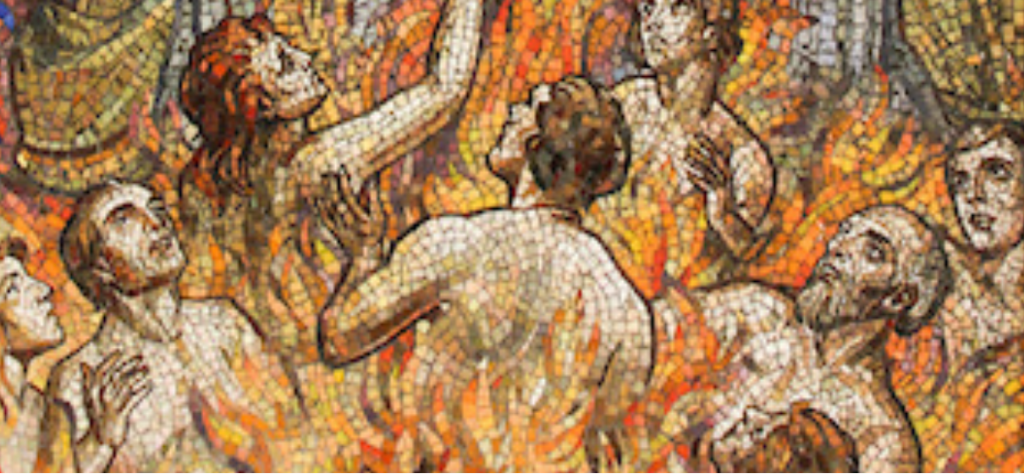
Purificandum est Purgatorium:
Flames, pains and indulgences or a most beautiful doctrine?
By Brian Hamill
The doctrine of Purgatory, well-attested in basic form from biblical times, through development in the Patristic era and formally declared at the Councils of Lyons, Florence, Trent and Vatican II, as well as in the Catechisms from Trent to St John Paul II, seems now to have been quietly forgotten. Why?
I suggest the doctrine, as it has been popularly portrayed, has an image problem, to the extent that RCIA programmes seem to ignore it, as do Catholic RE syllabuses. Flames, Pains and Indulgences sums up that image. This is a great misfortune for the Church; when one digs beneath those negative images to the basic concept of the doctrine of Purgatory, we encounter perhaps the most beautiful and consoling doctrine in the Church, the Communion of Saints. I will seek to show how this mining process needs to be done and what solid gold is found in the depths of a much-disgraced and apparently dark doctrine which, when brought to light, shines with a great power to bring Good News to all peoples.
Purgatory is a neglected issue. To illustrate this, I will tell of an incident which happened recently. I was visiting London with my wife Cindy and by chance we were in the Victoria area of the city with a little time in our hands, so we went along to Westminster Cathedral, more as tourists than as pilgrims. Opposite the Cathedral is the Catholic Truth Society bookshop, a place well-known to all Catholic theologians in London. I wanted to buy a book on a specific topic which I knew CTS would have something on, if my youthful memories of the 1950s are anything to go by.
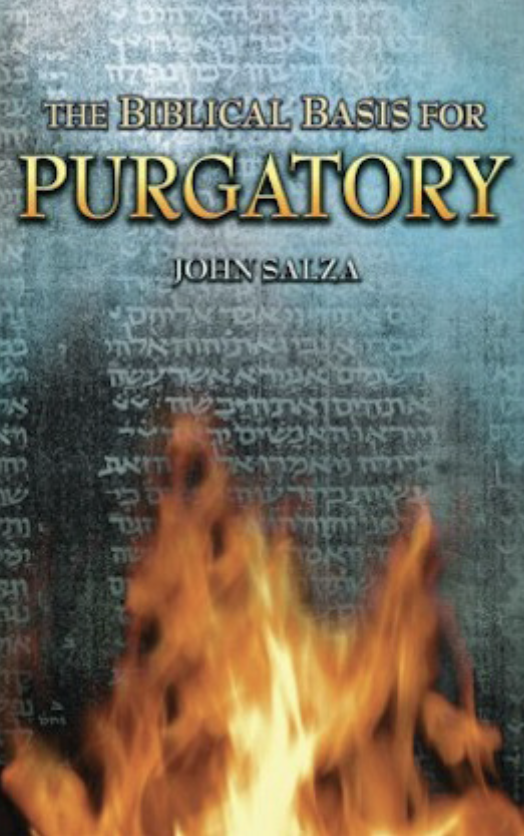
Books on Purgatory
I told Cindy beforehand that, when I asked for this topic, everyone in the shop would turn and look at me. I declined to tell her the topic and went in and asked the elderly shop assistant if they had any books on Purgatory. Sure enough, the four or five people in the shop turned towards me – and the assistant looked a bit startled. I seemed to have named one of the herd of elephants quietly grazing in the contemporary Catholic living-room. I actually had a discussion in the shop with a Heythrop veteran who recommended a 1977 book by the then Fr Ratzinger which he said was recognized as one of the best pieces of work the later Pope Benedict ever produced. I also purchased a book which the staff of the shop brought out, this one by John Salza, which tells me everything you ever wanted to know about Purgatory as it was taught to me in the middle of the last century.
It is a fascinating and informative read but it demonstrates quite clearly why Purgatory is an elephant very rarely, if ever, mentioned in polite theological circles – and anywhere else, for that matter, in its theological sense. Limbo is in the same category, but at least that was given a decent burial a few years ago by the International Theological Commission's report, endorsed by Pope Benedict. Limbo, indeed, was not mentioned in the 1983 edition of the Catechism of the Catholic Church.
But Purgatory certainly was mentioned, and the relevant paragraphs 1030-1032 of the Catechism are given under the general title The Final Purification, or Purgatory. The paragraphs are short and bear reading here.
1030 All who die in God's grace and friendship, but still imperfectly purified, are indeed assured of their eternal salvation; but after death they undergo purification, so as to achieve the holiness necessary to enter the joy of heaven.
1031 The Church gives the name Purgatory to this final purification of the elect, which is entirely different from the punishment of the damned. The Church formulated her doctrine of faith on Purgatory especially at the Councils of Florence and Trent. The tradition of the Church, by reference to certain texts of Scripture, speaks of a cleansing fire.
1032 This teaching is also based on the practice of prayer for the dead, already mentioned in Sacred Scripture: "Therefore [Judas Maccabeus] made atonement for the dead, that they might be delivered from their sin". From the beginning the Church has honoured the memory of the dead and offered prayers in suffrage for them, above all the Eucharistic sacrifice, so that, thus purified, they may attain the beatific vision of God.
Some extra points can be taken from the Decree of the Council of Trent De Purgatorio:
But let the more difficult and subtle questions which do not make for edification and, for the most part, are not conducive to an increase of piety (cf. Tim. 1-4) be excluded from the popular sermons to uneducated people. Likewise they should not permit opinions that are doubtful and tainted with error to be spread and exposed. As for those things that belong to the realm of curiosity or superstition, or smack of dishonourable gain, they should forbid them as scandalous and injurious to the faithful.
These final remarks, of course, manifest the reason why Purgatory is a tainted doctrine. In police terms, it has form. The doctrine of Purgatory, via an equally valid doctrine on indulgences, led in our fallen world, alas, to the abuses which detonated the Reformation when Martin Luther nailed his 95 Theses against indulgences to the door of the Church of Wittenburg in 1517. That act, and the underlying reasons for it in widespread sale of indulgences, especially by the Dominican Johann Tetzel, still resonate today. I recently asked a young Evangelical Minister friend what Purgatory meant to him; he immediately mentioned indulgences, and the sale thereof.
That episode was also the reason for the calming statement in the Tridentine document. But today, as far as contemporary Catholic theology is concerned, it is an event in the distant past. So what explains our Catholic reticence today? John Salza's book illustrates the difficulty very well, and that is why it is worth reading. He brings to bear all the scriptural and theological statements of Purgatory, or as it was known before the 11th century, purgatorial fires, since the earliest Christian times, to produce a vision of what happens to us after death which is utterly repugnant to contemporary ways of thought and expression.
I personally had great difficulty in my youth when told that, however great were the pains of my grandmother in dying, they were absolutely nothing to the pains she was going to experience in Purgatory, to which she was almost certainly bound since she was not a "great saint". This carefree and casual remark was matched by a parish curate who calmly told us ten-year-olds in our Primary School that, on the law of averages, half of us were going to Hell! This tended to be the style of thinking in those days.
Read James Joyce's Portrait of the Artist as a Young Man and in the sermon of Fr Arnall SJ you will get an extreme example of the cavalier attitude of religious teaching about the Last Things in the "good old days". Such was the theological tradition until the Vatican Council when Purgatory, not as a place but as a reality, was mentioned in the Dogmatic Constitution on the Church, Lumen Gentium N 49, when it refers to some [disciples] having died are [being] purified.
The Apostolic Constitution on indulgences Indulgentiarum Doctrina 3 states:
That punishment or the vestiges of sin may remain to be expiated or cleansed and that they in fact frequently do even after the remission of guilt is clearly demonstrated by the doctrine on Purgatory. In Purgatory, in fact, the souls of those "who died in the charity of God and truly repentant, but before satisfying with worthy fruits of penance for sins committed and for omissions" are cleansed after death with purgatorial punishment.
In paragraph 5 it goes on: For this reason there certainly exists between the faithful who have already reached their heavenly home, those who are expiating their sins in Purgatory and those who are still pilgrims on earth a perennial link of charity and an abundant exchange of all the goods by which, with the expiation of all the sins of the entire Mystical Body, divine justice is placated.
Pope Paul VI reiterates this teaching in his Apostolic Letter on The Credo of the People of God (1968). N. 28: We believe in the life eternal. We believe that the souls of all those who die in the grace of Christ whether they must still be purified in Purgatory, or whether from the moment they leave their bodies Jesus takes them to paradise as He did for the Good Thief are the People of God in the eternity beyond death, which will be finally conquered on the day of the Resurrection when these souls will be reunited with their bodies….and 30: We believe in the communion of all the faithful of Christ, those who are pilgrims on earth, the dead who are awaiting their purification, and the blessed in heaven, all together forming one Church.
Note again the two-connection teaching: Purgatory and the Communion of Saints. The Congregation for the Defence of the Faith (CDF), presumably with the approval of its then Prefect, Cardinal Joseph Ratzinger, added a comment in 1992 when in a letter to the Bishops on Communion Communionis Notio n. 6, it said: In its invisible elements, this communion exists not only among the members of the pilgrim Church on earth, but also between these and all who, having passed from this world in the grace of the Lord, belong to the heavenly Church or will be incorporated into it after having been fully purified.
St John Paul II in his Wednesday Audience of August 4th 1999 stated: The term [Purgatory] does not indicate a place, but a condition of existence. Those who after death exist in a state of purification are already in the love of Christ who removes from them the remnants of imperfection. Every trace of attachment to evil must be eliminated, every imperfection of the soul corrected. Purification must be complete, and indeed this is precisely what is meant by the Church's teaching on Purgatory.
And later in the same talk he said: Those who live in this state of imperfection after death are not separated from God but are immersed in the love of Christ. Neither are they separated from the saints in heaven – who already enjoy the fulness of life – nor from us on earth – who continue on our pilgrim journey to the Father's house. We all remain united in the mystical Body of Christ, and we can therefore offer up prayers and good works on behalf of our brothers and sisters in Purgatory.
Note that the Theology of the Mystical Body of Christ is here invoked in support of our prayers and good works on behalf of those who have died.
And finally Pope Benedict XVI, in his Encyclical on Christian Hope Spe Salvi (2007), nn. 45-48, states:
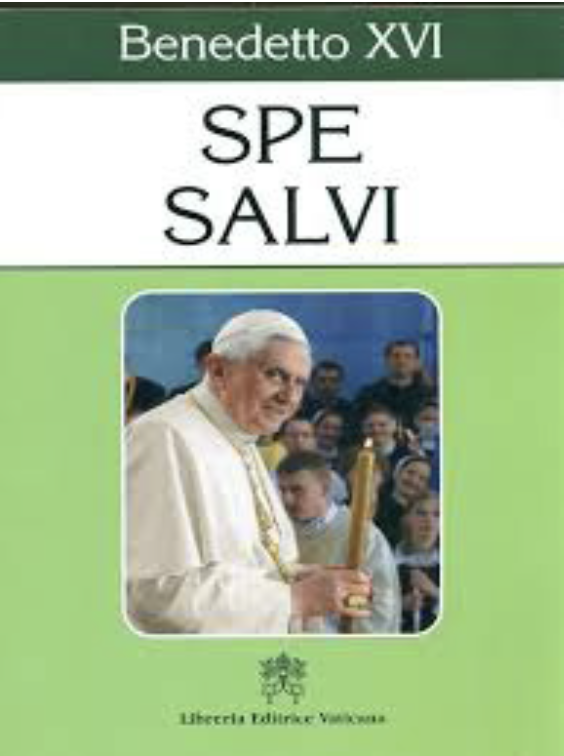
The early Church took up these concepts, and in the Western Church they gradually developed into the doctrine of Purgatory. We do not need to examine here the complex historical paths of this development; it is enough to ask what it actually means….St Paul writes in his First Letter to the Corinthians: If any man's work is burned up, he will suffer loss, though he himself will be saved, but only as through fire" (I Cor 3:12-15)….Some recent theologians are of the opinion that the fire which both burns and saves is Christ himself, the Judge and Saviour….His gaze, the touch of his heart, heals us through an unbearably painful transformation "as through fire". But it is a blessed pain, in which the holy power of his love sears through us like a flame, enabling us to become totally ourselves and thus totally of God.
Fire has always been in the Christian mind concerning Purgatory owing to the passage from First Corinthians and also owing to the cultural point of the practice of purifying metal and sterilizing objects by heat and fire. One has only to recall those dreadful pictures of people leaping from the windows of the Twin Towers on 9/11, choosing to die on the ground rather than be burned to death in the blazing building, to realise what a dreadful and destructive thing fire is. The relationship between Purgatory and Hell has been somewhat ambiguous over the centuries owing to the common factor of "fire", purgatorial fire and infernal fire. That ambiguity has seeped deeply into the Christian conscience and understanding. The fact that one is temporal and the other eternal does not mean a lot when one reads the stories of thousands of years in Purgatory. That sounds all but eternal to most mortals.
So much for the Flames, Pains and Indulgences in my title. It is now time to turn to the alternative part of that heading.
A most beautiful doctrine
I have hinted previously to the other, more fundamental, doctrine on which the whole system of indulgences, and prayers and good works on behalf of the dead, is constructed: namely, the Communion of Saints. In the texts we have seen, this has been developed along the lines of the Pauline-based doctrine of the Mystical Body of Christ, and Pope Benedict went further into the realms of the Eternal Oneness of Being. All these can be subsumed into the pre-eminent buzzword of our generation, Relationship.
We all need each other, not only economically but metaphysically. Just as there can be no Father or Mother without a child, so there can be no "I" without a "Thou". And we are immediately in the heart of the Trinity. When the author of Genesis 2 had the Lord God declare "It is not good that man should be alone" he was stating universal truth. No man or woman can exist in a fully human form without an "other". Through the doctrine of the Communion of Saints our relationship with the dead is not ended: it is enhanced. The dying person is not 'leaving', he or she is 'coming'.
There has always been from earliest times a relationship of prayer with the dead. Christians have always prayed for the dead, and this practice – along the lines of lex orandi: lex credendi (the way we pray manifests our beliefs) – was the historical foundation for the development of the doctrine of Purgatory. Likewise, they have always prayed to those who they consider are in heaven – namely the Saints – in times of need or trouble. The Patronage of the Saints invoked in the naming of our churches is clear evidence of this belief and practice. When the Reformers sought to eliminate Purgatory from Christian teaching they were, perhaps unwittingly, destroying at the same time this key, and most consoling, element of our Faith. What the doctrine of the Communion of Saints gives us is an everlasting link in love with those who have gone before us. So, the mother is consoled at the death of her son and the son at the death of his mother, and every other person whom either has ever known.
The great medium of communication is prayer, since true prayer works in time and in eternity. How? I have mentioned "relationship" and who bears that title above all others? The Holy Spirit, He who is Relationship personified since he is the Relationship between Father and Son. The Holy Spirit binds all things, both uncreated and created, into one. The Holy Spirit is the 'Being' of God and the 'Being' of God is Love.
When we pray, it is not we who pray but the Holy Spirit who prays within us. We are in time, he is in eternity and so is unbounded by past present and future. Our prayers for the dead can reach out backwards in our time to the time of their dying and give support in that great event. I use the word 'event' advisedly since there is a failing, I think, in the present official teaching of the Church on this point. Purgatory has now become not a 'place' but a 'state' or a 'condition of existence'. All three concepts share the same mode: stillness, no movement, no development. Since Purgatory is a temporal phenomenon it has a beginning and an end; it is therefore more accurately named as a happening or an event. Therefore, why not say that the event of Purgatory is death, the first great event of the Four Last Things?
Finally, the Holy Spirit has another role to play in Purgatory besides as the binding force of the Communion of Saints since he is named as the Soul of the Church. And the Church, in its fulness, is the Communion of Saints on earth, in heaven and in the anteroom to heaven, Purgatory. The Holy Spirit is the Fire of God's Love and as such he is the fires of Purgatory. He is the cleansing Power in Baptism. Read the Sequence for Pentecost, the Veni Sancte Spiritus, and consider that this is what awaits each of us in death, and be mightily consoled. All that the Fire of the Spirit does for us in Purgatory, either in this life on in death, is to change us into himself so that we become flame within the Flame of God. Now, that fate is worth dying for.
Brian Hamill is the Acting Hon. Secretary of The Newman Association. This talk was originally delivered to a Postgraduate Day at Durham University.