Jacques Fesch was born in 1930 in France into a wealthy family where his father was an avowed atheist and his mother nominally Catholic. He was expelled from school and although his father found him various jobs he lost them all by his laziness and disinterest in work. He fathered a child by his girlfriend, Pierrette, whom he married before his daughter was born but the marriage quickly ended in divorce and Jacques showed no interest in supporting his family. He later fathered a son by another woman who never knew Jacques as his father.
He then decided to sail to the South Pacific with the idea of buying a yacht and living an idyllic, pleasure-seeking life. His father refused him the money to buy the yacht and so on February 24th, 1954, he attempted to rob a currency dealer, Alexander Silberstein. He hit him on the head but Silberstein managed to call for help. A policeman, Jean Vergne, ran to the scene but Fesch shot him dead. He was arrested, tried for murder and inevitably convicted and sentenced to death by the guillotine.
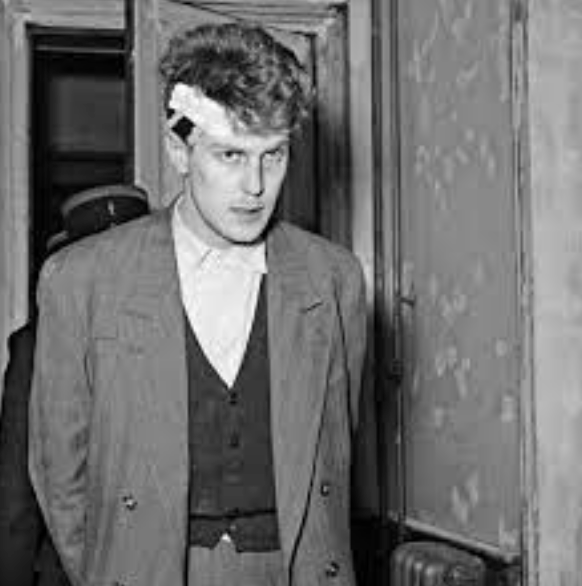
All of this seems totally unedifying and so it was. However, the real story of Jacques Fesch really begins here as in solitary confinement in prison he underwent a profound religious conversion. This did not happen at once but he gradually accepted the evil of what he had done and underwent a conversion, returning to the Catholic faith. This was through the ministry of three people: the prison chaplain, an old friend of Fesch who became a priest and his lawyer whose strong faith inspired Jacques. When in prison he wrote many letters and after he was guillotined on October 1st, 1957, his ex-wife Pierrette (who seems to have been a saintly person) and his daughter, Veronica, tried to publish them.
No-one was interested at first but they were eventually published with the help of a Carmelite nun, Sister Veronique, and a priest, Father Augustin-Michel Lemonnier. The English title of the book is Light over the Scaffold: Prison Letters of Jacques Fesch; and Cell 18: Unedited Letters of Jacques Fesch. He was 27 when he died.
Here are three extracts from the letters:
The first: Do not ask God to save such and such a person, or to help this one or that, but ask him that you may love him, and that his will may be done. You must talk with him familiarly and explain to him that you want to love him well, but that you can't do it, that many things seem obscure and illogical to you, and that you would like to understand them a little better … and do not hesitate, all day long, to invoke heaven.
The second: I am sad indeed. Is it a lack of humility that is making me insensitive? I could easily become violent, and at the least contradiction my hackles go up. Pride: the worst of evils and the one that most separates us from the Lord. I have plenty of reasons to be humble, but I'm not. The more I'm knocked down, the more I stiffen my neck and cling to the pride that is my form of courage
And in a letter to his mother, written a few days before he died. he ended:
Remain calm above all, and submissive. Think of the Blessed Virgin, who remained for hours beneath the cross without rebelling! It is to her that you must entrust yourself.
If God permits it, I will pray for all of you from heaven. Dear Mama, I don't know if tomorrow… well. I won't think about it. I'll write you a goodbye letter in any case. I embrace you with all my heart.
In 1993, the cause of Jacques Fesch was formally opened in Rome, giving him the title of Servant of God.
Anne and John Duddington