A Newman pilgrimage to Ravenna in September 2021 explored the city's astonishing Byzantine mosaics and early Christian heritage, from the Basilica of St Apollinaris to the masterpieces of art at St Vitale.
Ravenna: A World of Mosaics
By Barry Riley
Amidst all the Covid-19 uncertainties it was something of a miracle that the Newman Pilgrimage to Ravenna, the thirteenth in a series starting back in 1997, ever took place on schedule in mid-September this year. Only in the nick of time on August 31st did the Italian Government relax its quarantine requirement which would have made the Pilgrimage impracticable. One person who had booked dropped out at the last minute in the face of the formidable testing and certification requirements. But on Monday the 13th eleven brave Newman members travelled to Ravenna, together with our Chaplain Mgr Pat Kilgarriff and the organiser Anthony Coles.
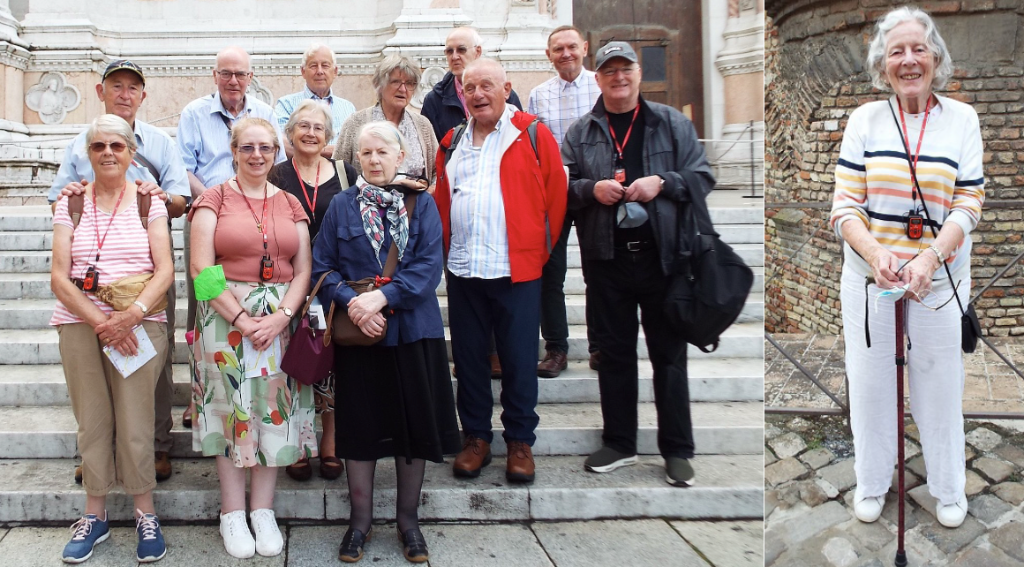 The Newman Pilgrimage Group
Ravenna today is a modest city, overshadowed by grander nearby locations such as Bologna and Venice. But it played a key part in the early history of the Roman Catholic Church. As Rome itself faded under pressure from Goths and other barbarians Ravenna in the year 402 became the capital of the Western Empire. Under rulers such as Justinian and Theodoric some astonishing religious buildings were created and were largely decorated by the mosaic walls and ceilings which remain so impressive today.
Ravenna's marshland
Moveable artistic treasures such as paintings and sculptures are often whisked away to distant galleries in places such as Rome, Florence or New York, but it is hard to transport mosaics or frescoes. However, they need to be carefully looked after and regularly restored as walls crumble and buildings sink over the centuries, as they often do in Ravenna which is built on reclaimed marshland.
Perhaps the most impressive of the many sumptuous buildings is the Basilica of S. Apollinare in Classe. Apollinare arrived from Antioch at the end of the 1st century and became Bishop of the new Christian community around the port of Classe which was developed as a major Roman naval base but which later silted up. The Basilica was built in the first half of the 6th Century and is notable for the spectacular mosaics in the apse, with an unusual green colour theme. S. Apollinare raises his arms in prayer and stands in the middle of a line of twelve sheep symbolising the faithful.
Some of the best mosaics are to be seen, however, in quite small buildings such as the Neonian Baptistry decorated at the behest of Bishop Neone in the mid-5th century and the Baptistry of the Arians which dates from the late 5th century. By this time, under Theodoric the Ostrogoth, Arianism had become the official court religion. Arians believed that Christ was not fully divine and although this doctrine had been condemned as heresy by the Council of Nicaea in 325 it remained widely believed in various parts of Europe until the 7th century.
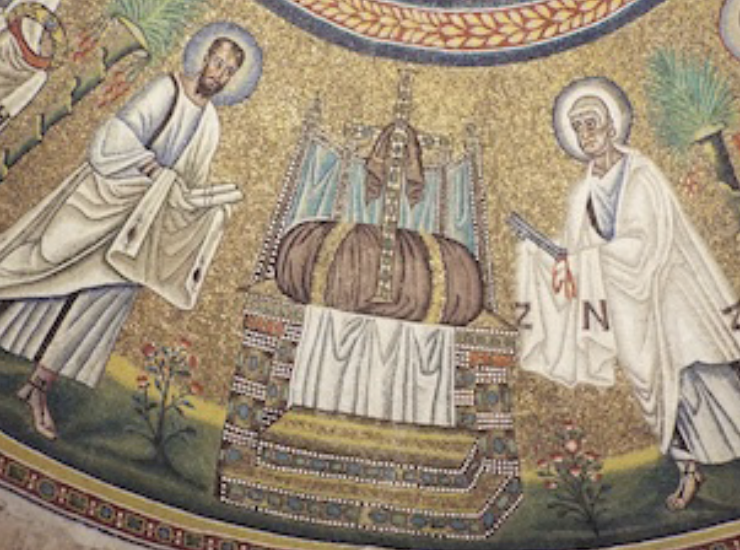 SS Peter and Paul in the Baptistery of the Arians
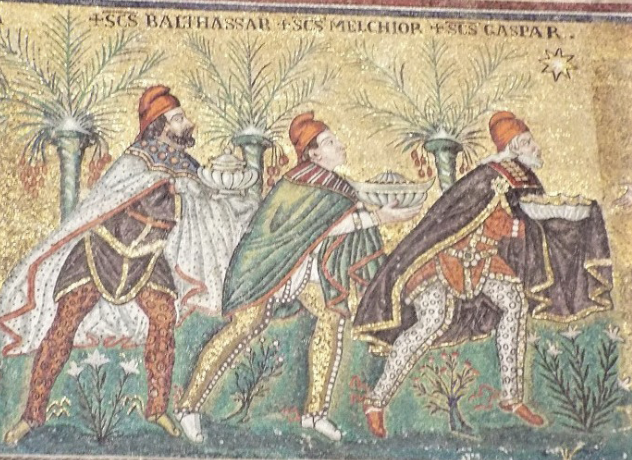 The Magi in the New Basilica of St Apollinaris
At the top of the list of attractions, though, is probably the Basilica di S. Vitale, sometimes described as "the most glorious example of Byzantine art in the West". It is lavishly decorated with mosaics all over the ceilings and walls. Many have Old and New Testament themes but there are portrayals, too, of the leading figures of the day including Emperor Justinian, Empress Theodora and also Bishop Maximian who consecrated the Basilica in 548. Viewing these mosaics proved testing for necks and eyesight: the smarter pilgrims had brought binoculars.
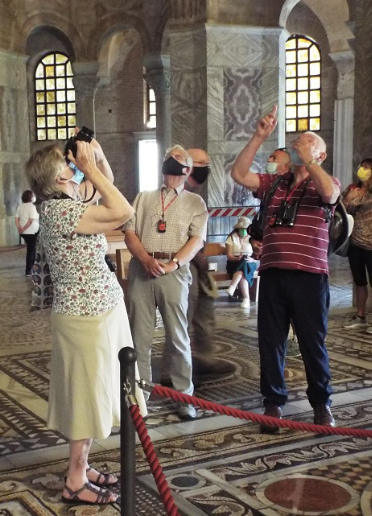 Straining the necks
Nestling nearby, and of the same age, is the Mausoleum of Galla Placidia, a daughter of Emperor Theodosius who died in Rome in 550. Historians are doubtful that she was ever buried in this mausoleum but a great deal of talent and money was expended on decorating the inside of this very small building. Galla Placidia ruled Ravenna and the West for many years, later acting as regent for her son Valentinian whose body may actually have been buried in the Mausoleum
Enormous thanks are due to Fr Pat who said Mass for us every day, usually in a side-chapel at the elegant tenth century Church of San Francesco, where the marsh water floods the crypt and goldfish can be seen swimming beneath the altar. It seemed odd to observe him reading the Gospel at Mass from a smartphone screen but an app weighs nothing whereas a Daily Mass Lectionary could help tip the airport check-in scales beyond the 23kg weight limit. The readings app is available on Google Play; today's pilgrims need to be tech-savvy as well as devout.
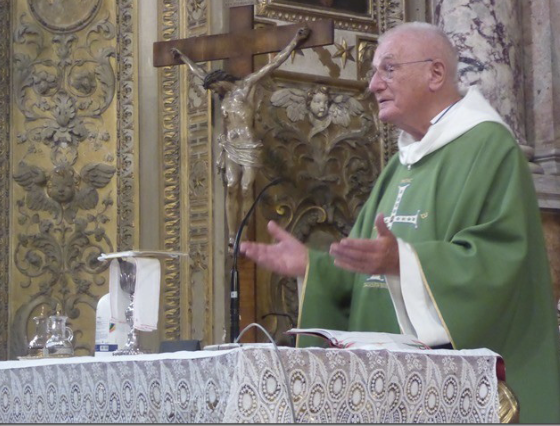 Fr Pat saying Mass in the Duomo
Fr Pat's compact but highly relevant sermons were much appreciated. He also gave us two lengthier discourses, one being on the role of the Arians in the early Church, a subject which greatly interested our patron St John Henry Newman who wrote a book, which is still in print, called Arians of the Fourth Century. Fr Pat's other lecture was stimulated by a commemoration which coincided with our visit, the 700th anniversary of the death of Dante Alighieri, the Divine Poet, in Ravenna on September 14th. The main local celebrations were held on the Sunday, the day before we arrived, but through the week there remained crowds around Dante's tomb, where a bell was tolled every evening at 6pm. Dante's remains have been moved about over the centuries but are now preserved in a small, neoclassical temple dating from the 1780s.
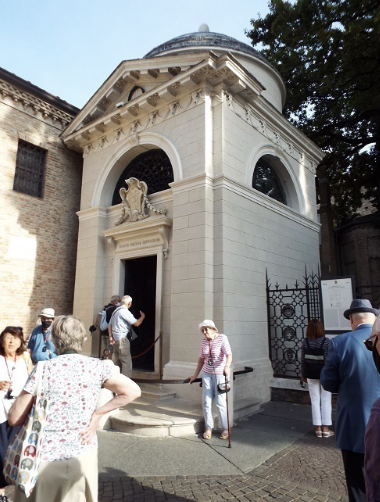 The Tomb of Dante Alighieri
Fr Pat described him as one of the two giants of world literature, the other being William Shakespeare. Dante's great work was The Divine Comedy or Divinia Comedia. He described the work, which is divided into three parts, Inferno, Purgatorio and Paradiso, as "profoundly Christian". In this fantasy narrative Dante, and companions such as the Roman poet Virgil, eventually arrive in Heaven and enjoy conversations with saints ranging from Thomas Aquinas to St Peter.
Back in the real world, however, we faced obstacles such as a constant requirement at each site to wear facemasks and present our NHS Covid Pass which showed we had received two vaccinations. The pedestrian area in the City Centre, which included our hotel the Centrale Byron, was useful in that we were not bothered by cars. But it also meant that on arrival we had to trundle our cases about half a mile along heavily-cobbled streets. And there was a constant risk from the numerous bicycles; curiously, on our one wet day, many of the cyclists were riding along holding umbrellas, which seems to be a uniquely Italian habit.
We enjoyed two excursions by coach to other locations, the first being a trip on Wednesday through part of the Po Delta National Park. We were told to look out for flamingoes in the lagoon but it seemed they had all flown off elsewhere. We did, however, see the strange structures in the rivers used to catch the plentiful eels. Our bus soon took us to the former Benedictine Abbey of Pomposa. Here Guido d'Arezzo invented modern musical notation in the 11th Century. The Benedictines decamped as long ago as 1650 but the Abbey has been well-restored by the Italian Government. It features a large church and an impressive campanile which is now nearly 1,000 years old and rises to 48 metres.
On the Thursday we went on a longer expedition to Bologna, a substantial city which has more than four times the population of Ravenna. It is notable for its colonnades (which were useful for us on a rainy day) and its towers, some of which lean noticeably but are not as famous for their tilt as the one in Pisa. One of the key religious buildings is the Basilica of St Dominic where the saint, who died in 1221, is buried in an elaborate multi-layered white carved stone shrine, small parts of which were contributed by Michelangelo. Gruesomely, his body was separated from his head which is contained in its own casket. Subsequently we visited the 14th Century Basilica of San Petronio where we saw some notable painted frescoes in the side chapels, including a fearsome depiction of Hell, with a huge devil eating sinners one by one.
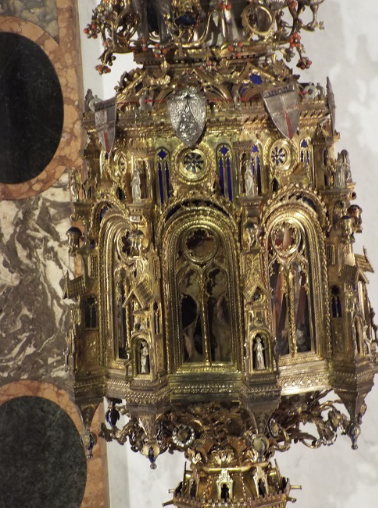 St Dominic's head is in here
On our last full day, Friday, we had to face up to our own penitential sufferings as we were required to fill in a Passenger Locator Form online and then endure, at a pharmacy, another swab test for Covid, the second of three tests which were required in all for the journey. One more awaited us at home, but fortunately all proved to be negative. However, our final Saturday morning turned out to be more relaxed as we toured the Cathedral Museum, which contains some notable items including the remarkable ivory throne of Bishop Maximian, and then Fr Pat celebrated Mass in the rather grim 18th Century baroque Cathedral (no mosaics there).
We must greatly thank the pilgrimage organiser Anthony Coles, who overcame all sorts of obstacles before and during the journey and finally hosted a splendid concluding lunch at the Trattoria al Cerchio, where we sat outside in the late summer sunshine. The forecast thunderstorms never arrived and several delicious courses were served. Finally, the restaurant produced a bottle of its iconic Ciliega Rosolio liqueur, a Po Delta speciality based on cherries: Rosolio translates as "dew of the sun".
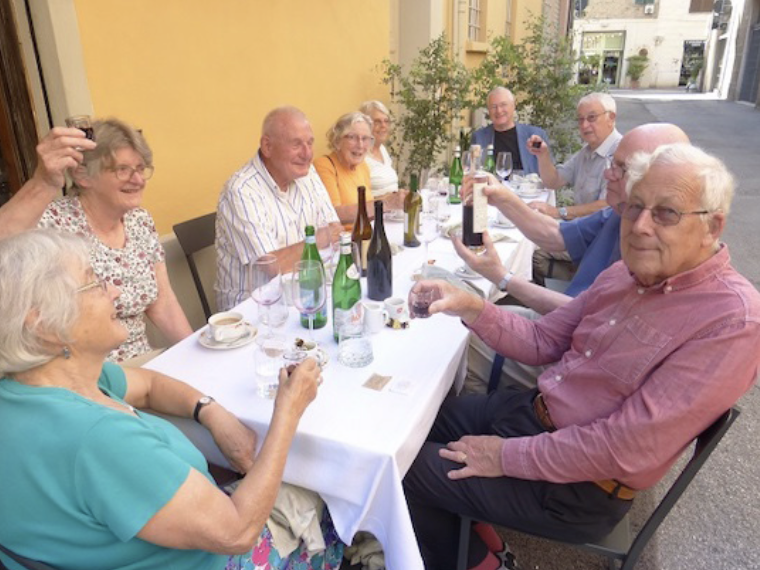
The Newman's 13th Pilgrimage included 13 pilgrims who travelled on the 13th of the month at 13.30pm. But pagan superstitions had absolutely no power over us.