Eileen Cheverton, a past President of the Newman Association, died just before last Christmas aged 100. She was central to the restoration of the Association's journal The Newman in 1984.
Eileen Cheverton 1921-2021
Eileen Cheverton, a past President of the Newman Association, died just before last Christmas aged 100. As President in 1992 she wrote the foreword to The Use of Gifts, a publication which celebrated the Association's first fifty years. "The fortunes of the Newman have varied over 50 years", she wrote then. "Membership has ebbed and flowed. Circles have come and gone and been replaced. But the Newman is still part of the questioning Church, maintaining a contemporary relevance to the world". She concluded by saying that the attempt to bring theological understanding and insight to many more people was an answer to John Henry Newman's call for "an educated laity".
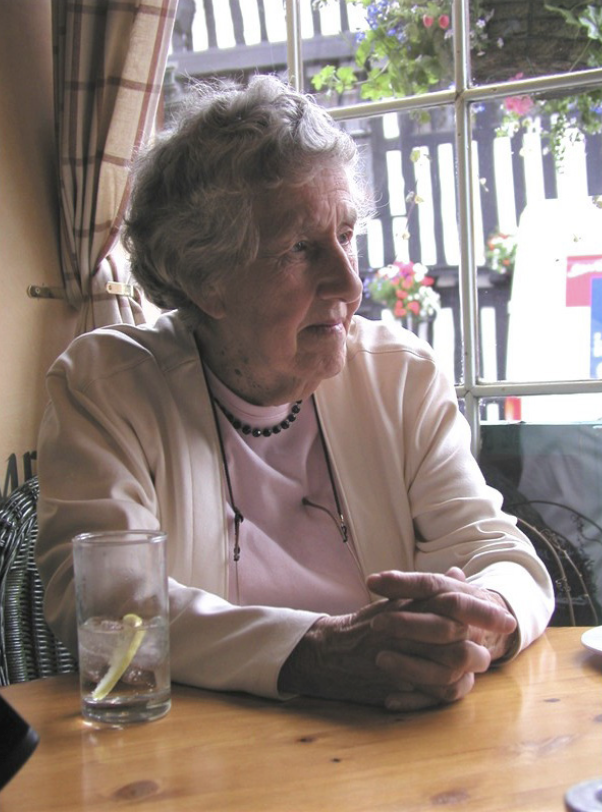 Eileen Cheverton
She was central to the restoration of the Association's journal The Newman in 1984, being one of a group of Newman members in the West Country who inspired the project. Robert Williams was the first editor but Eileen took over at various periods including during the years 2000-2008 when she was already into her 80s. Editorial meetings were held in her Cheltenham home over beer and sandwiches.
She was born in 1921 in London but spent much of her childhood on the Isle of Wight where her father's family had originated. Her parents set up a boarding house in Ventnor but the business failed during the Depression and the family moved to Bitterne near Southampton after Eileen won a scholarship to go to Itchen Grammar School. She went on to study English Language and Literature at what was then the Southampton branch of the University College of London.
On graduating in 1942 she was seconded to Bletchley Park, working in Hut Six which was at the centre of the mission to break the Germans' Enigma Code. Having signed the Official Secrets Act she was reluctant to talk about her work at Bletchley. After the war she moved to Cheltenham to continue her work at GCHQ, the intelligence-gathering unit.
 Hut six
When you thought of Eileen you always thought of her loyalty, her steadfastness and her quiet, unobtrusive acts of kindness. She cared for her mother for many years before she died and always had the habit of suddenly "being there" at a time when she was needed. This was accompanied by a matter-of-fact attitude to situations and she once memorably observed when a difficulty arose: "I've survived bombs". This was no idle boast as Southampton, where she was at university from 1939 to1942, was one of the most heavily-bombed towns in the UK. Her matter-of-fact attitude was seen too when, just before a meeting of the Editorial Committee of the Newman Journal at her house, all running water to houses in Cheltenham was cut off due to a flood. There was no question of cancelling or rearranging the meeting; instead, she got buckets and pails of water which were strategically placed around her house and the meeting proceeded as normal.
The Newman was a great part of Eileen's life and she was surely the quintessential Newman member. As a "Cradle Catholic" her fundamental loyalty to the Church was part of her life but it was not an unquestioning loyalty. She served as National President from 1991-1993 and when she died must surely have been the longest serving member of the Newman Association. She was, naturally, a stalwart member of her own local Circle, North Gloucestershire, for a great many years.
In 1984 what had been the Newman Newsletter was replaced by the Newman Journal and Eileen was one of the original Editorial Committee along with Robert Williams and others such as Philip Daniel. Eileen was Editor for many issues and meetings of the Editorial Committee at her home always followed the same pattern: sandwiches, then a discussion of what should and should not go in, punctuated by a vigorous debate on current topics in the Catholic Church followed by a glass of wine and good fellowship. She used to describe some articles as "timeless" and these went into a file to be used when other copy was short. The membership of the committee stayed the same for over twenty years which was a tribute to the enduring friendship which we enjoyed and Eileen's hospitality.
Then the journal had to be pasted up. No one dared to suggest the use of a computer! Instead, scissors, paste and a ruler did duty and 7¼ inches were carefully measured for the amount of text to be inserted. This may seem old-fashioned but the journal came out in this way, on time and full of excellent material, for nearly thirty years. She could, too, be quite disarmingly direct. On one occasion Eileen and one of us had laboured all afternoon on the "paste-up" of the journal, expecting to be joined by a third person. However, that assistant did not arrive until the very moment that the job was done. With a slight twinkle in her eye Eileen told the offender very firmly: "You are in disgrace!"
Eileen enjoyed travel and was fluent in many languages. This was reflected in her commitment to Pax Romana where she made many visits to meetings held in various parts of Europe and gave detailed accounts of these in the Newman Journal. She made many visits to Rome and when once asked if she had ever met the Pope calmly said; "Oh yes. Pope Pius XII". A friend that she was with had a cousin who was an Archbishop in the Vatican and through him the visit was arranged. Eileen explained that they just entered the Vatican and were escorted along some corridors and there was the Pope to meet them. Just like that! There was no elaborate security in those days, she remarked, but the Pope apparently could not fathom what a "civil servant" was. Kevin Lambert remembers Eileen's story about being in Assisi in 1997 for a Pax Romana meeting. She had gone for a walk in the surrounding countryside and while she was out, there was an earthquake. It was the earthquake which destroyed the beautiful frescoes in the basilica – and killed several people.
She only spoke of her work at Bletchley Park in later years as she, like many others of her generation, took the view that having taken the oath to observe the Official Secrets Act nothing should be said, even though the story of Bletchley Park became well known. When she did talk about her experiences she explained that she had not worked directly on codebreaking but was employed to listen to German radio transmissions, looking for unusual patterns of activity. She recalled that she worked shifts, was in Hut 6, and that the Saturday evening dances were lovely.
One tactic was to look for where in any message the encrypted version of the words "Heil Hitler"' appeared as it was a requirement for the Germans to include this somewhere. Once identified this made codebreaking easier. Another tactic was to watch for where a lazy German had used the previous day's code. After the War she worked in the Foreign Office in London before moving to Cheltenham to work at GCHQ.
Eileen's editorship of A Use of Gifts was appropriate as Eileen herself had many gifts and used them wisely and generously. One now has the sense of a life richly and fully lived, sustained always by a quiet but steadfast Christian faith. One cannot forget her. A last memory: the first time we met Eileen was at a Newman Conference at Spode House nearly forty years ago. The theme was "Unbelief" and she presented a paper on this topic from North Gloucestershire Circle. She began by saying: "It was my job to knock this into shape". That was the typical Eileen; always getting on with things, sorting them out and indeed knocking them into shape. May she be doing the same in Heaven.
With thanks to Anne and John Duddington
From A Use of Gifts, 1992
The Newman Association sees its primary purpose to enable Catholics to use their minds and their talents for the extension of the Kingdom of God. In the early days the Association was closely linked with the universities. Members were almost exclusively graduates and there was considerable intellectual firepower which is perhaps not now so prominent. The wider membership today can be seen as a response to changing times and the broadening of educational possibilities.
In the Association members find the opportunity and the stimulus to keep in touch, however superficially, with developing thought in the Church on moral and theological issues. The local circles are all-important and through them The Newman, with its national and international, professional and academic links, can offer theological understanding and insight of a high standard to many people, some of whom have lost touch with any academic institution.
Eileen Cheverton