A reflection on St. Theresa of Ávila (1515-1582) — mystic, Doctor of the Church, reformer of the Carmelites, and author of The Interior Castle — including her famous morning prayer and the beloved poem found in her breviary after her death.
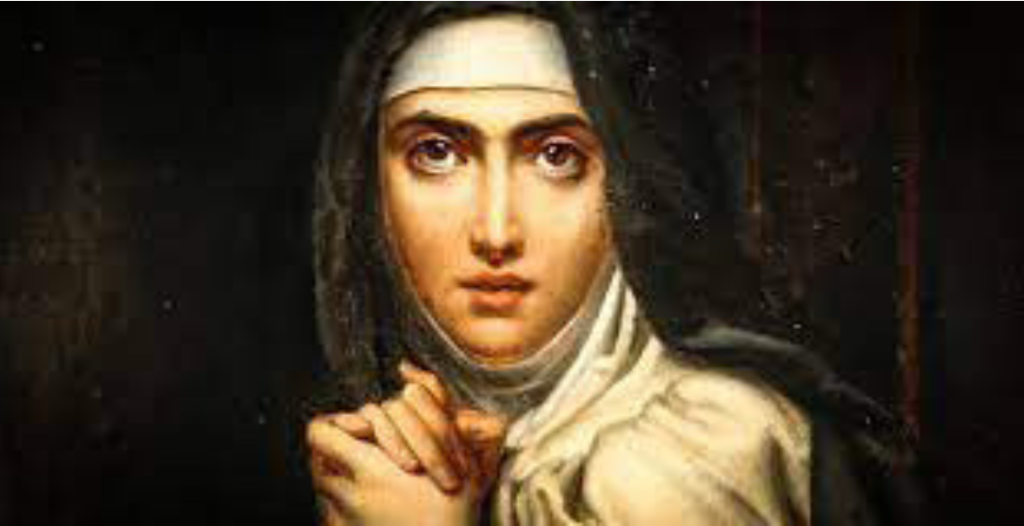
St. Theresa of Ávila, also called Saint Theresa of Jesus (1515-1582), was one of the great mystics of the Church and the author of many spiritual classics, especially on prayer. Of these the best known is probably The Interior Castle which is divided into seven mansions (also called dwelling-places), each level describing a step to get closer to God.
She began the Carmelite Reform, which restored and emphasised the austerity and contemplative character of the life of Carmelite nuns and was also active in the reform of the Carmelite friars in association with St. John of the Cross. She was made a Doctor of the Church in 1970 by Pope St. Paul VI, the first woman to be so honoured, and is also quite incidentally the patroness of headache sufferers.
St. Theresa, like so many other saints, of which St. Thomas More comes especially to mind, had a wry sense of humour with which we can easily identify. The best known instance is surely the story of when she was crossing a ford in the river on her donkey when the beast suddenly bucked and she fell into the water, along with all her belongings. Sitting in the river, St. Teresa simply looked toward Heaven and said: "If this is the way you treat your friends, I can understand why you have so few." Nor did she have time for unintelligent nuns: "God preserve us from stupid nuns!" she said. Instead she wished her nuns to have good judgement and to avoid narrow mindedness.
This is a perfect morning prayer of hers:
Lord, grant that I may always allow myself to be guided by You,
always follow Your plans,
and perfectly accomplish Your Holy Will.
Grant that in all things, great and small,
today and all the days of my life,
I may do whatever You require of me.
Help me respond to the slightest prompting of Your Grace,
so that I may be Your trustworthy instrument for Your honour.
May Your Will be done in time and in eternity by me,
in me, and through me. Amen.
St. Teresa led a restless life and as one of her biographers has said: "Of outward peace she knew none until the end of her days". Yet inwardly she was undoubtedly at peace and no mention of her would be complete without a reference to the famous prayer found written in her handwriting in the margins of her breviary after she died:
Let nothing disturb you.
Let nothing frighten you.
All things pass away.
God never changes.
Patience obtains all things.
They who have God
lack nothing.
God alone is enough.
Anne and John Duddington