Drawing on Scripture, feminist scholarship, and his own research, Chris Maunder explores the often-overlooked role of Mary in the founding of Christianity — from the birth narratives and the anointing story to the complex web of 'Marys' in the gospels — arguing that Mary served as a mother figure to the Jerusalem Church and that women deserve to be called 'founders of Christianity'.
In his Mariological work, Newman emphasised the ancient insight that Mary could be described as a "New Eve". In parallel to Christ, who was described as the second Adam in the Pauline epistles, Mary was the woman in the story of redemption which restored what had been lost by the original man and woman in Eden. According to the second century theologians, Justin Martyr and Irenaeus, Mary by her obedience to God put right what Eve had spoiled. This is a familiar theme in the development of Mariology.
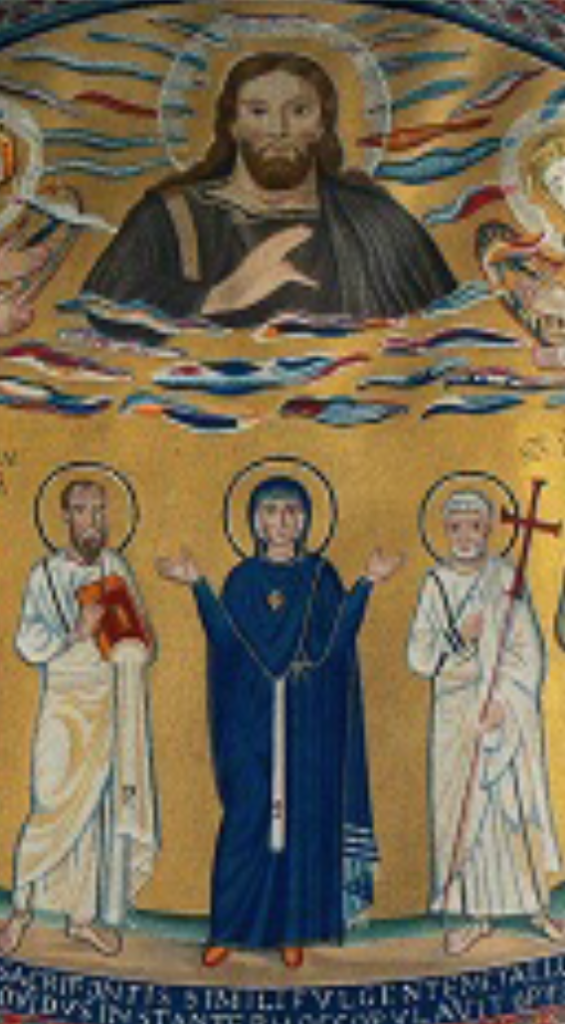
Byzantine-style mosaic depicting Mary among the saints
Therefore, Mary's relationship to her son Jesus Christ is in some sense analogous to that between Adam and Eve. Eve was Adam's "helpmate" in the Genesis story. It can be asked: what kind of helpmate is Mary to Christ? Does her contribution mainly consist in her agreement to bearing Jesus in her womb and her loyalty to him at the cross? Or was it this and more?
The question as to whether we should maintain a literal belief in the virgin birth in a modern age in which we understand the role of religious myth and know about the function of DNA has been alive in Catholicism since at least the 1960s. It led Karl Rahner, in his Theological Investigations, to suggest that Catholics who believed the virgin birth literally and also those who did not could at least agree that Mary "was incorporated with her whole body-soul existence into the historical salvific mission of Jesus" (Volume 19, English translation, DLT 1983, p. 229). In other words, at the very least, even if it were regarded as a mythical narrative, the virgin birth story is true in a metaphorical sense: it does at least assure us that Mary was called to a vocation in which she wholeheartedly made possible the ministry of Jesus.
Birth narratives
In addition to the birth narratives in Matthew and Luke, there are two passages in John in which Mary features: the marriage at Cana (2.1-12) and the crucifixion (19.25-7). In both, she is not named but referred to as the "mother of Jesus". Clearly, these two passages are linked because of the reference to Jesus' "hour", which is the cross, and they serve to present Mary at the beginning and end of Jesus' ministry. Unfortunately, for the purposes of knowing how Mary contributed to the ministry between these moments, there is nothing about her in the Johannine narrative from 2.13 to 19.24. Can we retrieve anything from that long gap in the story?
There are two reasons that suggest an explanation as to why Mary's activity during the ministry is not as prominent as it might be. The first is that, as many feminist scholars have pointed out, the New Testament is true to the culture of its time, that is, it is androcentric, with an emphasis on male participation and male leadership. The Catholic Church itself accepts that we have to read scripture with a knowledge of the culture in which it was written; Catholics are not "fundamentalists" (The Interpretation of the Bible in the Church, Pontifical Biblical Commission, 1993). While it is clear that women were crucially involved in the ministry – we read glimpses of this at Matthew 27.55-6, Mark 15.40-1, and Luke 8.2-3 – we do not find out much about them.
The second obstacle to the inclusion of detail about Mary in Jesus' ministry is a hesitation on the part of the evangelists about Jesus' family, who get only a very small mention. In several places – Matthew 12.46-50, Mark 3.31-5, Mark 6.3, Luke 8.20-1, John 2.12, Acts 1.14 – the "mother and brothers" of Jesus are mentioned as a family unit (the assumption that Mary was a widow by the time of Jesus' ministry is probably a sound one). We know that at least one of these brothers, James, became the Church leader in Jerusalem, as is in evidence in Acts 15, Galatians 1-2, and other early Christian sources, such as the Gospel of Thomas and the Church History of Eusebius. Both James and Jude have letters attributed to them in the New Testament.
The Will of God
The evangelists seem to have been a little nervous of the authority of these brothers. In Mark 3.31-5, Jesus waves his family aside and says that "whoever does the will of God is my brother and sister and mother" (quotes from New Revised Standard Version, Catholic Edition). This reticence can be explained by referring to Galatians 1-2, where Paul makes clear that James was associated with those Jewish Christians who were committed to maintaining the Jewish Law, the Torah, which Paul regarded as a crucial limitation on the spreading of the Gospel.
So perhaps we would know more about the traditions of the family of Jesus if it were not for the fact that Paul and the evangelists were trying to wean the early Church from the idea that the family were indispensable. There are stories about them in some of the non-canonical or apocryphal writings; these are impossible to substantiate historically, of course, but they do show evidence of the importance of Jesus' family in some traditions. This is not to imply that the policy of downplaying the family by the evangelists was unwarranted in the circumstances of spreading the gospel: it is just to observe, in agreement with many recent studies on James and the other brothers, that it was the case.
With Mary in the New Testament, we are not left with almost nothing, as with the brothers, because of the passages we have mentioned already: the birth narratives in Matthew and Luke, and the two places in John. However, these do not really present the authoritative and important figure that might be inferred from the fact that Mary was the mother of a family which had a prominent role in the early Church. There is enough evidence available in research into Christianity and Judaism to show that women did hold important positions of leadership and influence, thanks to, for example, Bernadette Brooten, Women Leaders in the Ancient Synagogue (1982), Ute Eisen, Women Officeholders in Early Christianity (2000) and Ally Kateusz, Mary and Early Christian Women: Hidden Leadership (2019).
Yet in the birth narratives we have the portrait of a very young woman who is uncertain at the visit of an angel; at Jesus teaching in the Temple aged twelve, a mother who is worried and perhaps confused about the vocation of her Son; in Mark 3.31-15 and its parallels, a mother who seems not to be admitted to the group of disciples; at Cana, a mother who seems not to fully understand what her Son's ministry is about; at the cross, a woman who is entrusted to the care of a male, the "disciple whom Jesus loved".
Altogether, this does not amount to a strong image of femininity. Admittedly, it is counterbalanced somewhat by the power of the Magnificat, in which Mary echoes her Hebrew forebears Miriam and Hannah in announcing God's victory, and by the fact that the miracle at Cana, initiated by Mary, reveals Jesus' glory and causes people to believe in him. Nevertheless, several Church fathers of the early centuries, including Irenaeus, Tertullian, Origen and John Chrysostom, commented on Marian passages in the gospels by observing the weakness of Mary which consisted in her being female. Unconditional and uncritical devotion of Mary is a later development from the fourth century onwards; in the West, its roots lie in Ambrose and Augustine.
In the gospels, despite the lack of detail, we do find hints of the considerable contribution of women to the ministry of Jesus, which assure us that it was very important. Matthew 27.55-6, Mark 15.40-1, and Luke 8.2-3 tell us that women "provided for [Jesus and the twelve] out of their resources" (Luke 8.3). In John's Gospel, in addition to Cana, Jesus has three conversations with women which are pivotal; the Samaritan woman in chapter 4, who goes off to spread the news about him; Martha in chapter 11, who declares that he is the Messiah and Son of God after he tells her that he is "the Resurrection and the Life"; Mary Magdalene in chapter 20, the first witness to the resurrection who is sent out to tell the apostles, and who later in Church tradition gained the title "apostle to the apostles".
The story of the anointing
Above all, there is the story of the anointing, as this appears in all four gospels in different forms. The version in Mark and Matthew is probably the earliest, as scholarship concurs on the priority of Mark, and Matthew often follows Mark reasonably closely. These versions (Mark 14.3-9; Matthew 26.6-13) portray a woman anointing Jesus on the head. Those present object that the ointment could have been used for the poor but Jesus counters this by pointing out that the woman has anointed him beforehand for his burial, and then we read his assessment of her: "Truly, I tell you, wherever in the whole world the good news is proclaimed, what she has done will be told in remembrance of her" (Mark 14.9).
Elisabeth Schűssler Fiorenza's famous feminist analysis of this passage, In Memory of Her (1983), rightly asks why we do not even know the woman's name, given the importance of her action. The solemn declaration by Jesus indicates that the anointing is not a routine piece of hospitality. In it, the woman declares Jesus to be the Messiah and anticipates his death and burial at the same time, thus prophesying the difficult truth of the dying Messiah. Mark's and Matthew's versions, in which the anointing is on the head (it is on the feet in Luke and John), strongly suggest that a Messianic anointing is intended. Nowhere else is Jesus, the "Anointed One", actually anointed.
The anointing woman is not named in three gospels, but in the fourth – John – she is identified as Mary the sister of Martha and Lazarus. She is not Mary, the mother of Jesus. However, there are several parallels between the anointing woman of Mark's and Matthew's versions and Mary in the Lukan narrative of the annunciation, visitation, and birth and presentation of Jesus. Both women foresee the suffering of Jesus: the anointing woman by anticipating the ritual anointing after his death, and Mary through the prophecy of Simeon ("a sword will pierce your own soul too", Luke 2.35). Both women understand that Jesus is the Messiah, and both are told that they will be praised and remembered by all future generations.
These clues suggest that we must at the very least assume that the very earliest Christian community was a joint enterprise between males and females, not only in the daily tasks and providing resources, but also in the theological and intellectual vision. One could go further and infer that those who understood Jesus to be the Messiah were predominantly women: Christianity began as a woman's religion, albeit one the centred on the male Jesus as Messiah. Women in those patriarchal times would naturally have chosen a non-violent response to the malaise that Israel suffered under the Romans and Herodians, one that sought to build up the community, reunite it where it was fragmented, and place particular emphasis on restoring and including the poor and suffering. In these actions, they intended to establish the "kingdom of God" as a place of identity and meaning for their people, a concept considerably distinct from an armed insurrection, yet the challenge that it represented still led to the death of Jesus as its Messiah, or anointed king.
The different Marys
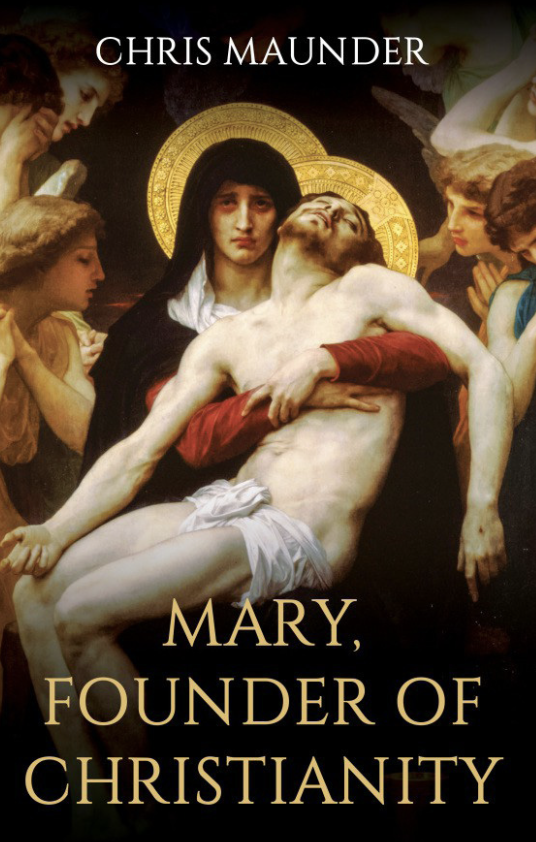
In the case of Mary, the mother of Jesus and his brothers and sisters, another clue comes in the confusion that exists over the various Marys at the cross and tomb. In my book Mary, Founder of Christianity, I provide arguments to support the ancient claim that Mary the mother of James and Joses (as she is named at Mark 15.40 – mother of James and Joseph in Matthew 27.56, and mother of James at Luke 24.10) was none other than Mary the mother of Jesus. This was proposed by a certain Helvidius at Rome in the fourth century but refuted by Jerome, who was concerned about the perpetual virginity; he concluded that James and Joses were merely cousins of Jesus. The identification of the two is held in some traditions of the Orthodox, where it does not threaten the perpetual virginity, as the Orthodox follow Epiphanius in understanding James and Joses as the sons of Joseph by a previous wife; thus Mary is their step-mother.
In the book, I go further and identify Mary the wife (? – the Greek is not clear) of Clopas as Mary the mother of Jesus too, and tentatively also Mary the mother of John Mark at Acts 12.12. I cannot give all the detailed arguments in a short article, but the best answer as to why all these ways of describing Mary were used is that she was a mother figure to the Church at Jerusalem and its most important apostles. James the brother of Jesus was the first leader in the Church at Jerusalem and, according to later writers, he was succeeded by Simeon the son of Clopas. John Mark was important to the narrative in Acts and seems to have served as the Jerusalem Church's appointee to accompany Paul (which he ceased to do in Pamphylia, much to Paul's chagrin, Acts 15.38).
The fact that Mary could have served as a mother figure to apostles for which she was not the natural mother is supported by that most familiar of Marian passages in the gospels: the adoption by her of the beloved disciple and vice versa in John 19.26-7: "When Jesus saw his mother and the disciple whom he loved standing beside her, he said to his mother, 'Woman, here is your son'. Then he said to the disciple, 'Here is your mother'. And from that hour the disciple took her into his own home."
While there is some speculation in this reconstruction, it does serve as an explanation for some of the mysteries surrounding the name Mary in the gospels and Acts. Otherwise, we have to assume that being called Mary was an advantage that helped several different women to become prominent members of Jesus' community and the post-Easter Church! I think that there were only three: Mary the mother of Jesus, Mary Magdalene, and Mary, sister of Martha and Lazarus at Bethany.
The theory that Mary was a mother figure, first for her own very influential family and then for the Jerusalem community, establishes Mary's importance in the very earliest Church and situates her at the forefront of the ministry as well as after the crucifixion and resurrection (when her presence is summarised very briefly by Luke in Acts 1.14). The reasons why more is not said about this we have explained by two cultural tendencies in the gospels: one reducing the memory of the leadership of women in the movement, and the other downplaying the dominance of the family of Jesus in the Church which followed him at Jerusalem.
For me, these deliberations about Mary's role are not merely rational attempts to find gender balance in the gospel story. They take on a near-mystical appreciation of the central role of Mary, not just as a transitory mother figure who appears at pivotal moments in the story of Jesus, but as someone with enormous influence across the breath and length of his mission, contributing intellectually as well as emotionally and physically. And Mary would not have carried out her vocation separately from the other women in the community, such as Mary Magdalene. She and they worked and reflected together, providing their resources as the gospels tell us, and deserve to be called "founders of Christianity".
This article is based on a talk given to the York Circle on June 6th 2022.
Chris Maunder is a retired visiting fellow of York St John University and Treasurer of the Centre of Marian Studies (based at St Mary's University). He is the author of Mary, Founder of Christianity, Oneworld Press, 2022. His previous books include The Oxford Handbook of Mary (OUP, 2019) and Our Lady of the Nations: Apparitions of Mary in 20th Century Catholic Europe (OUP, 2016).