The aim of this lecture is to present the Document on Human Fraternity for World Peace and Living Together signed jointly by Pope Francis and the Grand Imam of Al-Azhar, Dr Ahmad al-Tayyeb, in Abu Dhabi on February 4th 2019. A word will be said about the antecedents of the document; its wide-ranging contents will be described; some difficulties it raises will be addressed. Finally, a brief reference will be made to the follow-up of the document. A version of this text was originally delivered at Hope University, Liverpool, on February 17th, 2022.
The Manchester Newman Lecture 2022
Fraternity
A proposal and a project for relations between Christians and Muslims
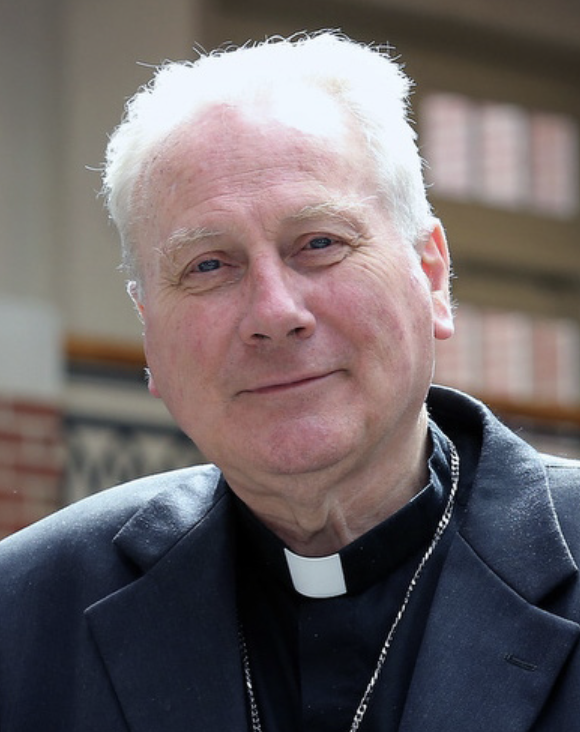
By Cardinal Michael Fitzgerald
Summary: The aim of this lecture is to present the Document on Human Fraternity for World Peace and Living Together signed jointly by Pope Francis and the Grand Imam of Al-Azhar, Dr Ahmad al-Tayyeb, in Abu Dhabi on February 4th 2019. A word will be said about the antecedents of the document; its wide-ranging contents will be described; some difficulties it raises will be addressed. Finally, a brief reference will be made to the follow-up of the document. A version of this text was originally delivered at Hope University, Liverpool, on February 17th, 2022.
Cardinal Michael Fitzgerald
Introduction
In Abu Dhabi, on February 4th 2019, Pope Francis and Dr Ahmad al-Tayyeb, the Grand Imam of al-Azhar solemnly signed a document entitled Human Fraternity for World Peace and Living Together. To show that this event did not come out of the blue, I would like to call attention to its antecedents. Then, after examining the contents of the document, I will say a word about its follow-up.
Relations between the Holy See and al-Azhar
At Pentecost in 1964, even before the final approval in October 1965 of Nostra Aetate, the Declaration of Vatican II on the relation of the Church to non-Christian religions, Pope Paul VI had established the Secretariat for Non-Christians [SNC] (later to become the Pontifical Council for Interreligious Dialogue [PCID]). The first years of this body were spent in laying the foundations for the work of dialogue, rather than in establishing relations with people of other religions, yet with al-Azhari contact was made right from the beginning.
In March 1965 Cardinal Franziskus Koenig, Archbishop of Vienna, a renowned scholar of religions and one of the leading figures at Vatican II, delivered a lecture at the University of al-Azhar on Monotheism in the Contemporary World which was very well received. In 1970 the SNC received a visit from representatives of the Supreme Council for Islamic Affairs of Egypt. In 1974 there was a return visit to Cairo by a delegation from the SNC including the new President, Cardinal Sergio Pignedoli, the Secretary (Msgr Pietro Rossano) and the head of the office for Islam (Fr François Abou Mokh). Four years later a further visit to Cairo was made and, with the assistance of a number of local Catholics, conversations were held at al-Azhar. The wish of the SNC to maintain contact with al-Azhar is confirmed by the visits carried out by its next two Presidents, Mgr Jean Jadot in 1981 and Cardinal Francis Arinze in 1988. It is recorded that the latter had a meeting with Sheikh al-Azhar.
A decision was taken to set up an International Liaison Committee between the Holy See (represented by the PCID) and international Islamic organizations of a religious character. Representatives of al-Azhar were present at the meeting in Rome, in June 1995, where this new body was created, but al-Azhar was not included in the membership of the committee. The reason for this exclusion was that al-Azhar was considered not to be an international organisation but a national (Egyptian) institution, though with an international outreach.
This did not please al-Azhar, and after several years of negotiations, led with obstinacy by Dr Ali Elsamaan, a special agreement was signed between the PCID and al-Azhar in 1998. It should be mentioned that during the intervening years a special office for dialogue with monotheistic religions had been set up in al-Azhar. Annual meetings followed, alternately in Cairo and in Rome. In 2000, as part of his Great Jubilee programme, Pope John Paul II visited Egypt, in the steps of Moses, and was warmly welcomed at al-Azhar. The subsequent Al-Azhar – PCID meetings were, at the request of the Muslim side, programmed each year on or about 24 February, to keep alive the memory of Pope John Paul II's visit.
It should be mentioned that relations with al-Azhar have not been confined to the Catholic Church. The Anglican Communion has also been engaged in dialogue with this institution. In an address delivered at al-Azhar on 24 November 1999 the then Archbishop of Canterbury, George Carey, proposed “An Agenda for Action: Islam and Christianity in Today's World”.
After the discourse of Pope Benedict XVI in Regensburg in September 2006, which caused consternation in the Islamic world, there was a brief interruption of the dialogue with al-Azhar. But the annual meetings resumed, taking place from 2008-2010. A further suspension occurred following another discourse of Benedict XVI in January 2011, this time to the diplomatic corps accredited to the Holy See. Commenting on bomb attacks on a church in Baghdad and another church in Alexandria, the Pope said: “This succession of attacks is yet another sign of the urgent need for the governments of the region to adopt, in spite of difficulties and dangers, effective measures for the protection of religious minorities”. The Egyptian government understood this statement as interference in its own internal affairs; it recalled its ambassador to the Holy See for consultations, and the Apostolic Nuncio was for a time considered persona non grata.
With the election of Pope Francis in 2013 there came about a change of attitude. This led to the visit to al-Azhar of a delegation from the Holy See in 2016, and in May of the same year there took place the first visit of a Sheikh al-Azhar (Dr Ahmad al-Tayyeb) to the Vatican to meet with Pope Francis. In April of the following year, 2017, Pope Francis accepted to attend an International Peace Conference organized by the Grand Imam of al-Azhar. Later the same year, Dr Ahmad al-Tayyeb was in Rome to participate in a conference organised by the Community of S. Egidio. He requested an audience with Pope Francis and was received with a delegation of five persons after the General Audience. This meeting remained rather formal, but Pope Francis invited the Imam and his delegation to lunch where the atmosphere became more relaxed. It was then that the idea of a joint document was brought up.
Preceding documents produced by Muslims
This would not be the first document produced by Muslims in recent times. Among others, mention could be made of the Message of Amman (2004), approved by King Abdallah II of Jordan, which proposed tolerance and unity within the Islamic world. In 2007, as a reaction to the Regensburg lecture of Pope Benedict XVI, already mentioned, a group of Muslim scholars wrote an open letter to Pope Benedict and other Christian religious leaders of different denominations. This letter, entitled A Common Word between Us and You, presents love of God and love of neighbour as the common ground of Christianity and Islam.
In 2016 the Forum for the Promotion of Peace in Muslim Societies produced the Marrakesh Declaration after discussion on the rights of minorities in majority Muslim countries. A year later appeared the Cairo Document, also on citizenship. In 2018, after a further meeting organized by the Forum for the Promotion of Peace in Muslim Societies, came the Washington Declaration. This is a statement produced by Jewish, Christian and Muslim scholars who commit themselves to work for the common good. This Washington Declaration was later renewed at a further meeting of the Forum in Abu Dhabi to become the Charter of the New Alliance of Virtue (2019), a charter which appeals not only to Muslims but to the followers of other world religions, as also to secular and humanist worldviews.
These documents have been listed in order to show that Muslim religious scholars appear to be becoming much more open, and also that many of the topics dealt with in the Document on Human Fraternity have already been discussed in Islamic circles. It is now time to examine this document more closely.
An analysis of the Document on Human Fraternity xvi
The Title
As stated above, the title of the document under discussion is Document on Human Fraternity for World Peace and Living Together.
The question has been put whether it was necessary to specify “human” fraternity in the title, since fraternity is really found only among humans. It can be seen that the document considers fraternity to be based not on religious belonging, but on "faith in God, who has created... all human beings” (Introduction). In other words, this fraternity does not spring from belonging to a particular religion, but from a common sharing in humanity. The final expression in the title, “living together” is not very common in writings on interreligious dialogue in English, but the Italian term adopted, convivenza, is frequently used.
Introduction
This consists of three paragraphs. The first states that faith in God, the Creator, leads to considering all human beings as brothers and sisters. This entails a common responsibility for “safeguarding creation....and supporting all persons, especially the poorest." The second paragraph refers to “several meetings characterised by a friendly and fraternal atmosphere” in which “the joys, sorrows and problems of our contemporary world" were shared. Reference is made to progress, both scientific and technical, particularly in therapeutics and in the field of communications, but attention is also called to poverty, inequality, conflict and extremism. Finally, the introduction offers the document as an invitation “to unite and work together” and as “a guide for future generations to advance a culture of mutual respect in the awareness of the great divine grace that makes all human beings brothers and sisters".
Invocations
The Document itself starts with a series of eleven invocations. The first reads: In the name of God who has created all human beings equal in rights, duties and dignity, and who has called them to live together as brothers and sisters, to fill the earth and make known values of goodness, love and peace (1).
The Islamic resonance here is evident, for in the Islamic tradition every document starts with the qur'anic invocation: bi-smi Llâhi l-Rahmâni l-Rahîm “In the Name of God, the Lord of Mercy, the Giver of Mercy”. Yet the context is widened by invocations of innocent human life and of different categories of people: the poor, orphans, widows, refugees, victims of wars, persecution and injustice; and then of ideals such as human fraternity "that embraces all human beings, unites them and renders them equal” (6). There is a further invocation of “this fraternity torn apart by policies of extremism and division, by systems of unrestrained profit" (7), and then the ideals of freedom, justice and mercy are invoked. The penultimate invocation reads: “in the name of all persons of good will present in every part of the world" (10).
I think it is useful to cite the final invocation in full: In the name of God and of everything stated thus far, Al-Azhar al-Sharif and the Muslims of the East and West, together with the Catholic Church and the Catholics of the East and West, declare the adoption of a culture of dialogue as the path; mutual cooperation as the code of conduct; reciprocal understanding as the method and standard" (11).
The declaration is resounding and well formulated. The mention of the two bodies making it raises nevertheless a problem which I shall discuss later.
Contents
One of the characteristics of this document, or Declaration (a term which is used in the document itself), is that it is wide-ranging. Here only a summary of its contents can be given. It enters into its real topic by evoking the causes of the crises in today's world, suggesting the following: a desensitized conscience, distance from religious values, individualism and materialism. Advances in science and technology are contrasted with deterioration in the moral sphere. The latter is seen to foster frustration leading to extremism whether religious or non-religious. This extremism is itself the source of conflict – reference is made here to a “third world war being fought piecemeal" (16), an expression used frequently by Pope Francis. It is added that conflict is sometimes fueled by "narrow-minded economic interests” (16) There is a mention of “situations of injustice" and "catastrophic crises” which meet with “an unacceptable silence on the international level" (17).
The document then underlines the importance of the family, as "the fundamental nucleus of society”. It states: “To attack the institution of the family, to regard it with contempt or to doubt its important role, is one of the most threatening evils of our era" – the words are strong. In the same invocation the importance of education is underlined, and particularly that of providing children with a “solid moral formation" (18).
Attention is then turned to the primacy of belief in God, the need to recognise God as the source of the gift of life. Deviation from religious teachings and the manipulation of religions are seen to lead to violence and war. Accordingly a strong appeal is made "to stop using religions to incite hatred, violence, extremism and blind fanaticism, and to refrain from using the name of God to justify acts of murder, exile, terrorism and oppression" (21).
The authors, noting that this document accords with previous international documents, express their "firm conviction” that “authentic teachings of religions invite us to remain rooted in the values of peace" (23). “Freedom of belief, thought, expression and action" (24) is upheld. Recognition is given to pluralism and diversity as “willed by God in His wisdom" (24). “Justice based on mercy" (25) is advocated. Dialogue, both cultural and religious, is encouraged. The protection of places of worship is considered a duty. Terrorism is roundly condemned, including support for terrorist movements. Full citizenship is called for. Calls are made to respect the rights of women, children, the elderly and the weak.
Some reflections
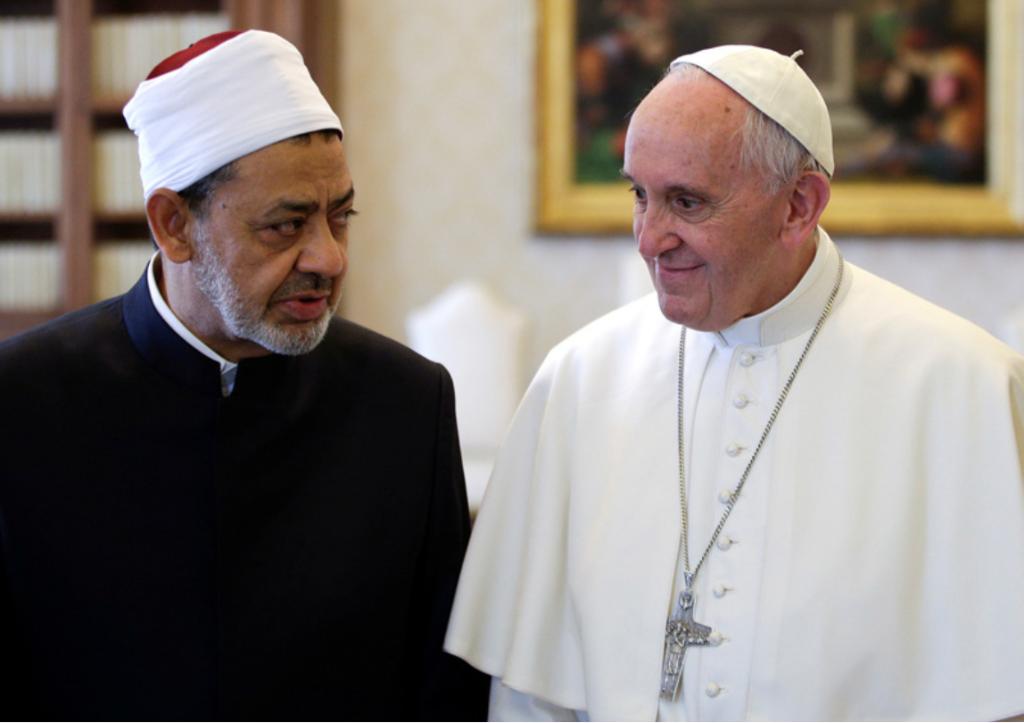 Pope Francis and the Grand Imam of Al-Azhar, Dr Ahmad al-Tayyeb, signing the Document on Human Fraternity, Abu Dhabi, 4 February 2019.
The final invocation, cited earlier, raises a question about representation. Can there really be a parallel between Al-Azhar al-Sharif and the Catholic Church? The leaders of these two bodies are the joint signatories of the document, but their roles are not exactly the same. Francis, as Pope, could be said to represent all Catholics of the East and West (we might be more inclined to say of the North and South) – but he would surely not claim to represent all Christians. Ahmad al-Tayyeb, as Grand Imam of Al-Azhar, certainly does not represent all Muslims of the East and West. The existence of divisions within Islam – the Sunni-Shi'a divide – would seem to be ignored or at least over-looked. It could be added that even among Sunni Muslims the authority of Al-Azhar does not go uncontested.
With regard to the title of the document a question was raised concerning the specification "human” fraternity. A further question arises about the concept of universal fraternity. Muslims who support this idea will refer to the Qur'an which states: "The believers are brothers" (Q 49:10). Of course, everything depends on how the term “believers” is understood, whether as referring to all who believe in God, or as restricted to “true believers”, in other words to Muslims only. The latter would seem to be the interpretation of Yusuf Ali, who in his translation of the Qur'an proposes: "The Believers are but a single brotherhood" and who adds in a note: "The enforcement of the Muslim Brotherhood is the greatest social ideal of Islam”. Before criticising this restriction, it is good for us, as Christians, to remember that the earlier practice was to restrict the term “brothers" to those belonging to the Christian community. This was certainly true up to the time of St Augustine who addressed the Donatists as his brothers because they were fellow Christians, even if they did not wish to be treated as brothers.
A common destiny
It is noteworthy that the idea of fraternity in this joint document is not based on religious belonging but rather on belief in God, the Creator of all human beings. The belonging is therefore not to one particular religion but to the human family. This is in fact the starting point of Nostra Aetate, the Declaration of the Second Vatican Council on the Relation of the Church to non-Christian Religions. It states: All men form but one community. This is so because all stem from the one stock which God created to people the entire earth (cf. Acts 17:26), and also because all share in a common destiny, namely God (NA 1).
The consequence of this common belonging to the one human family is spelt out in the final section of Nostra Aetate: We cannot truly pray to God the Father of all if we treat any people other than in brotherly fashion, for all men are created in God's image. Man's relation to God the Father and man's relation to his fellow men are so dependent on each other that Scripture says “he who does not love does not know God” (1 Jn 4:8) (NA 5).
The mention of God as Father can cause difficulties for Muslims, since calling God "Father" is considered to be disrespectful of divine transcendence; consequently Father is not found among the Ninety-nine Names of God. Yet, as the joint document shows, the idea of common belonging can be developed without mention of the fatherhood of God.
A further question has been raised by the following passage of the document: "The pluralism and the diversity of religions, colour, sex, race and language are willed by God in His wisdom, through which He created human beings" (24). If the term "plurality” had been used rather than “pluralism” there would have been no controversy. That there exists de facto a plurality of religions is evident; what is questioned is whether this plurality is to be considered de jure, in other words as directly willed by God.
From the Islamic point of view there would hardly be any objection. The Qur'an teaches that God has observed diversity in creating: Another of His signs is the creation of the heavens and earth, and the diversity of your languages and colours. There truly are signs in this for those who know (Q30:22).
There is a purpose in this diversity: People, We created you all from a single man and a single woman, and made you into races and tribes so that you should get to know one another (Q 49:13).
This is further emphasised by another oft-quoted passage from the Qur'an: If God had so willed, He would have made you one community, but he wanted to test you through that which He has given you, so race to do good: you will all return to God and He will make clear to you the matters you differed about (Q5:48).
What justification can be given from the Catholic side for accepting the plurality of religions? One could at least have recourse to the classic distinction between the direct will of God and God's permissive will. God has permitted different religions to develop. But something more positive can be said. Lumen Gentium, the Second Vatican Council's Dogmatic Constitution on the Church, states clearly that “the plan of salvation also includes those who acknowledge the Creator, in the first place amongst whom are the Muslims" (LG 16).
This plan of salvation is surely something willed by God, and it is stated that it includes the followers of Islam. Moreover, as Nostra Aetate says, “The Catholic Church rejects nothing of what is true and holy in these religions" (NA 2). These religious elements come from God for, as Pope Saint John Paul II pointed out: "the Spirit brings [them] about in human hearts and in the history of peoples, cultures and religions" (Redemptoris Missio 19).
A process of dialogue
To sum up, I would consider this document to be courageous, practical and realistic, though wide-ranging. It is courageous of the two religious leaders to sign this common document and thus express their readiness to engage the members of their respective religions in a process of dialogue. They will surely not be surprised if the document has met with opposition from certain quarters.
It is practical. From the above presentation of its contents, it will have been understood, I hope, that this document is geared more to cooperation in practical matters than to a deepening of theological understanding. It is nevertheless based on a theological understanding of creation and sees the creative act of God as the foundation for the fraternity that it desires to promote.
It is a realistic document, taking into account change and progress in the world today, but also recognising the presence of constant conflict and the injustice of inequality that exists in our world. It is very wide-ranging, touching on so many different points. It upholds freedom, including the freedom of “belief, thought, expression and action" (24) (the term mumârisa used in the Arabic text would seem to suggest that what is intended here is communal participation in living out one's faith, whether in worship or in mission/da'wa and social action). It emphasises recognition of rights: the rights of women, but also of children, of the elderly and the weak. It is clear in its condemnation of terrorism and of extremism in all its forms and of the use of religion to incite to violence and war. It calls for a culture of tolerance which, one could say, almost by definition goes beyond mere tolerance, certainly beyond a laissez-faire attitude, since the document stigmatises individualism. It thus demands moral regeneration.
An on-going process
The authors recognise that their document is not a definitive statement, but rather an invitation to engage in a work-in-progress. This is why I have called it “a proposal and a project”. The authors pledge “to make known the principles contained in this Declaration" so that they can be “translated into policies, decisions, legislative texts" (35). They express the hope that the document may become an “object of research and reflection" (36) in schools, universities and institutes of formation. Their aspiration is that it "may constitute an an invitation to reconciliation and fraternity among all believers, indeed among believers and non-believers, and among all people of good will" (38).
An "application committee" has been set up: the Higher Committee of Human Fraternity (HCHF). This is encouraging since it underlines that the document is truly considered to be but a step in a process. So far there are only two women out of eleven members of the committee: Leymah Gbowee, Liberian peace activist and advocate for women's rights, who was awarded the Nobel Peace Prize in 2011; and Irina Bukova, the former Director of UNESCO. A representative of the Jewish faith has been included in this committee, Rabbi M. Bruce Lustig (Senior Rabbi, Washington Hebrew Congregation); this is a sign that dialogue and cooperation is to be pursued not only by Christians and Muslims, but by and with others too, whether believers or not. A further sign of outreach within Christian circles is the inclusion, ex officio, of the Secretary General of the World Council of Churches.
The committee has already been active in promoting a day of prayer and fasting for the end of the pandemic. It was instrumental in having 4 February recognized by the UN Assembly General as the Day of Human Fraternity. It has instituted the Human Fraternity Award; and it has promoted the building of the Abrahamic House in Abu Dhabi which will include a synagogue, a mosque and a church.
I would hope that the Higher Committee might help to clarify some of the points in the document which remain rather vague, such as the reference to the “authentic teachings of religions" or the idea of “full citizenship”. Yet the committee has shown that its aim is to fulfil the programme formulated, as already mentioned, as a kind of slogan: the adoption of a culture of dialogue as the path; mutual cooperation as the code of conduct; reciprocal understanding as the method and standard.
Michael Cardinal Fitzgerald, M.Afr.
Notes
* The text of a Distinguished Lecture delivered at Hope University, Liverpool, 17 February 2022., published in Islamochristiana 47(2021) pp.133-142.
i The English version of this document can be found at w2.vatican.va/content/Francesco/en/event.dir.html/content/vaticanevents/en/2019/2/4/fratellanza-umana.html.
ii The mosque of al-Azhar was founded by the Fatimids in their new capital city of Cairo (al-qâhira) in CE 969/970. It soon developed into a centre of learning. Although originally shi'ite, it became a stronghold of Sunni Islam. Al-Azhar University is a renowned centre of Islamic studies, attracting students from all over the Muslim world. It has, however, extended its faculties to include other disciplines, such as agriculture, education, languages, medicine and science. It has moreover a network of schools and colleges throughout Egypt so, as an institute, it is much broader than just a university. It contains also an important centre for Islamic research. For further information, see the article Azhar in Shorter Encyclopaedia of Islam, Leiden, Brill 1961; as also John L. ESPOSITO (ed.), The Oxford Dictionary of Islam, Oxford, OUP 2003, art. Azhar, al-.
iii Cf. FITZGERALD M.L. "The Secretariat for non-Christians is Ten Years Old" in Islamochristiana 1(1975), pp.87-95; as also, for what follows, Id. “Twenty-five Years of Dialogue. The Pontifical Council for Inter-religious Dialogue” in Islamochristiana 15 (1989), pp.109-120. The annual volume of Islamochristiana, in its Notes and Documents section, reports on the various visits and meetings that have taken place.
iv The text of the conference, delivered in English, can be found in Mélanges de l'Institut Dominicain d'Etudes Orientales (MIDEO) (1964).
v On the 1978 and 1988 visits see Islamochristiana 4(1978), pp.214-217; 15(1989), p.190.
vi Cf. the report in Islamochristiana 24(1998) pp.218-220 with the text of the Agreement.
vii Cf. Islamochristiana 26(2000) pp.179-186 including a translation of an article in the leading Egyptian newspaper al-Ahram by Ali ELSAMAAN (“The Pope in Egypt – Meeting of the Symbols").
viii The text of this discourse can be found in Islamochristiana 26(2000) pp.177-179.
ix For the full text see: vatican.va/content/benedict-xvi/en/speeches/2011/January/documents/hf_ben_xvi_spe_20110110_dipomatic-corps.html
x Cf. Islamochristiana 42(2016) p.310; for further details see Mohammad ABDULSALAM, The Pope and the Grand Imam. A Thorny Path. A Testimony to the Birth of the Human Fraternity Document, Dubai/London Motivate Media Group 2021 pp.67-84. The author relates that the Grand Imam told him of his decision to visit the Vatican “on a November night in 2017” (p.67); this should be corrected to 2015, since the visit took place in 2016.
xi On this International Peace Conference see M.ABDUSALAM, A Thorny Path pp.91-104; the speech of Pope Francis on this occasion is given in Islamochristiana 43(2017) pp.303-306.
xii See M.ABDULSALAM, A Thorny Path pp.108-121. A short report in Islamochristiana 43(2017) p.307 corrects one detail: the audience took place not in the Apostolic Palace but in a small room adjacent to the Paul VI Audience Hall.
xiii Cf. Laurent BASANESE, “Il documento sulla Fratellanza Umana per la Pace mondiale e la Convivenza comune del febbraio 2019” in Islamoochristiana 45 (2019) pp.29- 38, and especially 29-31.
xiv The text of this letter is reproduced in the special dossier published in Islamochristiana 33(2007), in English (pp.241-261), and in Arabic (pp. 262-280).
xv For an appraisal of the Common Word initiative see Yazid SAID and Lejla DEMIRI (eds), The Future of Interfaith Dialogue. Muslim-Christian Encounters through A Common Word, Cambridge University Press 2018.
xvi For a more detailed discussion of different versions of the text see my article “Reflection on Human Fraternity” in Islamochristiana 45(2019) pp.17–27.
xvii The original texts of the document are not numbered; the numbers in brackets are taken from the texts published in Islamochristiana 45(2019).
xviii Translation of M.A.S. ABDEL HALEEM, The Qur'an. English Translation and Parallel Arabic Text, Oxford University Press 2010, p.2. This translation will be used for further quotations from the Qur'an, unless otherwise stated.
xix Abdullah YUSUF ALI, The Holy Qur'an. Text, Translation and Commentary, Beirut, Dar al Arabia 1968, note 4928, p.1405.
xx For more details on the HCHF see M.ABDULSALAM, A Thorny Path, pp209-212.
xxi The full list of members of the Higher Committee is as follows: Cardinal Miguel AYUSO GUIXOT (President of the Pontifical Council for Interreligious Dialogue) Co-President; Professor Mohamed Hussein MAHRASAWI (President of al-Azhar University) Co-President; Judge Mohammad ABDULSALAM (Advisor to the Muslim Council of Elders) Secretary General; Irina BUKOVA (Former Director General of UNESCO); Yoannis Lahzi GAID (Former Private Secretary to Pope Francis); Leymah GBOWEE (Nobel Peace Laureate); Yasser HAREB (Writer and TV Presenter); Rabbi M. Bruce LUSTIG (Senior Rabbi Washington Hebrew Congregation); Mohamed Khalifa al-MUBARAK (Chairman, Department of Culture, Abu Dhabi); Sultan Faisal AL-REMEITHI (Secretary General, Muslim Council of Elders); Joan SAUCA, Acting General Secretary, World Council of Churches.